Friday, November 5, 2021

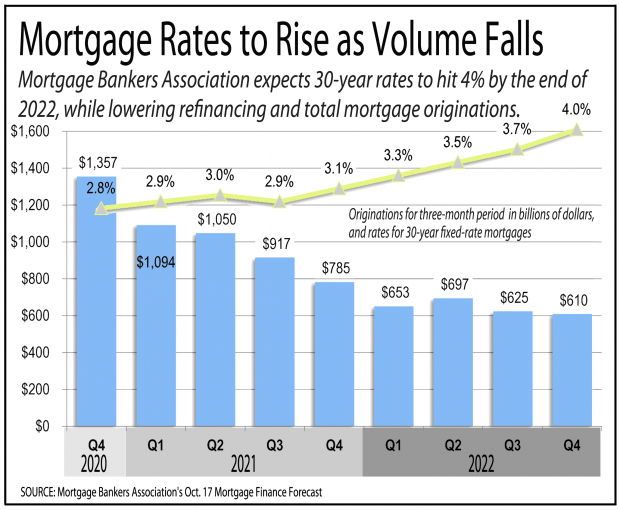
Mortgage rates are now expected to jump to 4% by the end of 2022 as originations fall.

Fed chiefs met. They spoke. Economists opined.

Mortgage Bankers Association Chief Economist Mike Fratantoni summed up what lenders need to know:

“As the Fed’s actions were anticipated, this announcement will not impact our latest forecast for mortgage rates and mortgage originations. We expect that rates on 30-year mortgages will increase from 3.2% today to about 4% by the end of 2022,” Fratantoni said.

The MBA’s Oct. 17 Mortgage Finance Forecast also predicted originations, which reached a high of $1.36 trillion in last year’s fourth quarter, will fall to $610 billion by the fourth quarter of 2022 as the refinance boom ends.

The Federal Reserve on Wednesday said it would reduce its $120-billion-per-month purchases of bonds and mortgage-backed securities of this money, buying $10 billion a month less in Treasury securities and $5 billion less a month in agency mortgage-backed securities. The purchases, called monetary easing, were begun after COVID-19 was declared a pandemic to help keep money flowing into the financial system.

Fed Chair Jerome Powell said the economic outlook has been brightening, despite the slow pace of economic growth in the third quarter.

“Aggregate demand has been very strong this year, buoyed by fiscal and monetary policy support and the healthy financial positions of households and businesses. With COVID case counts receding further and progress on vaccinations, economic growth should pick up this quarter, resulting in strong growth for the year as a whole,” Powell said.

NAFCU Chief Economist Curt Long said the tapering of asset purchases was expected, and the reduction rate puts the Fed on track to end the purchases by June 2022.

Long said the Fed is likely to begin raising rates next June if inflation pressures persist into 2022. However, he said he believes the Fed will start raising rates later.

“The FOMC committed to reach full employment prior to liftoff, and employment remains several million workers shy of pre-COVID levels,” Long said.

“Second, although the recent spike in inflation has brought forward market expectations for the next rate increase, it is likely that supply chain disruptions will improve – if only marginally – over the first half of 2022, which could relieve price pressures,” he said.

MBA economists said they expect higher inflation to persist, in part because of the effect of higher home-prices and rents caused by the lack of for-sale inventory and decreasing vacancy rates for apartments.

The Fed has continued to signal it is waiting for the economy to reach full employment before raising short-term rates, and Fratantoni said his team expects the economy to reach that mark by mid-2022.

“Although job growth has been slower the past two months, there may well be a pickup through the remainder of the year,” Fratantoni said. “Employers continue to struggle to fill millions of open positions.”


Jim DuPlessis CrediyUnionTimes

Thursday, November 4, 2021

Federal Reserve said it will begin tapering its purchases of securities and bonds, leaves rates unchanged

WASHINGTON—Despite growing inflation pressure, the Federal Open Market Committee ended its two-day meeting today leaving rates unchanged.

But due to progress in the economy, the Federal Reserve said it will begin tapering its purchases of securities and bonds.

In a statement, the Fed noted “progress on vaccinations and strong policy support, indicators of economic activity and employment have continued to strengthen. The sectors most adversely affected by the pandemic have improved in recent months, but the summer's rise in COVID-19 cases has slowed their recovery. Inflation is elevated, largely reflecting factors that are expected to be transitory. Supply and demand imbalances related to the pandemic and the reopening of the economy have contributed to sizable price increases in some sectors. Overall financial conditions remain accommodative, in part reflecting policy measures to support the economy and the flow of credit to U.S. households and businesses.”

The Fed reiterated the path of the economy continues to depend on the course of the virus.

“Progress on vaccinations and an easing of supply constraints are expected to support continued gains in economic activity and employment as well as a reduction in inflation. Risks to the economic outlook remain,” the Fed said.

“The Committee seeks to achieve maximum employment and inflation at the rate of 2% over the longer run. With inflation having run persistently below this longer-run goal, the Committee will aim to achieve inflation moderately above 2% for some time so that inflation averages 2% over time and longer‑term inflation expectations remain well anchored at 2%. The Committee expects to maintain an accommodative stance of monetary policy until these outcomes are achieved,” the Fed continued.

The FOMC kept the target range for the federal funds rate at 0% to .25% and expects it will be appropriate to maintain this target range until labor market conditions have reached levels consistent with the Committee's assessments of maximum employment and inflation has risen to 2% and is on track to moderately exceed 2% for some time.

“In light of the substantial further progress the economy has made toward the Committee's goals since last December, the Committee decided to begin reducing the monthly pace of its net asset purchases by $10 billion for Treasury securities and $5 billion for agency mortgage-backed securities,” the Fed stated.

NAFCU Addresses Tapering

NAFCU Chief Economist and Vice President of Research Curt Long noted the Fed's tapering was expected.

"The $15-billion per month pace of tapering was also in line with expectations, and puts the Federal Reserve on track to wind down the process by June 2022," said Long. "Chairman Powell has said that the committee intends to complete tapering before raising rates, and markets have increasingly begun to look at June as a possibility for the next rate hike. However, the statement makes clear that the committee could alter the pace of tapering if economic conditions change. The prospect of a rate hike in mid-2022 is likely to be complicated by several factors. First, the FOMC committed to reach full employment prior to liftoff, and employment remains several million workers shy of pre-COVID levels. Second, although the recent spike in inflation has brought forward market expectations for the next rate increase, it is likely that supply chain disruptions will improve--if only marginally--over the first half of 2022, which could relieve price pressures. The committee is clearly divided on its view of the nature of these pressures. September's statement called them ‘transitory,’ while the current statement said they are ‘expected to be transitory.’ If inflationary pressures persist beyond the next month or two, a June date for a rate increase is likely."

Rate of Inflation Expected to ‘Decelerate’ In Rest of Year & 2022, Says CUNA Economist

Mike Schenk
MADISON, Wis.–With credit union leaders worried over the ongoing pace of inflation, a CUNA economist is projecting the pace of price increases will continue to “decelerate.”

In his most recent CUNA Economic Update, Deputy Chief Advocacy Officer for Policy Analysis and Chief Economist Mike Schenk noted the year-over-year (YOY) inflation of 5.4% reached its second-highest level in the last 40 years, dating back to the “Great Inflation.”

Two similarities between the Great Inflation and today are high increases in wages and high increases in energy prices, largely due to market disruptions,” said Schenk.

Schenk said CUNA is projecting monthly price increases will continue to decelerate, closing out the year with a 5% annual inflation rate and a rate of 2.5% in 2022.

Consumer inflation expectations are unlikely to rise significantly, giving the Federal Reserve more leeway to combat economic disruptions from the COVID-19 pandemic, Schenk added.

“Unlike the Great Inflation era, pandemic recovery will not require a strong policy response to squash inflation expectations,” Schenk said. “The Federal Reserve will allow inflation to run hot, ensuring those who were on the front lines of the pandemic can recover on the backend.”

Historical Context

Offering some historical context, Schenk reminded the Great Inflation (1966-1981) revealed “how difficult it can be for policymakers to counter inflationary pressures, especially when those pressures are become widely expected.”

During that era, high levels of inflation persisted over time, he said, and consumers responded by speeding up big-ticket purchases, such as home mortgages, which added to rising inflationary pressures.

“If we think about what’s happening in the economy today, there are a lot of similarities,” said Schenk. “While employee unions are not as prevalent today, record levels of job openings relative to the number of job seekers gives average workers more power than they would normally have. Both eras also reflect spikes in energy prices.”

Basis for Outlook

How do CUNA’s economists arrive at their economic outlook?

“We rely on two readings—the implied expectation among investors with skin in the game and the expectation among professional forecasters, which tends to be more accurate over time,” said Schenk. “Inflation pressures are important, and we expect them to stay elevated at the moment, but we can take some comfort in knowing that these numbers will soften as recovery moves forward. It’s also important to note that there is a large and misleading base-effect in the current annual data. A year ago the second wave of the COVID crisis was raging and people were hunkered down—they weren’t spending much. While-year-over-year price increases are high, monthly increases have been trending down recently.”


Credit Union Consolidation Continues


There were 70 CU mergers in the first six months of 2021, down one from last year at this point but continuing a decades-long trend.

The drumbeat of credit union industry consolidation continues. 

Don't let this happen to you! Remember your not alone with NCOFCU!

So far in 2021, there were 39 mergers in the second quarter and 31 in the first quarter. That total of 70 in the first six months of the year is down one from the same point in 2020. In trailing one-year numbers – from June 2020 to June 2021 – there were 135 mergers.

Back in 1985, there were nearly 18,000 banks and thrifts in America and about 15,000 credit unions. As of June 30, 2021, there were 5,005 and 5,136, respectively.

It’s also noteworthy that even with eliminating outlying mergers over $1 billion, 2021 has seen the largest average merger size of any year prior by a wide margin.

Let’s dig a bit deeper into the current numbers, courtesy of the Peer-to-Peer database we maintain at Callahan & Associates.
A Look at the Numbers in Aggregate

By total assets, the second quarter of this year saw far more merged away than in the first quarter of the year: $2.4 billion compared with $1.3 billion, or 78.5% more. For the first half of the year, total assets merged away was up 13.7% from the first half of 2021, $3.7 billion compared with $3.3 billion. In trailing one-year numbers, $7.2 billion in member assets were merged into other cooperatives from June 2020 to June 2021.

By average asset size, the average was $61.3 million for credit unions merged away in the second quarter of 2021, up 41.9% from the $43.2 million in average size from the first quarter of 2021. The average assets for merged credit unions in the first half of the year was $53.3 million, down 22.4% from $68.7 million on average in the first half of 2020 – though the 2020 average value was skewed upward by one large, $2.2 billion merger.
The Largest and Most ­Mergers by State and Credit Union

By state, Ohio had the most mergers in the trailing 12 months from June 2020 through June 2021 at 14, followed by New York at 11, Illinois at 10, Pennsylvania at six, and five each for California and Virginia. Only 11 states did not have a credit union acquired by another during that time.

Here are the five largest mergers in the second quarter of this year:

  • Xceed Financial Credit Union ($981.8 million, Calif.) merged with Kinecta Federal Credit Union ($5.4 billion, Manhattan Beach, Calif.)
  • Infinity Federal Credit Union ($336.3 million, Westbrook, Maine) merged with Deere Employees Credit Union ($1.4 billion, Moline, Ill.)
  • Premier Federal Credit Union ($251.6 million, Greensboro, N.C.) merged with Charlotte Metro Credit Union ($798.9 million, Charlotte, N.C.)
  • Aspire Federal Credit Union ($141.6 million, Clark, N.J.) merged with Pentagon Federal Credit Union ($27.3 billion, McLean, Va.)
  • Leyden Credit Union ($100.6 million, Franklin Park, Ill.) merged with Partnership Financial Credit Union ($248.4 million, Morton Grove, Ill.)

Here are the five largest from the first quarter:
  • Columbus Metro Federal Credit Union ($259 million, Columbus, Ohio) merged with Telhio Credit Union ($951.8 million, Columbus, Ohio)
  • NorthStar Credit Union ($211.8 million, Warrenville, Ill.) merged with NuMark Credit Union ($332.6 million, Joliet, Ill.)
  • Lower Valley Credit Union ($128.4 million, Sunnyside, Wash.) merged with Self-Help Credit Union ($1.5 billion, Durham, N.C.)
  • Riverset Credit Union ($117.6 million, Pittsburgh, Pa.) merged with Allegent Community Federal Credit Union ($151.7 million, Pittsburgh, Pa.)
  • Anderson Federal Credit Union ($107.5 million, Anderson, S.C.) merged with Spero Financial Credit Union ($543.0 million, Greenville, S.C.)


No credit unions acquired more than one other credit union over the first half of 2021, but if you extend that back one year (June 2020 to June 2021), PenFed acquired three credit unions totaling $441.7 million in assets, and 11 others merged two smaller credit unions into their cooperatives.
A Five-Year Lookback

Over the past five years – from June 2016 to June 2021 – there have been 852 credit union mergers, an average of 170 mergers per year. All told, $32.2 billion in assets were consolidated into another credit union over this period.

The average size of each acquisition was $37.8 million in assets. Five credit unions with more than $1 billion in assets merged into a larger credit union (a “super merger”) over the past five years, the largest of which was Schools Financial Credit Union ($2.2 billion, Sacramento), which merged into SchoolsFirst Federal Credit Union ($16.8 billion, Santa Ana, Calif.) in the first quarter of 2020.

Meanwhile, five mergers over the past five years were “reverse mergers,” where the surviving credit union had less assets than the credit union it acquired.

Over the past five years, Pennsylvania had the most mergers with 70, followed by Ohio (58), California and New York (54), and Illinois (50). Every state had at least one merger during that time.

PenFed also recorded the most mergers over the past five years, acquiring 16 smaller cooperatives with a total of $2.2 billion assets. American Heritage Credit Union ($3.6 billion, Philadelphia) and Nuvision Federal Credit Union ($2.8 billion, Huntington Beach, Calif.) had seven each totaling $56 million and $785.3 million in assets respectively. Superior Credit Union ($1.4 billion, Lima, Ohio) and Peach State Credit Union ($737.1 million, Lawrenceville, Ga.) recorded six each with total assets of $206 million and $113.2 million, respectively.
Bank Acquisitions

Outside of acquiring other credit unions, some credit unions have moved into the banking space, acquiring either an entire bank or a handful of bank branch locations. A credit union-bank transaction happened 14 times between June 2020 and June 2021. Four of these were branch acquisitions and the other 10 were full bank acquisitions.

 Will Hunt Industry Analyst Callahan & Associates Washington, D.C.

Wednesday, November 3, 2021

“Help Wanted”: Why ATM Management Might Be Stealing Valuable Time From Staff


Many of our credit unions (along with other businesses across America) are seriously short staffed at the moment. There are various reasons for this. Many people are leaving current jobs for other opportunities. Others have elected to stay home and are receiving unemployment and stimulus checks equal to or close to that of their former income. And then you have some people forced to stay home temporarily due to a COVID infection or close contact with someone who has been infected.

Whatever the reason, credit unions are facing a lot of issues as a result. Being short staffed seems to make everything worse. As always, the focus should be on the member, right? Well, what happens when you have facility problems or technology issues? These situations can pull your staff down a rabbit hole and divert hours of important member-facing time to background noise that can take hours or even days to resolve.

Consider your ATMs, for instance. When a credit union has an ATM problem, they go straight to the rabbit hole. Is it a communications issue? The processor? Maybe it’s the ATM network? Your staff has to manage four or five vendors for just one ATM. There’s finger pointing by the vendors and sometimes even a reluctance to respond to an issue. It’s no wonder it takes so long to get the situation fixed.

One client of ours recently explained that their ATM issues were requiring their AVP to focus efforts on the fleet nonstop. More than 40 hours a week were spent trying to keep 13 ATMs active and functioning. And the AVP’s time didn’t include the daily balancing and settlement issues that the accounting department was managing.

No matter how many ATMs you have in operation, your staff is far too valuable to be spending time corralling vendors into fixing a broken machine. At Dolphin, our outsourcing program takes the ATM burden off your staff. Our experienced team operates thousands of ATMs across the country. By working with Dolphin you eliminate finger pointing, all the vendor management and due diligence, even the accounting nuisance. Don’t waste any more time. Talk to your league representative today about scheduling a meeting. Your members will thank you with their continued business.

Joe Woods is SVP of Marketing & Partnerships and a 20-year payments veteran.

Joe Woods, CUDE
SVP, Director of Sales & Marketing
Dolphin Debit Access, LLC
PH# 614-378-0367
jwoods@dolphindebit.com


Monday, November 1, 2021

3 Reasons Credit Unions Must Offer Virtual Cards

It is easy to think that if something is not broken, there is no need to fix it. Many times, however, it takes a while for credit unions – or any financial institution – to recognize the need for change and make it happen. It is time to move away from that mindset and instead get ahead of what members want.

Right now, credit unions may think that their current debit or credit card offerings are good enough. Why go virtual if physical cards are “working”? If members are not crying out for change, why go through the trouble of implementing new technology? What difference would it make?

There are several reasons credit unions must consider virtual cards, namely: Competition, consumers and cost.

Competition

Credit unions are facing competition at nearly every turn. Both banks and non-banks are revolutionizing the way consumers pay today. Apple successfully launched a popular virtual card. Capital One has Eno, an online payment assistant, and there are seemingly endless possibilities for P2P payments in the form of PayPal, Venmo, Cash App and others.

Credit unions must begin to do the same if they want to keep up, much less stand out in today’s competitive market. These outside payment providers are drawing deposits away from the credit union. According to NerdWallet, 68% of survey respondents said they have maintained a balance in their mobile payment app accounts. On average, those users have kept up to $287 in their account before transferring it to their bank account. Every time a member turns away from their credit union and toward their payment competition, the credit union is losing market share, whether it be for P2P payments or cards.

Consumers

Because of all the innovation in payments, consumers expect more. Members will not settle for an unsatisfactory payment experience from their credit union. Instead, they can and will go elsewhere to find what they are looking for from a payment provider, such as virtual cards or P2P payments.

The pandemic has also driven consumer demand to a place no one really expected. So much innovation has taken place over a relatively short amount of time, and everything is so far ahead of where most people expected it to be.

Digital payments have especially taken off due to the need for contactless transactions. Juniper Research found that digital wallet spend is projected to increase 83% by 2025 due to adoption of digital payments during the pandemic. People experience digital payments nearly everywhere now – at restaurants, in ride shares, in retail and the list goes on. Credit unions must provide these same capabilities to meet member demands.

Cost

It is another common misconception among financial institution leaders that technology has large, immediate upfront costs, but takes a longer time to bring a return on investment. However, virtual cards can help bring in more revenue for the credit union right away.

It is easy for credit unions to get their interchange check and not think about ways that income could grow. In a way, it feels like free money, so why change it? For one, virtual cards bring in a higher interchange rate for the issuer, growing that income without any extra work on the part of the credit union. Virtual cards are also easier to use for online transactions. More use leads to even more revenue.

In addition, the ability to instantly issue virtual cards adds immediate interchange opportunities compared to a plastic card that a consumer must wait seven days or more to receive via mail.

Your credit union’s card program may not appear to be “broken” but it is time to fix it. Virtual cards help credit unions stand up to the competition, exceed consumer expectations and bring in more revenue than their card programs do today. Kelly Payne

Kelly Payne is Chief Marketing Officer for MOCA, a digital payment platform provider based in Austin, Texas.

How Long Will Inflation Linger? CUNA Mutual Economist Steve Rick Offers Some Thoughts

MADISON, Wis.– Look for inflation to continue to linger around, according to one CU economist. 

In the October Trends Report from CUNA Mutual, which is based on data through August, the company’s chief economist, Steve Rick, quotes the 1962 observation from Nobel prize-winning economist Milton Freidman in which he said, “Inflation is always and everywhere a monetary phenomenon, in the sense that it is and can be produced only by a more rapid increase in the quantity of money than in output.”

The Federal Reserve, said Rick, “is currently putting his hypothesis to the test.”

Rick noted the nation’s money supply has experienced the fastest growth rate in modern history.

“The money supply (called M2) consists of currency, checking deposits, savings deposits, money market deposit accounts and certificates of deposit,” wrote Rick. “M2 closely resembles the deposit products offered by many credit unions to their members. We can therefore see the close correlation between credit unions’ deposit growth rate and the M2 growth rate in the figure below.

During the last 18 months, the nation’s money supply and credit union deposits grew over 20%, but output increased less than 3%. In other words, credit union members and Americans, in general, are flush with cash but don’t have additional goods and services to spend it on.”

Members Have High Balances

Rick noted the data show the average credit union member was sitting on $13,490 in deposits this past June, up from $10,860 in June 2019, before the COVID-19 pandemic and the three resulting stimulus checks.

“This $2,630 in additional liquidity has provided members with significant additional spending power,” stated Rick. “Economists also define inflation as, ‘Too many dollars chasing too few goods.’ So, we could be looking at inflation staying around longer than some, as the Federal Reserve believes will be the case.

Sunday, October 31, 2021

Fiserv Partnership Will Allow Consumers to Buy, Sell, Send & Spend Digital Assets

BROOKFIELD, Wis.–Fiserv said it has entered into a strategic relationship with Bakkt, a digital asset platform that enables consumers to buy, sell, send and spend a range of digital assets.

“The combination of expansive capabilities from Fiserv, including the ability to move funds into and out of mobile wallets, with Bakkt’s digital asset platform will enable practical uses of crypto and emerging asset classes,” the company said.

According to the company, a future integration of Bakkt into the Carat omnichannel ecosystem from Fiserv will allow businesses to pursue new options for B2B and B2C payouts, loyalty programs, and transactions, all with crypto assets accessible via a digital asset wallet.

“Merchants will be able to deliver innovative consumer experiences through a simple integration to Carat and roll out new digital asset offerings that are right for their brand and customers,” Fiserv said.

“Carat is a trusted solution for businesses, including fintechs, that want to access a broad range of commerce-enabling capabilities, such as the ability to accept and disburse funds, from a single provider,” said Nandan Sheth, head of Carat and Digital Commerce at Fiserv. “Bakkt will be leveraging these capabilities while also working with us to build emerging merchant experiences that help bring crypto assets into the mainstream.”

‘An Important Moment’

Added Sheela Zemlin, chief revenue officer at Bakkt, “This partnership with Fiserv marks an important moment as we together create opportunities for consumers to seamlessly and at their own pace introduce digital assets into their daily habits. Whether it be buying bitcoin from within a financial institution’s app, redeeming loyalty points from their favorite restaurant for merchandise, using a digital asset wallet, or getting paid in bitcoin for their side gig grocery delivery runs, consumers will have new opportunities to participate in the digital economy.”

In addition to the new digital capabilities for merchants, Fiserv and Bakkt said they plan to introduce Bakkt technology that supports consumers’ ability to buy, sell, and hold crypto assets to Fiserv financial institution clients.


Thursday, October 28, 2021

CEO Compensation-Approach and Impact by DeeDee Myers

Numerous CEO shifts this year directly impact potentially outdated compensation philosophies related to creating a rewards package to retain and reward a newly hired or promoted CEO. Unfortunately, CEOs are often unsure of their performance metrics, short-term incentives, long-term incentives, and retirement package a year or more after they assume a CEO role. The impact is a lack of clarity on success factors between the Board and CEO, which inevitably transfers and translates to a less-than-adequate clarity of priorities and actions within the executive and management ranks.

Deedee Myers, Ph.D., MSC, PCC 
Direct office: 
602-840-1053 

Cell: 602-821-9300

https://ddjmyers.com/


Save The Date 10/5-8/2022 


Members to be Paid 2 Days Early

JACKSONVILLE, Fla.— VyStar Credit Union is the latest to offer a service that allows members to be paid up to two days sooner when they link their VyStar checking or savings account with a direct deposit payment.

“In an effort to provide members with additional benefits, VyStar is advancing access to direct deposit payments when they are posted to a member’s account, up to two days earlier than most traditional banks,” the credit union said.

In most cases, payers post their payment files in advance of the payment date, VyStar stated, adding that when this happens it will go ahead and advance the payment amount to the member’s account right away — resulting in members getting access to their payment up to two days before the actual payment date.

“We’re always looking for ways to help our members maximize their financial power, and this unique benefit is a prime example of that,” said VyStar EVP/Chief operations Officer Chad Meadows. “By providing our members with even earlier access to their money, we are creating flexibility, alleviating stress and hopefully improving their day-to-day financial lives.”

Other Benefits

In addition to two-day early direct deposit payments, VyStar said it also offers a wide variety of benefits to its members. Those include:
  • Free Checking
  • Interest on daily balance
  • No monthly minimums
  • Access to more than 20,000 no-fee ATMs nationwide
  • Online & Mobile Banking
  • Pay in-app with digital wallets

Ivory Tower IOUs (student loans)

  Ivory Tower IOUs    More than 40% of US adults who pursued education beyond high school have ...