Monday, November 14, 2022

The Fed’s Interest Rates Only Tell Part of the St

Things are tighter than the federal funds rate suggests, according to the San Francisco Fed.
When your business model depends on financing, of course, you focus on what decisions the Federal Reserve will make about raising interest rates. The benchmark federal funds rate, which is a target range that only directly affects how banks lend to one another, is massively influential. Any doubt, just look at the current going rate for financing in commercial real estate.

But it’s important not to forget other information. The Federal Reserve Bank of San Francisco issued an economic letter on Monday, noting that monetary policy is tighter than the federal funds rate.

It’s important knowledge because monetary policy affects much more than inflation. The amount of available capital is one, and that has been a factor in influxes of investment into commercial real estate that have helped drive prices higher and cap rates lower.

“The Federal Reserve’s use of forward guidance and balance sheet policy means that monetary policy consists of more than changing the federal funds rate target,” researchers Jason Choi, Taeyoung Doh, Andrew Foerster, and Zinnia Martinez wrote. “A proxy federal funds rate that incorporates data from financial markets can help assess the broader stance of monetary policy. This proxy measure shows that, since late 2021, monetary policy has been substantially tighter than the federal funds rate indicates. Tightening financial conditions are similar to what would be expected if the funds rate had exceeded 5¼% by September 2022.”

For perspective, the current federal fund's range is 3.75% to 4.00%. According to the researchers, the current conditions act as though the top fund's rate was 125 basis points higher.

One reason for assuming that the federal funds rate was the indicator of monetary policy goes back to before 2000, according to the paper, when that was the primary means of communication. But now there’s also balance sheet contraction or expansion as well as forward-looking guidance.

Back in the day before fiscal misfeasance, malfeasance, and nonfeasance kicked off the global financial crisis, watching the Fed was a matter of paying attention to interest rates. The organization wasn’t involved in the massive buying and selling of bonds to help stabilize system-wide liquidity and it wasn’t in the practice of explaining itself so that markets understood. Quite the opposite. Alan Greenspan was legendarily obscure, with financial experts just falling short of taking up birdwatching in an attempt at augury that might explain the Fed’s then-oracle. Compare that to recent times when the Federal Open Markets Committee kept saying it would hike interest rates to battle inflation and many reacted, assuming they didn’t mean it.

That makes understanding where things are going and the impact they may have a lot more complicated.


Friday, November 11, 2022

October Inflation Was Lower Than Expected; CU Economists Take a Closer Look

Credit union economists see signs that the Fed might start easing rate hikes.

Economic uncertainty - Businessman without head, and question ma Source: AdobeStock.

October’s inflation came in lower than expected, leading credit union economists to predict the Fed might have a reason to begin making smaller interest rate hikes.

The U.S. Bureau of Labor Statistics reported Thursday that the consumer price index rose 0.4% from September to October after seasonal adjustments, the same monthly increase that occurred in September. Prices in October were 7.7% higher than a year earlier, down from the annual inflation rate of 8.2% in September.

“This is the lowest increase for the year as prices for used cars, air travel and medical care declined in October,” CUNA Senior Economist Dawit Kebede said. “Overall, the October inflation report shows signs of prices slowing down.”

Dawit Kebede Dawit Kebede

Kebede predicted the annual inflation rate would fall to 7.5% by December — well above the Fed’s 2% target, but moving in the right direction.

On Nov. 2 the Federal Open Market Committee raised rates by 75 basis points — its fourth 75 bps increase in a row. Fed Chair Jerome Powell said then that rates will rise further, but the size of the increases might lessen as early as its next meeting Dec. 13-14, or perhaps the following one on Jan. 30-31, 2023.

The Fed’s rapid escalation in rates has increased borrowing costs for consumers, raised net interest margins for credit unions and lowered the value of their investments.

NAFCU Chief Economist Curt Long said October’s 0.4% inflation rate was “lower than expected and is hopefully an indication that the economy is cooling off.”

Curt Long Curt Long

“The report supports the step down to a 50-basis point hike in December that the FOMC foreshadowed last week, and another report or two similar to this one would present the fodder for an outright halt to rate increases,” Long said.

Kebede also said a 50 bps hike was likely next month.

Kebede said core inflation, excluding food and energy, also slowed down from 0.6% in September to 0.3%.

Both economists noted the out-sized role of housing in October’s inflation, but noted signs that price rises might start to ease even there.

Long said that although October’s 0.8% housing inflation was the highest monthly growth rate in over 30 years, it was spurred by a large increase in hotel prices. Housing rental costs decelerated during the month and are likely to begin a precipitous decline over the coming months as new lease costs decline.

Kebede said housing accounted for more than half of the 0.4% increase in overall monthly prices.

“There is a lag of up to 18 months between current market price and the CPI for housing. The CPI reflects increases from a few months ago but current market price for housing is cooling down,” Kebede said.

Long said used car prices fell at an accelerated rate and for the fourth consecutive month. While new car prices advanced in October, the rate of increase slowed as production improved.

Wednesday, November 9, 2022

Fed Rate Hikes Having Uneven Effect on Different Forms of Debt, Report Finds

 ST. LOUIS—The Federal Reserve rate hikes are having an uneven effect on different forms of debt. 

The hikes have led to a near-record gap between interest rates on personal loans and credit cards, according to the Federal Reserve Bank of St. Louis, Fox Business reported.

The average interest rate on credit cards was 16.27% as of August, while the average interest rate on personal loans was 10.16%, according to the latest data.  

Fed Bank St. Louis

“This marks one of the largest gaps between commercial bank interest rates on credit card plans and 24-month personal loans in the St. Louis Fed’s recorded history,” Fox Business said. 

The news comes as Americans are holding significant amounts of credit card debt. Credit card balances saw a $46 billion increase in the second quarter of 2022, marking the largest quarterly spike in more than two decades, according to the Federal Reserve Bank of New York. 

Fox Business added that half of Americans have fallen behind on their credit card debt, citing a Clever survey.

Properties With Foreclosure Filings Show Big Jump Over One Year Ago

 CUToday

Brian Turner

Brian Turner

The data was released as part of ATTOM’s U.S. Foreclosure Market Report for the third quarter.

The report further found there were a total of 31,836 U.S. properties with foreclosure filings in September 2022, down 8Q% from the previous month but up 62% from September 2021.

In his analysis of the data, Brian Turner, president and chief economist with Meridian Economics, observed, “Lenders started the foreclosure process on 67,249 U.S. properties in Q3 2022, up 1% from the previous quarter and up 167% from a year ago — nearly reaching pre-pandemic levels. Foreclosure activity is reflecting other aspects of the economy, as unemployment rates continue to be historically low, and mortgage delinquency rates are lower than they were before the COVID-19 outbreak.”

Turner said the data show the states that posted the greatest number of foreclosure starts in Q3 2022 include California (7,368 foreclosure starts), Florida (6,671 foreclosure starts), Texas (6,217 foreclosure starts), Illinois (4,702 foreclosure starts), and New York (3,997 foreclosure starts).

Cities With Most Disclosures

The data further show that among the 223 metropolitan statistical areas analyzed in the report, those that posted the greatest number of foreclosure starts in Q3 2022, include New York City (4,621 foreclosure starts), Chicago (3,950 foreclosure starts), Los Angeles (2,275 foreclosure starts), Philadelphia (1,991 foreclosure starts), and Miami (1,990 foreclosure starts).

Turner said the ATTOM analysis also reveal bank repossessions increased nationwide, with lenders repossessing 10,515 U.S. properties through foreclosure (REO) in Q3 2022, up 18% from the previous quarter and up 39% from a year ago.

“But very few of the properties entering the foreclosure process have reverted to the lender at the end of the foreclosure,” Turner wrote. “In fact, nearly three times more homes were repossessed by lenders in the second quarter of 2019 than in the second quarter of 2022. We believe that this may be an indication that borrowers are leveraging their equity and selling their homes rather than risking the loss of their equity in a foreclosure auction.”

Additional Data Points

Other data points in the ATTOM report:

  • Properties foreclosed in Q3 2022 had been in the foreclosure process an average of 885 days, down from 948 days in the previous quarter and down 4% from 924 days in Q3 2021.
  • States with the longest average foreclosure timelines for homes foreclosed in Q3 2022 were Hawaii (2,121 days), New Jersey (2,002 days), Louisiana (1,963 days), Kansas (1,848 days,  and New York (1,808 days).
  • States with the shortest average foreclosure timelines for homes foreclosed in Q3 2022 were Minnesota (113 days), Mississippi (167 days), Texas (168 days), Nebraska (168 days), and Missouri (172 days).

Tuesday, November 8, 2022

Ongoing Rate Increases Have Not Only Not Slowed Member Borrowing (Yet), Pace Has Picked Up

MADISON, Wis.–Not only have ongoing rate increases by the Federal Reserve not slowed down member borrowing, it actually picked up pace through September, according to CUNA’s latest Monthly Credit Union Estimates. But the slowdown is coming, said one economist.

SchenkMike

Mike Schenk

“In general, the trends we see are continuations of what we have reported in the recent past,” said CUNA’s chief economist, Mike Schenk. “Despite a very aggressive Federal Reserve,  loan growth actually accelerated for third month in a row, increasing 2.1%. That’s the third month of loan growth over 2%. We have never seen a calendar year where we have had three months of loan growth like that.”

Lending at credit unions grew almost 16.5% year-to-date through September, which is on pace for 22% growth in 2022, which would set another record, according to Schenk.

Loan-to-Share Ratio Hitting High Marks

On the other side of the balance sheet, Schenk said the latest data show savings were up 4.2% in September and are on pace for 6% growth on an annualized basis.

As a result, the industry’s loan-to-share ratio was 79%, up from 71% pre-pandemic and above the long-term average of 72%. “There is not a lot of liquidity; liquidity is tightening very significantly,” Schenk said. “Despite some challenges to credit unions from what we can tell, there are no real issues. But liquidity will be a front and center issue going forward.”

The good news, said Schenk, is the credit union delinquency rate remains steady and near all-time lows.

In addition, he said memberships was up 4.1% in September, compared to population growth of .5%.

“There is a lot of good news in the data,” said Schenk. “But we expect with additional Federal Reserve aggressive interest rate moves that that strong loan growth will be tapering off.”

CUToday

Friday, November 4, 2022

It Takes Time For Loan Portfolios To Reprice

If history is a guide, the average yield on loans will take time to adjust to the sharp increases in the federal funds rate.

FEDERAL FUNDS RATE VERSUS YEILD ON LOANS
FOR U.S. CREDIT UNIONS | DATA AS OF 06.30.22
© Callahan & Associates | CreditUnions.com


SOURCE: FEDERAL RESERVE BANK OF ST. LOUIS; CALLAHAN & ASSOCIATES
  • The average yield on loans for U.S. credit unions historically lags changes in the federal funds rate by a minimum of one year.

  • When the Federal Reserve cut the federal funds rate beginning in the second half of 2007, it wasn’t until mid-2009 that the yield on loans started to reflect the repricing of loan portfolios.

  • Similarly, in 2016, loan yields at U.S. credit unions fell throughout the year despite the benchmark rate rising.

  • The Fed has raised interest rates five times in 2022 — for a total of 300 basis points since March — and is expected to raise rates into 2023. The historical data above provides perspective on when credit unions might expect to see a change in their own loan yields.

Thursday, November 3, 2022

CU Industry Braces for What's Next After Fed’s 75-Basis-Point Rate Hike

For credit unions, rapidly rising rates have increased net interest income and raised paper losses on investments.

 Federal Reserve Building in Washington, D.C. (Source: Shutterstock)

The Fed’s 75-basis-point rate hike announced Wednesday was its sixth increase in a row, a pattern that has increased borrowing costs for consumers, raised net interest margins for credit unions and lowered the value of their investments.

It was the fourth 75 basis point rate hike in a row. It met the expectations of most economists, including those from CUNA and NAFCU.

Fed Chair Jerome Powell said rates will rise further, but the size of the increases will lessen at some point.

“That time is coming,” Powell said. “It might come at the next meeting or the next one.”

The Fed next meets Dec. 13-14, then on Jan. 30-31, 2023.

NAFCU Chief Economist Curt Long said the Federal Open Market Committee is “foreshadowing a slower tightening pace. The text provides plenty of wiggle room, but barring a hot CPI (Consumer Price Index) figure next week, market expectations are likely to coalesce around a 50-basis point hike in December.”

Curt Long Curt Long

CUNA Senior Economist Dawit Kebede the Fed’s decision to raise its target rate range to 3.75% to 4.00% will make it more expensive for consumers to finance big price items.

“Credit unions managed to increase their market share in auto loan origination this year because they charge lower interest rates compared to other lenders and there is pent-up demand for cars,” he said. “However, as the Federal Reserve continues to increase rates to fight inflation, we may see a slow down in auto lending.”

Dawit Kebede Dawit Kebede

For credit unions, this year’s fast pace of rate hikes has meant higher core earnings and lower investment values.

Net interest income has been rising this year as higher payouts on savings has lagged gains in interest income on loans.

For the 10 largest credit unions by assets, net interest income was an annualized 3.49% of average assets for the three months ending Sept. 30, up from 3.12% in the second quarter and 2.89% a year earlier.

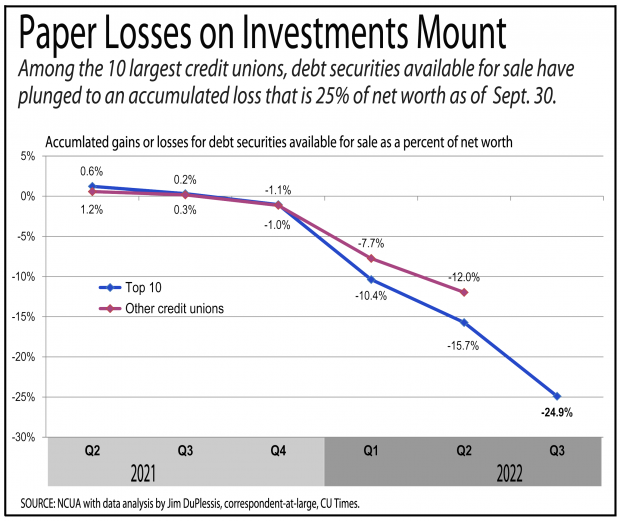
Chart showing paper losses on investments mount for credit unions.

However, credit union consultant Mike Higgins said interest expenses are starting to rise sharply at some credit unions to maintain and attract deposits.

“Deposits have economic value again,” Higgins said. “The fact that you can now make a good spread on deposits flips the script. Everyone will want deposits if they can earn a decent risk-free spread that covers the cost of capital — including ‘non-traditional’ banks and investment houses.”

On the flip side, balance sheets are showing rapidly growing unrealized losses on debt securities available for sale (AFS). Among the Top 10, AFS securities were showing an accumulated net gain that was 0.3% of their net worth at the end of September 2021. As of Sept. 30 this year, they showed a net loss that was 25% of net worth.

Higgins said that ratio generally falls as interest rates rise.

“Each time the yield curve shifts upward, it gets worse,” he said. “Some of it is driven by Fed movements on the short end, some of it is driven by general economic uncertainty and the need to have enough yield to offset that on the longer end.”

Among four of the Top 10 credit unions the ratio was -30% to -35%: Navy Federal Credit Union of Vienna, Va. ($156.5 billion, 12.1 million members), State Employees’ Credit Union of Raleigh, N.C. ($52.1 billion, 2.7 million members), Golden 1 Credit Union of Sacramento, Calif. ($18.3 billion, 1.1 million members) and Alliant Credit Union of Chicago ($18 billion, 734,595 members).

Three credit unions had ratios of -0.3% to -10%: PenFed Credit Union of Tysons, Va. ($35.9 billion, 2.8 million members), SchoolsFirst Federal Credit Union of Santa Ana, Calif. ($27.7 billion, 1.3 million members) and America First Federal Credit Union of Riverdale, Utah ($17.6 billion, 1.3 million members).

Higgins said a ratio of -35% is not unusual.

“It’s mostly a marker of interest rate risk, but if the investments are held to maturity, there is no loss. It goes away. The bond simply paid what it was supposed to pay,” he said.

Wednesday, November 2, 2022

Fed unleashes another big rate hike but hints at a pullback

Associated Press
November 2, 2022, 1:00 PM


The Federal Reserve’s move raised its key short-term rate to a range of 3.75% to 4%, its highest level in 15 years.

WASHINGTON (AP) — The Federal Reserve pumped up its benchmark interest rate Wednesday by three-quarters of a point for a fourth straight time but hinted that it could soon reduce the size of its rate hikes.

The Fed’s move raised its key short-term rate to a range of 3.75% to 4%, its highest level in 15 years. It was the central bank’s sixth rate hike this year — a streak that has made mortgages and other consumer and business loans increasingly expensive and heightened the risk of a recession.

But in a statement after its latest policy meeting, the Fed suggested that it might soon shift to a more deliberate pace of rate increases. It said that in coming months it would consider the cumulative impact of its large rate hikes on the economy. It noted that its rate hikes take time to fully affect growth and inflation.
Those words indicated that the Fed’s policymakers may think borrowing costs are getting high enough to possibly slow the economy and reduce inflation. If so, that would suggest that they may not need to raise rates as quickly as they have been doing. The Fed’s signal that it might soon decide to slow its hikes sent stock and bond prices higher and reduced Treasury yields.

For now, the persistence of inflated prices and higher borrowing costs is pressuring American households and has undercut the ability of Democrats to campaign on the health of the job market as they try to keep control of Congress. Republican candidates have hammered Democrats on the punishing impact of inflation in the run-up to the midterm elections that will end Tuesday.

Speaking at a news conference, Chair Jerome Powell avoided sending any clear signal of whether the Fed’s next expected rate hike in December might be only a half-point rather than three-quarters.

Typically, the Fed raises rates in quarter-point increments. But after having miscalculated in downplaying inflation last year as likely transitory, Powell has led the Fed to raise rates aggressively to try to slow borrowing and spending and ease price pressures.

Wednesday’s rate increase coincided with growing concerns that the Fed may tighten credit so much as to derail the economy. The government has reported that the economy grew last quarter, and employers are still hiring at a solid pace. But the housing market has cratered, and consumers are barely increasing their spending.

The average rate on a 30-year fixed mortgage, just 3.14% a year ago, surpassed 7% last week, mortgage buyer Freddie Mac reported. Sales of existing homes have dropped for eight straight months.

Blerina Uruci, an economist at T. Rowe Price, suggested that falling home sales are “the canary in the coal mine” that demonstrate that the Fed’s rate hikes are weakening a highly interest-rate sensitive sector like housing. Uruci noted, though, that the Fed’s hikes haven’t yet meaningfully slowed much of the rest of the economy, particularly the job market or consumer demand.


“So long as those two components remain strong,” she said, the Fed’s policymakers “cannot count on inflation coming down” close to their 2% target within the next two years.

Several Fed officials have said recently that they have yet to see meaningful progress in their fight against rising costs. Inflation rose 8.2% in September from 12 months earlier, just below the highest rate in 40 years.

Still, the policymakers may feel they can soon slow the pace of their rate hikes because some early signs suggest that inflation could start declining in 2023. Consumer spending, squeezed by high prices and costlier loans, is barely growing. Supply chain snarls are easing, which means fewer shortages of goods and parts. Wage growth is plateauing, which, if followed by declines, would reduce inflationary pressures.

Yet the job market remains consistently strong, which could make it harder for the Fed to cool the economy and curb inflation. This week, the government reported that companies posted more job openings in September than in August. There are now 1.9 available jobs for each unemployed worker, an unusually large supply.

A ratio that high means that employers will likely continue to raise pay to attract and keep workers. Those higher labor costs are often passed on to customers in the form of higher prices, thereby fueling more inflation.

Ultimately, economists at Goldman Sachs expect the Fed’s policymakers to raise their key rate to nearly 5% by March. That is above what the Fed itself had projected in its previous set of forecasts in September.

Outside the United States, many other major central banks are also rapidly raising rates to try to cool inflation levels that are even higher than in the U.S.

Last week, the European Central Bank announced its second consecutive jumbo rate hike, increasing rates at the fastest pace in the euro currency’s history to try to curb inflation that soared to a record 10.7% last month.

Likewise, the Bank of England is expected to raise rates Thursday to try to ease consumer prices, which have risen at their fastest pace in 40 years, to 10.1% in September. Even as they raise rates to combat inflation, both Europe and the U.K. appear to be sliding toward recession

Tuesday, November 1, 2022

Lots of Interest in Crypto, But 60% Say They Don’t Understand It, Survey Finds, Even As…

10/31/2022 CUTodayu

WILTON, Conn.–Cryptocurrency investors are attracted by the opportunity for growth, but a high level of skepticism and lack of understanding remains, according to new research.

In fact, 60% of respondents to the survey of more than 10,000 people admitted they don’t understand cryptocurrency

The research by consumer insights provider Toluna surveyed people between the ages of 18 and 64 years from four regions and 19 markets to understand consumer perceptions around cryptocurrency during August 2022. The survey builds on previous waves of research carried out in December 2021 and June 2022, and examines how perceptions of cryptocurrency have continued to develop and change over time, the company said.

Toluna Crypto

The 10,500 survey respondents came from people in  Australia, Singapore, Hong Kong, Thailand, Philippines, India, Malaysia, Indonesia, Vietnam, US, UK, France, Germany, Spain, Italy, UAE, and Brazil; with China also among the list of countries surveyed in APAC for this wave.  

Key Findings

Despite the temptation around both short- and long-term growth, the hesitation around cryptocurrency remains strong, with almost half (42%) of global respondents stating that crypto is a risky investment, according to Toluna.

“Respondents in emerging markets continue to view cryptocurrency in a more positive light, compared to those in developed markets where attitudes toward crypto are more skeptical,” the company said in releasing the findings.

For those already investing in crypto, loyalty remains strong.

“Despite the recent Luna & UST crashes, most existing crypto investors are still interested in crypto, seeing the potential for long-term stable growth (36%),” Toluna reported. “In fact, 42% of respondents plan to place more of their assets in crypto within the next six months.”

FOMO, But…

The survey also revealed investors are torn between FOMO and losing to a risky investment. Among the findings:

  • Cryptocurrency is the second most well-known form of investment, with 57% of respondents stating they were aware of it. Despite the high awareness, 60% of respondents state that they don’t understand cryptocurrency
  • Of those who haven’t invested in cryptocurrency, they cite that it’s too risky (42%), they don’t understand it enough (32%), and it isn’t secure enough (28%)
  • Many still view crypto as a currency for the underworld. When asked to rate agreement (scale of 0-10, with 10 being strongly agreed) with the statement, ‘Crypto facilitates illegal activities,” 45% agreed (top-5 box).
  • 47% of respondents agree that ‘Crypto can be easily converted into cash’ (top-5 box) 

Many Remain Optimistic

Despite the crashes that have taken place in the crypto market, Toluna said many remain positive, finding:

  • 81% of respondents plan to either maintain or increase the percentage of their assets invested in crypto within the next six months
  • Among those who currently invest in crypto, 42% plan to place more of their assets into crypto within the next six months
  • There are many reasons that people choose to invest in crypto: the potential for long-term stable growth (36%), short-term high growth (35%), to diversify (30%), to use as a means of payment for online purchases (25%), to avoid government regulation (11%), to hedge against traditional asset crashes (16%), and the general fear of missing out (15%) 

Additional Findings

Additional findings revealed, according to Toluna:

  • Developed markets are starting to favor crypto. The research highlighted that developed and APAC markets were experiencing a positive shift regarding their feelings of cryptocurrency and said they felt curious, optimistic, excited, inspired, and intrigued by it
  • Consumers in emerging markets claim higher familiarity with crypto (7.1/10) than their counterparts in developed markets (5.1/10)
  • Respondents in emerging markets have more trust (5.8/10) in crypto than those in developed markets (3.9/10). Likewise, they feel that it’s more secure (4.8/10) than consumers in developed markets (3.6/10)
  • Respondents in emerging markets are more likely to recommend investing in crypto (6.2/10) than those surveyed in developed markets (4.0/10)  

Spending Using BNPL Solutions to Hit More Than $400B By 2027, Study Predicts

10/31/2022 CUToday

HAMPSHIRE, U.K.–A new study from Juniper Research has found that consumer spending using  buy now, pay later (BNPL) platforms will reach $437 billion globally in 2027; rising from $112 billion in 2022.

Buy Now Pay Later

“This sizeable growth of 291% will be driven by escalating financial pressures from the rising cost of living, increasing the demand for cheap credit solutions,” Juniper said.

According to Juniper, the research found that the most significant issue currently facing the BNPL market is the debt trap.

“BNPL’s lack of credit checks poses a considerable market hurdle, as consumers are being approved for larger loans than they are actually able to repay,” Juniper said in its analysis. “However, the report predicts that the introduction of financial regulations in several countries will help alleviate this issue. These new regulations are similar in nature to existing credit services.”

In markets where regulations are softer, it is still vital that vendors act responsibly and clearly communicate all incurred debts promptly to users, to help minimize repayment default rates, Juniper added. 

“Though the future of the market seems unclear given the plethora of impending regulatory changes, enforcing legislation for eligibility checks will ensure the market develops securely,” said research author Dominique Tetnowski.

Expansion into New Verticals Needed

Juniper said the research additionally predicts that BNPL vendors must look to provide services in alternative verticals to diversify their monetization opportunities, as eCommerce becomes oversaturated with solutions. It identified the healthcare sector as an emerging opportunity for vendors, owing to a lower risk of defaulting payments from overspending in comparison to the eCommerce market.

“As such, vendors must look to make strategic partnerships with established healthcare providers to offer BNPL services to healthcare users; ensuring successful entry into the market,” the company said.

Building Tomorrow’s Credit Unions, or Just Managing Today’s?

===================================================================== Remember, you're not alone with NCOFCU.org / Join Check out some ...