Friday, October 28, 2022

Delinquencies darken the horizon for credit unions. Is yours prepared?

by Ashley Stopinski, SWBC
CUInsight

In their Q2 report, Historically Low Delinquency Rates Coming to an End, economists at the Federal Reserve Bank of New York made the following observations about the economy that point to delinquency storm clouds brewing for many credit unions and their members:

  • Total household debt increased by $312 billion during Q2 2022.
  • Consumer debt balances are now more than $2 trillion higher than they were in 2019.
  • All debt types saw sizable increases, with the exception of student loans.
  • Mortgage balances have climbed $207 billion since Q1 2022.
  • Credit card balances saw a $46 billion increase since Q1.
  • Auto loan balances rose by $33 billion in Q2.

In recent months, borrowing has increased significantly across the board due to inflationary pressure on just about everything from homes and vehicles to fuel and groceries.

According to the report cited above, “In part, the growth in each debt type reflects increased borrowing due to higher prices. Prices for both homes and motor vehicles have been rising, and the borrowing amounts have risen in tandem—in fact, the average dollar amount for new purchase originations of both autos and homes is up 36% since 2019. Purchase mortgage origination volume is up 7% in the second quarter, driven primarily by increased borrowing amounts … Increases in car prices are also pushing up auto loan origination volumes.”

As Consumer Balance Sheets Deteriorate, Delinquencies Are Starting to Rise

In his Q3 Economic Outlook for Financial Institutions, SWBC’s Chief Economist, Blake Hastings, provided the following insights on rising consumer credit and deteriorating borrower balance sheets:

Consumer balance sheets are still relatively healthy, today, thanks in large part to the rounds of stimulus during the pandemic. Those savings have been spent and credit card usage has risen an astonishing 13% quarter-over-quarter.

This indicates that with high gas and food prices, consumers are turning to their credit cards to make ends meet. This deterioration in consumer balance sheets will continue as long as inflation outpaces wages. 

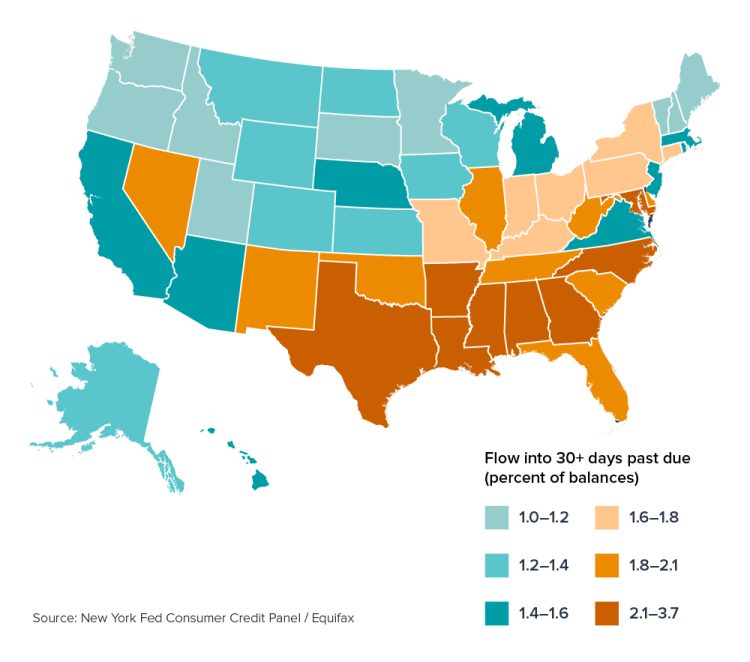
Some borrowers are already beginning to fall behind on payments. According to the New York Fed, delinquency transition rates for credit cards and auto loans are creeping up, particularly in lower-income areas.

Credit Unions in the Southern States Are Being Hit Hardest by Rising Delinquencies

As you can see in the map below, the share of auto loan balances 30+ days past due is heavily concentrated in southern states, reflecting varying borrower demographic makeup and economic conditions in these areas.

The New York Fed notes that a map of the delinquency transition rates from Q4 2019 would yield a nearly identical picture; the rankings of the states in this map are hardly changed from their ranks before the pandemic.
Steps Your Credit Union Can Take to Prepare for Rising Delinquencies

Thanks in part to pandemic-era relief packages insulating savings accounts in 2020 and 2021, the overall credit health of many Americans remains relatively resilient.

However, the recent rise in delinquencies suggests a pattern that points to some communities or individuals experiencing harsher economic realities. These patterns may be hinting at the return of pre-pandemic delinquency patterns.

Having an innovative collections communication strategy is a critical aspect of staying relevant, engaging, and providing value to your borrowers.

By orchestrating a suite of omnichannel communications for collections, including text, email, and interactive voice response (IVR) systems, credit unions can be better prepared to communicate effectively with members. Taking an omnichannel communication approach also allows collections departments to scale much faster.

In the face of rising interest rates and delinquencies, leveraging outsourced collection services can be an efficient, cost-effective option to minimize your collections queues and the time employees dedicate to the collections process. SWBC’s omnichannel collections communication strategy allows you to meet borrowers on their preferred channel, substantially improving their member experience.

To learn more about how your credit union can prepare for rising delinquencies, check out our latest white paper, Modernizing Your Collections Operation. Download your free copy, today!


Step Aside, Side Hustle. SF Fire CU Has Introduced the 'Side Bank'

 SAN FRANCISCO–Noting that one of the biggest obstacles to switching financial institutions is the “overwhelming hassle” of moving accounts, SF Fire Credit Union is encouraging Bay Area residents to open up their financial relationships by exploring a credit union membership in addition to their main bank.

It said the effort is aimed at “giving a nudge to those who are credit union curious, but hesitant to join.” 

“We want this unexpected campaign to make people laugh, but also think seriously about the benefits of a credit union,” said SF Fire CEO Kathy Duvall. “We know that one in-three people are not familiar with Credit Unions, and only one in five know who SF Fire is. This campaign encourages Bay Area residents to get to know SF Fire and consider us for a better, more personalized banking experience we're sure they'll love." 


Officially launching on Nov. 1, SF Fire said its “playful campaign” dubs the term “Side Bank” as a progressive way to take advantage of credit union services, without the hassle of first leaving a bank or moving around accounts.

‘Once People Try Us…’

The credit union added that by diversifying with an SF Fire credit union account, Bay Area residents have “access to topnotch services, low fees,  and great rates – that they may just want to leave their big bank for.” 

"SF Fire's motto is 'Where members come first,’ and we live that out every day with our intentional and attentive approach to our members and the services we offer," said Duvall. "Once people try us, they usually stay."  

The commercial can be viewed at this link.

More Pain to Follow GDP Gain, CUNA Predicting 'Growth Will Not Last'

The economy grew from spring to summer, but CUNA and others warn of what's ahead.

By Jim DuPlessis | October 27, 2022 CUTimes

Source: AdobeStock.

The U.S. economy rebounded in the third quarter after two quarters of small declines, but the happy music might be ending soon.

The U.S. Bureau of Economic Analysis on Thursday reported that real gross domestic product (GDP) increased at a seasonally adjusted annual rate of 2.6% from the second quarter to the third quarter.

The gain reflected improvements in exports, consumer spending, nonresidential fixed investment and government spending. Reducing GDP were decreases in residential fixed investment and private inventory investment.

CUNA Chief Economist Mike Schenk said the rebound was solid, but “widely expected.” CUNA’s baseline economic forecast called for the economy to grow by 2.5% in the third quarter and the consensus estimate among economists was 2.3%.

“Healthy economic growth will not last,” Schenk said. “The Federal Reserve’s recent aggressive policy response to stubbornly high inflation virtually guarantees that fourth-quarter output will decelerate — perhaps significantly.”

Mike Schenk

By raising the federal funds rate sharply this year, Schenk said the Fed has raised the cost of homes, autos, and other big-ticket items purchased on credit.

“Spending and borrowing will therefore undoubtedly take a big hit in the fourth quarter,” he said. “The end result will be obvious and impactful labor market dislocations.”

Prices for goods and services bought by consumers rose at a seasonally adjusted annual rate of 4.2% from the second quarter to the third quarter. The Personal Consumption Expenditures (PCE) Price Index gain fell from a 7.3% increase in the second quarter and a peak of 7.5% in the first quarter.

“Overall, this was exactly the type of report the Federal Reserve is looking for,” NAFCU Chief Economist Curt Long said. “Rate-sensitive areas are responding to tightening monetary policy, but the rest of the economy is moderating more slowly.”

Curt Long

“It is still too early for the FOMC to think about a pivot, but after next week’s 75 basis-point hike, this report would support a mild step down to a 50-point increase in December,” Long said.

Economists from the Mortgage Bankers Association on Oct. 23 predicted a recession in early 2023. On Thursday, MBA Deputy Chief Economist Joel Kan said the third-quarter GDP gain hasn’t derailed its prediction.


“Despite a strong third quarter result, our forecast is for a slowdown in economic growth in the coming quarters and for the economy to enter a recession in 2023,”

 Kan said.
Joel Kan

“Sharp slowdowns in global growth and tighter financial conditions have started to exert pressure on parts of the economy, in particular housing,” he said. “There are also early signs of weakening in the job market, such as slower monthly payroll growth and declining job openings.”

On Thursday, MBA reported that homebuyer affordability dropped in September. The national median payment applied for by mortgage applicants increased 5.5% to $1,941 from $1,839 in August. It is up by $558 in the first nine months of the year, equal to a 40.4% increase.

MBA’s Oct. 23 forecast showed purchase originations in the third quarter were $388 billion, down 22% from a year earlier.

MBA’s also made sharp downward revisions over the next nine quarters. It expects purchase originations to fall 29% to $340 billion in the fourth quarter and fall 3% to $1.53 trillion next year.

Kan said Thursday’s GDP report showed residential investment declined for the sixth straight quarter, subtracting 1.37 percentage points from GDP growth, the largest drag since 2007.

Home purchase applications, home sales, and housing starts “showed significant weakening last quarter as mortgage rates reached multi-decade highs and as economic uncertainty grew,” he said.

The 2.6% gain in GDP from the second quarter to the third quarter follows dips of 1.6% in the first quarter and 0.6% in the second quarter. GDP took a record 29.9% plunge in the second quarter of 2020 as the COVID-19 pandemic began, followed a record surge of 35.3% in the following quarter. GDP continued growing at more normal rates through 2021’s fourth quarter.

Some other key measures from the BEA report include:

  • Third-quarter GDP was 1.8% greater than GDP in 2021’s third quarter after adjusting for inflation.
  • Real disposable personal income increased 1.7% from the second quarter to the third quarter, in contrast to a decrease of 1.5% in the second quarter a 10.6% drop in the first quarter. It had been falling quarter to quarter since the third quarter of 2020.
  • The personal saving rate—personal saving as a percentage of disposable personal income—was 3.3% in the third quarter, compared with 3.4% in the second quarter.
  • The price index for gross domestic purchases increased 4.6% in the third quarter, compared with an increase of 8.5% in the second quarter.

Thursday’s “advance” estimate will be followed by a second estimate based on more complete data to be released Nov. 30.

Jim DuPlessis

CFPB Issues Guidance to Help Banks & Credit Unions Avoid Charging Illegal Junk Fees on Deposit Accounts


Agency highlights surprise overdraft and surprise depositor fees

OCT 26, 2022

Washington, D.C. – Today, the Consumer Financial Protection Bureau (CFPB) issued guidance about two junk fee practices that are likely unfair and unlawful under existing law. The first, surprise overdraft fees, include overdraft fees charged when consumers had enough money in their account to cover a debit charge at the time the bank authorizes it. The second is the practice of indiscriminately charging depositor fees to every person who deposits a check that bounces. The penalty is an unexpected shock to depositors who thought they were increasing their funds.

“Americans are willing to pay for legitimate services at a competitive price, but are frustrated when they are hit with junk fees for unexpected or unwanted services that have no value to them,” said CFPB Director Rohit Chopra. “We are providing guidance on existing law that will help law-abiding businesses seeking to fairly compete and the families they serve.”

Overdraft and depositor fees likely violate the Consumer Financial Protection Act prohibition on unfair practices when consumers cannot reasonably avoid them.

Today’s Consumer Financial Protection Circular on surprise overdraft fees and the CFPB’s compliance bulletin on surprise depositor fees layout when a financial institution’s back-end penalties likely break the law.

Surprise Depositor Fees

When a consumer deposits a check that bounces, banks sometimes charge a fee to the depositor, usually in the range of $10 to $19. However, a person trying to deposit a check has no idea or control over whether the check will clear, and sometimes, that person is the victim of check fraud. In fact, there are many reasons deposited checks can bounce, and the most common reason is that the check originator does not have enough money available in their account. Charging a fee to the depositor penalizes the person who could not anticipate the check would bounce while doing nothing to deter the originator from writing bad checks.

The bulletin explains that indiscriminately charging these depositor fees, regardless of circumstances, likely violates the Consumer Financial Protection Act. Financial institutions can generally stay on the right side of the law when they employ more tailored fee policies that charge depositor fees only in situations where a depositor could have avoided the fee, such as when a depositor repeatedly deposits bad checks from the same originator.

Surprise Overdraft Fees

An overdraft fee can become a surprise fee when the customer doesn’t reasonably expect their actions to incur an overdraft fee. For instance, even if a person closely monitors their account balances and carefully manages their spending to avoid overdraft fees, they can easily incur penalties when financial institutions employ processes that are unintelligible or manipulative.

Today’s Consumer Financial Protection Circular explains that when financial institutions charge surprise overdraft fees, sometimes as much as $36, they may be breaking the law. The circular provides some examples of potentially unlawful surprise overdraft fees, including charging penalties on purchases made with a positive balance. These overdraft fees occur when a bank displays that a customer has sufficient available funds to complete a debit card purchase at the time of the transaction, but the consumer is later charged an overdraft fee. Often, the financial institution relies on complex back-office practices to justify charging the fee. For instance, after the bank allows one debit card transaction when there is sufficient money in the account, it nonetheless charges a fee on that transaction later because of intervening transactions.

In September 2022, the CFPB took action against Regions Bank for charging surprise overdraft fees known as authorized positive fees. As early as 2015 the CFPB, as well as other federal regulators, including the Federal Reserve, began cautioning financial institutions against charging certain types of authorized positive fees, such as the ones used by Regions to unlawfully penalize customers. Regions is required to, among other consequences, reimburse consumers all the funds it unlawfully charged since August 2018 and pay a $50 million penalty.

Today’s Consumer Financial Protection Circular on surprise overdraft fees and its bulletin on surprise deposited item fees are just the latest announcements as part of the CFPB’s junk fee initiative, one of many efforts across the federal government to increase competition and reduce unnecessary financial burdens on American families.

Junk Fee Initiative

In January 2022, the CFPB launched an initiative to scrutinize back-end junk fees that cost Americans billions of dollars. Tens of thousands of people responded to a CFPB Request for Information with their stories and complaints about unnecessary fees in banking. Since then, the CFPB has taken action to constrain “pay-to-pay” fees, and has announced a rulemaking proceeding on credit card late fees. In the last year, the CFPB has also published several research reports on overdraft fees and an analysis of college banking products.

The CFPB has observed that financial institutions have started to compete more when it comes to fees. Earlier this year multiple banks announced they were eliminating overdraft fees or updating their policies to be more consumer friendly. And, in recent months, multiple large banks announced that they are eliminating non-sufficient fund fees on their checking accounts. The CFPB estimates that these changes mean $3 billion in savings for consumers.

Thursday, October 27, 2022

Planning, Budgeting, and The Rise of ATM-As-A-Service


Fall is upon us and we’re heading into planning season. There is a lot to consider this year. It 
seems like there’s more uncertainty for the near-term future than there normally is. We’re in a qualified recession (although we’re not stating it officially), we have mid-term elections coming in November, inflation is above 8% with little signs of a reprieve and although we’ve been adding jobs at a considerable pace, wait times and member service still seems to be feeling the effects of the pandemic shutdown and subsequent “Great Resign”.

This weakening of service & response is affecting every industry. Every one of my business trips has been met with longer lines, closed-early signs, or an interaction with someone completely overworked and exhausted from pulling the weight of two or more employees that have gone missing in action.

As we head into budget and planning season, we need to take the issue of weak service & staffing into account and consider how to put our credit union in the best situation possible to avoid poor service, slow response, and general lack of empathy. And not just from our own front-line and member-facing staff, but from our vendors and business partners as well.

Self-service access through mobile apps, online banking & ATMs are great ways to ensure your credit union can continue to provide strong service and access for your members. But, these access points are not immune to understaffing and the resulting poor service. Take your ATMs & ITMs (if you’ve taken the leap). Keeping an ATM up and running takes the work of four to five different vendors as well as your branch, operations, and accounting staff. You may not even be fully aware of all the hands involved in your ATM program. And this coordination of efforts to keep your fleet running smoothly is more expensive and time-consuming than you realize.

ATM-as-a-Service (or ITM-as-a-Service) is not a new concept, but it is catching on with more credit unions now than ever. ATMs have evolved from after-hours access to an extension of the branch, a means for teller interaction, and the beginnings of new market expansion. As the ATM's responsibility grows, so does the need for better program management. Outsourcing to an ATM-as-a-Service focused entity provides a layer of expertise that was not available to you before. It also alleviates your staff from having to coordinate internal and external vendor efforts when issues arise. And it provides economies of scale for service contracts, equipment, and software procurement.

Whether planning for different branch approaches, market expansion or focusing on providing the optimum member experience, make sure to give strong consideration to the evaluation of your ATM or ITM fleet this Fall. Would your credit union be better served by a business-as-usual approach or by an industry expert that can help you reduce costs, develop a strategic plan and implement a stronger program for your member access? Click the link in the email to request a consultation today.

Joe Woods, CUDE | SVP, Marketing & Partnerships

Dolphin Debit Access, LLC | 1340 Rayford Park Rd., Spring, TX 77386

(M) 614-378-0367

It’s Time to Take HELOCs Off the Backburner

Is your credit union ready to quickly and conveniently offer the lending product more borrowers need today?

HELOC use is shifting. (Source: Shutterstock)

Mortgage refinancing had quite a moment the last two years. Borrowers rushed to take advantage of the historically low interest rates, resulting in $5.5 trillion in mortgage lending in 2020 and 2021, according to Black Knight’s January 2022 Mortgage Monitor.

Enter 2022 … and the winds have completely changed. As the Federal Reserve rapidly adjusts interest rates upward, the housing market reacted with a sharp and abrupt drop in mortgage refinances. Weekly mortgage applications are down 83% compared to one year ago, according to the Mortgage Bankers Association.

Homeowners have record levels of home equity and still have financial needs. Where a cash-out refinance might have made sense last year, interest rates likely make a home equity loan a better financial decision.

HELOCs: Then Versus Now

I recall from my days as a credit union lending manager that HELOCs were often a “backburner” product. Mortgages, car loans and personal loans were almost always the first-line solutions. There were a few reasons why HELOCs weren’t a go-to pick – but, those same reasons aren’t true today. I’m happy to count the ways things have become very different, thanks in large part to automation technology.

Then: HELOCs were cumbersome for lenders.

Now: Processing and underwriting can be done with the click of a button.

Then: The ROI of HELOCs was lower than other types of loans.

Now: Automation drives efficiency, reducing manual touches per file and making it easier to scale the volume without more effort.

Then: Borrowers often didn’t ask for HELOCs.

Now: Borrowers know they are sitting on peak home values – and are constantly reminded by the regular influx of home equity offers.

Then (and also now): HELOCs didn’t put resources in borrowers’ hands quickly, taking weeks to process and close.

Now: Borrowers can get funds in as little as a week, with automation enabling a clear-to-close in a matter of days.

Simply put, in the current rising interest rate environment, HELOCs should be a go-to, game-changing lending product.

Changing Perspective: From Backburner to High-Value Loan

HELOCs can be extended much more efficiently than in days past. In fact, you may be making them much harder than they need to be! Digitization, advanced technology, and updated processes can make HELOCs surprisingly fast and simple. Capitalizing on this trifecta benefits the borrower and institution – here’s why.

Technology is changing the “return-on-effort” equation. Many institutions treat HELOCs like mortgage loans, and as such, follow the same, or very similar, loan process. For the amount of effort, many lenders see the return as “unrewarding,” when they could be extending other forms of credit more quickly and easily.

Home equity loans are actually quite different. They aren’t subject to the same requirements as mortgage loans, which opens the door to implementing a more streamlined process. Credit unions today have access to automated workflows capable of intelligently executing home equity loans quickly, consistently and accurately. With powerful technology working on their behalf, lenders’ perception of effort can quickly change from “unrewarding” to “almost too easy.”

HELOCs are a good choice for most borrowers today. Many homeowners are sitting on significant sums of home equity, but few want to refinance or take out a longer-term home equity loan at a higher interest rate. HELOCs are an important tool to have in your lending portfolio to help tap into those resource pools. HELOCs provide higher lines of credit at much lower rates than credit cards, which allows borrowers to only pay on what they use. And because it’s collateralized, it can be used more flexibly to address a broad array of needs.

Even those who need funds fast will find value in HELOCs. Thanks to the aforementioned automated workflow technology, a HELOC can be cleared to close in days, not weeks. With many institutions still requiring anywhere from 20 to 60 days, this is monumental progress. It’s a logical leap forward for community lenders that want to remain competitive against ultra-speedy, tech-first competitors, hungry to capture more of the financial services market.

HELOCs help diversify and mitigate risk in the portfolio. From my experience in credit union lending, I’ve seen how loan portfolios can become two-dimensional. Home and auto loans are the bread and butter of community lending institutions. However, the tandem rise of interest rates, and prices of cars and homes have slowed demand significantly for these two cornerstone products.

Personal loans are another popular lending product, but they carry additional risks. Without collateral at stake, delinquency and default rates can creep higher. In addition to potential portfolio risk, collection efforts require valuable time and resources.

Home equity borrowers are more likely to repay their loans on time. This can provide lenders an appealing way to add diversification as the economy navigates the volatile market and meet the financial needs of their members and customers.

As the lending environment evolves, it’s important to change alongside your borrowers’ expectations and needs. Is your institution ready to quickly and conveniently offer the lending product more borrowers need today? With the assistance of technology that transforms, HELOCs are poised to be game changers in 2022.

Scott Meier Scott Meier

Scott Meier is a former credit union lending manager who oversees western region sales for LenderClose, a West Des Moines, Iowa-based CUSO that automates home equity lending processes at scale using 

Wednesday, October 26, 2022

Mortgage Bankers Predict Early 2023 Recession, Cuts Forecast


House expense and cost, too expensive payment or high interest rate mortgage concept, heavy house broke savings piggybank metaphor of too much payment Source: AdobeStock.

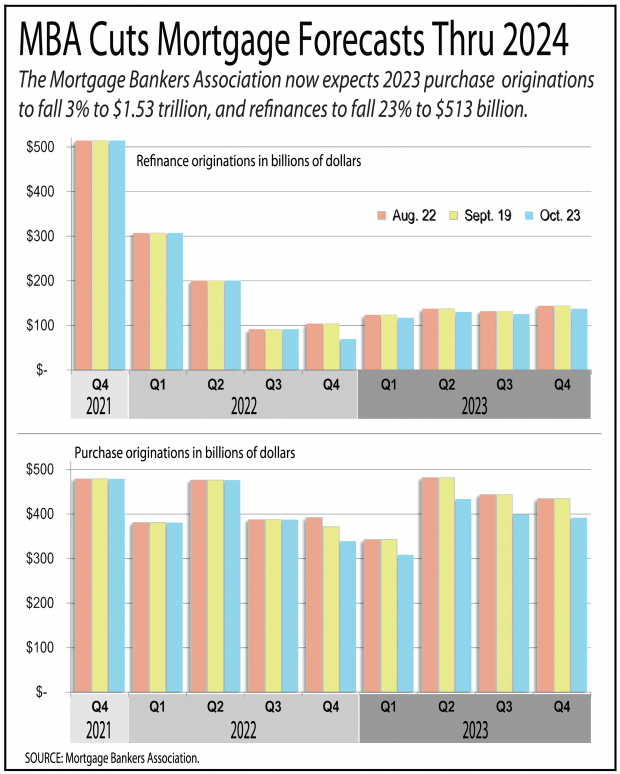
The Mortgage Bankers Association expects a recession early next year that will take a bigger bite out of origination volumes than it expected a month ago and lead to more layoffs by lenders.

MBA cut its forecast by 15% for the fourth quarter and by about 8% over the next two years from its Sept. 19 forecast.

Its forecast, released Sunday at the opening of its annual meeting in Nashville, showed total volume will fall 49% to $2.26 trillion for this year, and fall a further 9% to $2.05 trillion next year before starting to recover in 2024 and 2025.

MBA Chief Economist Mike Fratantoni said MBA is forecasting a recession in the first half of next year “driven by tighter financial conditions, reduced business investment, and slower global growth.”

Mike Fratantoni Mike Fratantoni

“Next year will be particularly challenging for the U.S. and global economies,” Fratantoni said. “The sharp increase in interest rates this year – a consequence of the Federal Reserve’s efforts to slow inflation — will lead to an equally sharp slowdown in the economy, matching the downturn that is happening right now in the housing market.”

The unemployment rate will rise from its current rate of 3.5% to 5.5% by the end of the year, and some joining the ranks of the unemployed will be those working for mortgage lenders.

Bar chart showing the MBA has cut the mortage origination forecast through 2024

Marina Walsh, MBA’s VP of industry analysis, said more lenders will be losing money this year for the first time since 2018.

As a result, MBA forecasts lenders will cut jobs by 25% to 30% from their peak levels to the trough as their production volumes fall from the record levels of 2020 and 2021. Credit union layoffs attributed to the drop in mortgage lending include 38 jobs on Oct. 6 by Collins Community Credit Union in Cedar Rapids, Iowa ($1.6 billion in assets, 91,034 members as of June 30) and 42 jobs announced in September by GreenState Credit Union in North Liberty, Iowa ($10.7 billion, 385,624 members).

Marina Walsh Marina Walsh

“Origination volumes have declined, revenues have dropped, and expenses continue to rise,” Walsh said. “Lenders have started to shrink excess capacity by reducing staffing levels, exiting less profitable channels or exiting the business entirely.”

MBA began cutting its refinance forecasts for 2023 in March and its purchase forecasts for 2023 in May.

Fratantoni said refinance volume is anticipated to decline by 24% to $513 billion next year, and purchase originations will fall 3% to $1.53 trillion because of the recession, continued Fed rate hikes and persistent high buying costs.

However, for those who haven’t lost jobs, home affordability will improve as prices flatten and mortgage rates fall to 5.4% by the end of 2023 after more than doubling to about 7% so far this year.

However, Fratantoni said to expect rates to be volatile in the near-term. One reason will be quantitative tightening by the Fed and other central banks. Other reasons include geopolitical, economic and monetary policy uncertainties.

MBA Deputy Chief Economist Joel Kan said home price growth will fall because of lower sales and higher mortgage rates.

MBA expects half of homes this year will sell for $382,800, up 10% from 2021′s median home price. However, MBA lowered its price expectations over the next two years by 6%. As a result, it now expects prices will fall 2% to $374,200 next year before rising 3% in 2024.

Joel Kan Joel Kan

“MBA expects national home prices will be roughly flat in 2023 and 2024, allowing household incomes some much-needed time to catch up to elevated property values,” Kan said. “However, many local markets will see home-price declines, even if national price measures remain largely unchanged.”

While existing homeowners will resist moving to avoid losing their cheap mortgages, leaving more of the purchase market to the bubble of Millennials now in their prime home-buying years, Kan said.

However, he said the still-low levels of for-sale inventory and slowing new construction activity means that housing supply is likely to remain constrained for some time.

But conditions will begin to improve by 2024. Fratantoni said inflation will gradually decline towards the Fed’s 2% target by the middle of 2024.

In 2024 and 2025, MBA forecasts mortgage originations will rise modestly. MBA forecasts total originations will be $2.31 trillion in 2024, which exceeds 2019 volume, but would be well below peaks of $4.11 trillion in 2020 and $4.44 trillion in 2021

Monday, October 24, 2022

What the Apple Card High-Yield Savings Account is Really About


Don't think of the new Apple Savings account as a standalone competitive banking product. Analysts say it's one more brick for building a 'walled garden' of financial and other services for iPhone users that will drive the growth of Apple Pay, Apple Card, and more of the big tech's offerings.

By Steve Cocheo, Executive Editor at The Financial Brand

Many in banking may view the news of Apple’s latest consumer financial product — a high-yield savings account — as unlikely to be a game-changer. High-yield digital savings offers abound and tend to come out of the woodwork in rising-rate environments.

Yet Apple being Apple, things are never that simple, or obvious. The Financial Brand dug behind the headlines to tease out key aspects of the rollout. Taken together, they present a compelling case that once again, Big Tech is taking incremental steps to dominate what it views as a financial ecosystem.

The latest case in point is Apple’s October 2022 announcement that it was going to augment its Daily Cash rewards system for the Apple Card by setting up a high-yield Savings account that cardholders could place Daily Cash into. The account would be offered through Goldman Sachs, Apple’s card partner. Beyond that, cardholders will be able to deposit additional money into Savings from a linked bank account or from their Apple Cash card, a virtual card offered through Apple’s partner, Green Dot Bank. All of this will go through the Apple Wallet, which is also home to Apple Pay.

It’s a payments play, a banking play, and something else entirely.

Considering Flywheels, Ecosystems, and ‘Apple Bank’

“Apple’s motivation is not to become a bank, but to drive an ecosystem,” says Ron Shevlin, Chief Research Officer at Cornerstone Advisors. He applauds the timing of introducing “high-yield” savings at a point when rates have started to actually rise towards meaningful levels for savers, but, again, this is not traditional competition.

The word — “ecosystem” — comes up a lot in discussions about Apple’s financial activities -

It is never too early to plan and re-plan for a disaster or active shooter!


A disaster/emergency occurs somewhere in the world almost daily, but these events vary considerably in scope, size, and context.

How quickly your company can get back to business after a tornado, a fire or flood or a terrorist attack often depends on emergency planning done today.

While these incidents have led to an increase in general emergency/disaster awareness, the relative infrequency of major catastrophes affecting defined populations leads to a certain degree of complacency and underestimation of the impact of such an event.

A key way to cope with an emergency/disaster or active shooter is to have a plan. Know how to react before, during, and after an emergency/disaster. Know the threats that could affect where you live, work, and go to school.

To refresh your business emergency/continuity plan. Take a minute and watch the Active Shooter Video and download FEMA’s  “Every Business Should Have a Plan”  

It is never too early to plan and re-plan for a disaster or active shooter!

Friday, October 21, 2022

Mortgage Applications Fall Along With Home Sales

Economists attribute the decline to high prices and interest rates rising to their highest mark in 20 years.

Mortgage applications fell for the fourth week in a row as existing home sales continued sliding and interest rates reached new records.

The National Association of Realtors (NAR) reported Thursday that existing homes sold at a seasonally adjusted annual rate of 4.71 million in September, down 24% from a year earlier and down 1.5% from August. It marked the eighth month in a row of declines.

NAR Chief Economist Lawrence Yun said the housing sector continues to undergo an adjustment due to the continuous rise in interest rates, which surpassed 6% for 30-year fixed mortgages in September and are now approaching 7%.

“Expensive regions of the country are especially feeling the pinch and seeing larger declines in sales,” Yun said.

Lawrence Yun Lawrence Yun

Applications for mortgages in the week ending Oct. 14 were 4.5% lower than the previous week after seasonal adjustments – the fourth week in a row of decline and continuing a generally downward trend over the past four months.

“Mortgage applications were down again last week as mortgage rates hit 20-year highs, and ongoing economic uncertainty and affordability challenges continue to impact borrower demand,” MBA President/CEO Bob Broeksmit said Thursday.

Bob Broeksmit Bob Broeksmit

The refinance index fell 7% from the previous week and 86% from a year earlier. The seasonally adjusted purchase index fell 3% from the previous week and fell 38% from a year ago.

MBA Deputy Chief Economist Joel Kan said applications have fallen to their lowest level since 1997, as the average contract interest rate for 30-year fixed-rate mortgages with conforming loan balances hit 6.94% last week – the highest level since 2002.

The effective rate for a 30-year fixed rate mortgage that is 80% or less of value was 7.21% last week – up from 6.52% four weeks ago and 3.50% a year ago.

“The speed and level to which rates have climbed this year have greatly reduced refinance activity and exacerbated existing affordability challenges in the purchase market,” Kan said. “Residential housing activity ranging from housing starts to home sales have been on downward trends coinciding with the rise in rates.”

Joel Kan Joel Kan

The average contract interest rate for 30-year fixed-rate mortgages with conforming loan balances ($647,200 or less) increased to 6.94% from 6.81% last week.

Broeksmit said the share of applications from adjustable rate mortgages (ARM) was at a 14-year high as prospective buyers turned to ARMs to reduce their monthly mortgage payment. “Even at 13%, however, the share of ARM applications is still roughly a third of the peak seen in the early 2000s,” he said.

NAR reported that home prices remain high. More than half of homes sold for at least $384,800 last month, an 8.4% jump from September 2021 as median prices climbed in all regions. Prices were lower than August. While it was the third monthly price drop since reaching a record high of $413,800 in June, it followed the usual seasonal trend of prices trailing off after peaking in the early summer.

Unsold inventory sat at a 3.2-month supply at the current sales pace – unchanged from August and up from 2.4 months in September 2021.

“Despite weaker sales, multiple offers are still occurring with more than a quarter of homes selling above list price due to limited inventory,” Yun said. “The current lack of supply underscores the vast contrast with the previous major market downturn from 2008 to 2010, when inventory levels were four times higher than they are today.”

Thursday, October 20, 2022

Service Credit Union Outsources 90 ATMs With Dolphin Debit


DDA Header.png


Service Credit Union Outsources

90 ATMs with Dolphin Debit


Based in Portsmouth, New Hampshire, Service Credit Union has ATMs in the states and at U.S. military bases throughout Germany. Finding ATM organizations that could provide international operations was proving difficult for the $5.4B credit union. Dolphin was uniquely positioned to offer a complete outsourcing program that could cross the Atlantic. The move to outsource will save Service CU over $1M in capex. In addition, Dolphin is helping to facilitate Service Credit Union’s migration of certain branch ATMs to ITMs. 


Shrink Your Budget & Strengthen Your ATM Fleet! 


shutterstock_517189252.jpg

Let the experts manage your ATM operations...


Click the link to request a consultation today:


Dolphin___Euronet__EEFT__BIGGER-removebg-preview.png


Dolphin Debit is a wholly owned subsidiary of Euronet Worldwide Inc. a world wide leader in ATM deployments and ATM technology.


Contact us to learn more


Facebook Twitter  LinkedIn

Dolphin Debit Access | 1340 Rayford Park Road, Spring, TX 77386

New Orleans Firemen’s to Deploy $7 Million in ECIP Grant Funding in Its Communities

 METAIRIE, La.– New Orleans Firemen’s FCU said it will be deploying $7 million into its communities after receiving the funds from the Treasury Department’s Emergency Capital Investment Program.

thumbnail_New Orleans Firemen's

The $259.6-million NOFFCU noted the investments are designed to support the efforts of community financial institutions to, among other things, provide loans, grants, and forbearance for small and minority-owned businesses and consumers, especially in low-income and financially underserved communities that struggled the most during the COVID-19 crisis.

The investments made by Treasury are expected to be used for a range of purposes, said NOFFCU, which did not indicate how it specifically plans to deploy the funds. The credit union is a CDFI.

At the time the ECIP awards were announced, Treasury Secretary Janet Yellen said, “These essential funds provide an opportunity to underserved communities across the country, helping them to regain their footing following the pandemic and strengthening their resilience against future shocks.”

New Orleans Firemen’s FCU has more than 28,000 members across Louisiana and Mississippi and is the second oldest federally insured credit union.

Announcing NCOFCU's 2027 Executive Leadersh

  ...