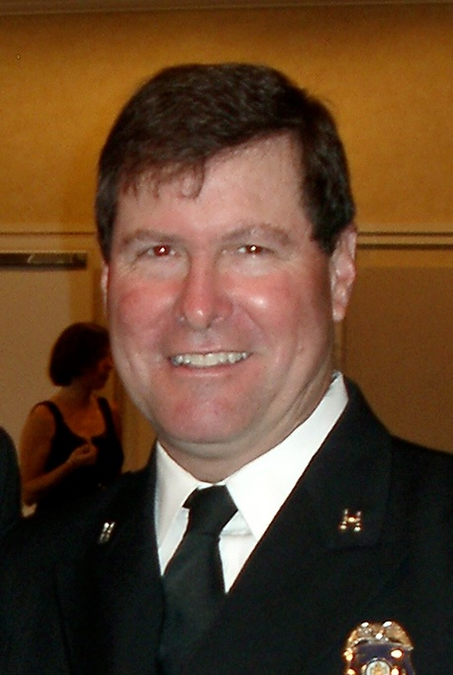
NCOFCU Awards Presentations Seattle WA

Seattle WA 9/20/18
These prestigious awards are presented annually recognizing a credit union professional and volunteer whose career best embodies the National Council of Firefighter Credit Unions Inc (NCOFCU) mission.  The recipients will have demonstrated support for the credit union philosophy of “people helping people” and organized and/or provided significant assistance to their credit unions needs which constructively impacted the growth, image and/or service capacity of their credit union. 

Volunteer of the Year

Michael McCormick V Chairman
San Diego Firefighters FCU
Mike has been a volunteer at the credit union for the past 20 years and is currently the Vice-Chairman of the credit union's Board of Directors. Mike is also on the Board of the NCOFCU.
Mike has been a great advocate for the credit union over these past 20 years and has attended numerous educational conference on behalf of the credit union. He has also been a valued member of the ALCO committee for most of those 20 years. Mike's years of experience in both the private sector and the public sector along with an Executive MBA allows him to play a key role in the decision-making process regarding the strategic financial direction of the credit union.
The credit union is truly fortunate to have someone of Mike's dedication and commitment to the success of the credit union.


Lifetime Achievement Award

Richard T. Andrews CEO
F & A Credit Union
Rich Andrews holds over 40 years of service within the credit union industry. He began his career with credit unions as a Real Estate and Special Service Manager, working his way up to Executive Vice President of Operations and eventually to the CEO position he holds today.  A vast majority of Rich’s credit union career has been serving as President/CEO of F&A Federal Credit Union.

F&A Federal Credit Union closed its books in 1985 with $115 million in assets and a capital ratio of 5.27%. In March of 1986, Rich was hired to take the helm of the Credit Union and lead them into the future. Today, F&A stands as one of the most successful credit unions in the country with over $1.6 billion in assets, nearly $260 million in capital, and an outstanding capital ratio of 15.79%.

Soon, Rich Andrews will leave his long, distinguished career at F&A behind knowing that he, with the help and support of many others, has crafted one of the most successful credit unions in the country. 
Comments

Popular posts from this blog

The Skills Board Chairs Need Now: Leading Through Complexity, Not Control

NCOFCU Podcast   Grant Sheehan CCUE | CCUP | CEO-NCOFCU The role of the board chair has quietly—but fundamentally—changed. A decade ago, success was defined by experience, authority, and strategic judgment. Today, those traits are still relevant—but no longer sufficient. The modern board chair operates in a world shaped by competing stakeholder demands, technological disruption, geopolitical uncertainty, and increasing scrutiny. What emerges is a role that is less about control—and more about navigating complexity. Below are the core capabilities that now define effective board leadership. 1. From Authority to Orchestration The most important shift is conceptual. Board chairs are no longer expected to be the smartest voice in the room. Instead, they are expected to make the room smarter . This requires the ability to: Synthesize large volumes of information Reconcile conflicting perspectives Facilitate high-quality dialogue Traditional strengths like executive experience matter les...

It All Starts in the Boardroom

It all starts in the boardroom—but the consequences are felt far beyond it. When Governance Breaks Down, Members Pay the Price Credit unions are built on a simple but powerful idea: they are owned by their members. Unlike traditional banks, where shareholders drive decisions, credit unions are meant to operate democratically—guided by a volunteer board elected by the very people they serve. But that model only works when participation exists. A governance breakdown happens when the people elected to oversee an institution stop truly representing the people who own it. In credit unions, this breakdown doesn’t usually come from scandal or sudden failure. It happens quietly, over time—through disengagement. The Root of the Problem: Low Engagement Most credit union members don’t vote. Board election turnout is typically in the low single digits. In some cases, it’s barely measurable. That means a very small percentage of the membership is effectively deciding who governs an institution th...

On Stablecoins, NCUA Has Opportunity to Strike Right Balance and Get it Right

By Grant Sheehan As digital payments continue to evolve, the National Credit Union Administration’s (NCUA) efforts to establish a regulatory framework for stablecoins mark an important step forward. For credit unions, especially those serving mission-driven communities like firefighters and first responders, access to emerging financial technologies is not just an opportunity but a necessity to remain competitive and relevant. The  National Council of Firefighter Credit Unions  (NCOFCU) appreciates the  thoughtful input  provided by both America’s Credit Unions and the Defense Credit Union Council (DCUC) on the NCUA’s proposed stablecoin framework. We find strong merit in the recommendations of both organizations and believe their combined perspectives offer a constructive roadmap for getting this right. Important First Phase, But… At its core, the proposal represents an important first phase in implementing the stablecoin provisions of the GENIUS Act. Establishing a...

Sunday Reading - Why the IRS is necessary

  'Taxman'   Why the IRS is necessary The Internal Revenue Service, or IRS, is a division of the US Treasury Department created in 1862   that enforces the Internal Revenue Code —Title 26 of the US Code, a compilation of federal statutes—and, effectively, oversees tax collection. In 2024, the IRS's roughly 75,000 employees collected roughly $5T in tax revenue.   Given its role in diverting household income streams, it also has a bad reputation. Half of Americans had an "unfavorable view" of the IRS as of 2024 ( see data ). In a ranking of 16 well-known federal agencies by popularity that year, t...

It's Financial Literacy Month

April is Financial Literacy Month—a time dedicated to empowering individuals and families with the knowledge and tools needed to make informed financial decisions. Whether you're budgeting, saving, managing debt, or planning for the future, improving your financial literacy can have a lasting impact on your well-being. We invite you to explore our Consumer Education website, where you'll find helpful resources, tips, and guidance to support your financial journey. If you find it valuable, please share it with your family and friends—because financial knowledge is even more powerful when it’s shared. https://www.ncofcu.org/financial-literacy  ================================================= Remember, you're not alone with  NCOFCU.org Join/Upgrade Check out some of NCOFCU's additional features: Annual Conference First Responder Credit Union Academy Financial Literacy Podcasts YouTube Mini's Advocacy  

Growing Use of Stablecoins Could Reshape How FIs Manage Liquidity, Allocate Assets, NY Fed Report Suggests

NEW YORK — The growing use of stablecoins tied to the U.S. dollar could reshape how banks manage liquidity and allocate assets, potentially leading institutions that support the digital tokens to hold more reserves and make fewer loans, according to a new study from the  Federal Reserve Bank of New York . The paper, titled “ Stablecoin Disintermediation ,” was authored by economists Michael Junho Lee and Donny Tou and examines how stablecoin activity affects the balance sheets and liquidity management of banks that partner with stablecoin issuers. The researchers found that while stablecoins rely on traditional banks to function, the relationships can alter the liquidity demands placed on those institutions. Banks serving stablecoin issuers tend to hold larger reserve balances and reduce the share of assets devoted to lending, shifting toward a more reserve-heavy banking model. Focus of Study The study focused on developments following the March 2023 collapse of...

Why is NCUA Overlooking the Biggest Fee of All?

By Frank J. Diekmann NCUA has made a priority out of the F word in 2024—fees--announcing a special focus on NSF and OD fees this year.  And yet the agency seems to have little interest in the biggest and most egregious fee of all—the “merger” fee that comes when net worth isn’t returned to the people whose money it is in the first place, and it instead goes to insiders—often in amounts a multitude larger than any bounced check fee. It's sadly ironic that NCUA seems bothered by fees members opt into, but not by a merger fee they don’t seem able to opt out of. The merger fee is a hidden-in-plain-sight cost to members that is so brazen and increasingly occurring it has entered that dangerous territory of almost being taken for granted, wi...

Where are your children banking?

  Grant Sheehan CCUE | CCUP | CEO, NCOFCU The B reach  Between Purpose and Experience Just recently, I came across a story that has stayed with me. It wasn’t dramatic in the traditional sense. There was no scandal, no crisis, no headline-grabbing failure. In fact, it was something much quieter than that. It was simply the story of an eighteen-year-old leaving his credit union. On the surface, that might not sound remarkable. Young people move their money frequently. They open new accounts, experiment with apps, follow trends, and often make financial decisions influenced by the digital tools at their disposal. But this story was different. This young man had been a credit union member since he was a few weeks old, as many credit unions do. His mother has spent her career working inside the credit union movement as an executive. For eighteen years, his financial life was connected to a credit union. If anyone might be expected to remain a lifelong member, it wou...

NCUA REQUIRED INFORMATION FOR CREDIT UNION BOARD CHAIRMEN AND MANAGEMENT

Letter to Federal Credit Unions (20-FCU-03) Amended Field of Membership Application Requirements for Combined Statistical Area and Core-Based Statistical Area Dear Boards of Directors and Chief Executive Officers: On October 14, 2020, amendments to the NCUA’s chartering and field-of-membership rules ( 12 CFR Part 701 Appendix B ) will go into effect. These changes will allow a credit union applying for NCUA approval of a community charter, expansion, or conversion to designate a Combined Statistical Area (CSA) or an individual, contiguous portion of a CSA as a well-defined local community (WDLC) if the area has a population of 2.5 million or less. Beginning October 14, 2020, prospective and existing federal credit unions seeking a community charter may use a CSA or portions of a CSA (within certain limitations, as defined in the rule) as a basis for defining their proposed service area without documenting how a CSA’s residents interact or sha...

How Your Bank/Credit Union Can Fight ‘Soft Switching’ — and Even Steal a Few Accounts of Your Own

Your Members Aren't Leaving in a Huff, They're Just Fading Away. Here's How to Stop It. “Soft switching” is picking up as Americans’ financial activity continues to fragment among multiple players, according to new research from JD Power. This trend has implications both for banks and credit unions that want to retain and grow existing relationships, as well as those that would also like to expand by snapping up accounts from other institutions. Key risk:  Once someone establishes a relationship with another provider, their one-time primary financial institution risks slipping into second place — or even losing the relationship entirely. Need to Know: The average checking account customer now has three deposit accounts at different institutions, the study found. One out of five consumers moved money away from their primary financial institution in the past three months, according to the study, an increase over the 17% rate seen in the previous edition. Departures aren’t sud...