Friday, September 30, 2022

Web3 Terms Every Professional Should Know

 Jose Triana SideCar

Web3 Terms Every Association Professional Should Know

For most people, Web3 is an often confused and hard-to-imagine future version of our world complete with its own financial systems and virtual realities we’ll use to interact. And while many of these new technologies sound exciting, a polished and functional version of them is still a ways away. 

However, many of the tools and systems that will be used in the future are already being experimented with and are quickly making their way into the association and non-profit industry. 

This is why having a basic knowledge of Web3 terms and concepts is key to not only understanding the possibilities for your organization, but also the future implications you need to prepare for as an association leader. 

Understanding Web3

At its most basic, however, Web3 is a future iteration of the internet that will be secured by blockchain technology, likely immersive and decentralized, and using alternative finances to keep things moving. 

Whether that means it’s a fully immersive world that replaces day-to-day interactions or simply an upgrade to the web as we know it is yet to be seen. 

Of course, there is a lot more to it than that, and if you need a full primer, be sure to check our Guide to Web3. 

Related: How To Talk to Your Members About Web3
Learn More >

Essential Web3 Terms You Should Know

One of the biggest reasons Web3 is misunderstood is because of all the components and terminology that go into how it functions. While terms will continue to develop as the technology does, having a basic understanding of critical Web3 terms can ensure that you and your organization are prepared for the future.

Building Blocks

  • Blockchain – A virtual or digital ledger that is used to record any and all transactions. Using cryptography and duplication across a network of nodes. This duplication is what helps create a secure process because all changes are tracked and recorded on the ledge, which allows for complete transparency. 
Related: How to Talk to Your Members About Blockchain
Learn More >
  • Smart Contracts – A smart contract is an agreement that’s converted into computer code, which is stored on the blockchain, and self-executes when the terms of the agreement are complete. By relying completely on blockchain networks, there is no need for an intermediary and agreements are always executed, assuming the terms have been met.   
  • Decentralization – Many of the applications and systems in Web3 are considered decentralized. As opposed to our current systems, which have oversight by either a private company or government, a decentralized system wouldn't have a central authority in charge. Instead, decision-making happens within a group. 
  • Decentralized Autonomous Organization (DAO) – The future of associations and organizations. Members would buy into a DAO using a token, which then affords them a vote on any decisions the organization makes – anything from purchases to organizational structure. 
  • Decentralized Application (Dapp) – Software applications built on blockchain technology. They often use smart contracts and can be designed for applications like games, NFT marketplaces and accounts to store and save cryptocurrencies. 
  • Decentralized Finance (DeFI) – An entire decentralized financial system that combines decentralized apps, exchanges and cryptocurrencies. Not only will it allow users to exchange coins, but it can also create opportunities for lending, borrowing and investing, with all interactions being executed via smart contracts and secured by blockchain. 
  • Decentralized Exchange (DEX) – A decentralized exchange that allows users to exchange cryptocurrencies. There is no intermediary and users can exchange any type of coin in most systems. 

Finance

  • Cryptocurrency – A digital currency encrypted on the blockchain and used for secure transactions. There are over 17,000 currently in existence and more are being created daily. Their appeal often depends on uses and the amount minted. For example, Bitcoin is one of the most valuable and sought after because of its wide usage and finite amount. 
Related: What Are The Major Cryptocurrencies?
Learn More >
  • Wallet (Crypto wallet) – A wallet is designed to store your private keys, which prove ownership of a specific cryptocurrency. They are also critical when connecting to any decentralized exchange or app. Wallets can either come as software, which is stored on your computer, or hardware, which is a physical device that stores your keys. 
  • Bitcoin – The cryptocurrency that launched it all. Bitcoin has the largest market cap and is viewed as a stable store of value due to its universal acceptance. It was created in 2008 by Satoshi Nakamoto with a limit of 21 million to ever be created. 
  • Ethereum – Launched in 2015, Ethereum is one of the more popular cryptocurrencies. It has become the foundation of things like NFTs, event tickets and real estate transactions on the blockchain, which also allows it to be used to build Dapps. 
  • Altcoin – Officially, an altcoin is any cryptocurrency that is not Bitcoin. While they can still represent currency and are stored and secured by the blockchain, they also have wider applicability, including stable coins and governance tokens. 
  • Mining – When transactions need to be confirmed on a blockchain, a complex mathematical problem is used. When it’s solved, cryptocurrency is created and the transaction is added to the blockchain. This process is called mining and it's one of the ways new cryptocurrency units are created. 
  • Proof-of-Stake (PoS) – One of the methods used to confirm transactions on the blockchain. Users stake their own cryptocurrencies to validate transactions that are being added to the blockchain. Once confirmed, they are also given portions of the cryptocurrency as payment. 
  • Proof-of-Work (PoW) – Unlike PoS, where you need to put your own cryptocurrency as stake, PoW works by solving mathematical problems. Once solved, the miner is also awarded cryptocurrency. 

Tokenization & Collectibles

  • Creator Coins – Whether you’re an organization or an individual creator, you can create your own cryptocurrency that is categorized as a creator coin. Not only can they be used to purchase things like merchandise and NFTs, but they can work as a key to additional features, membership perks and content. 
  • Fungibility – In order to understand what an NFT is, you need to know the fungibility aspect. “In less geeky terms, fungible simply means replaceable,” says Amith Nagarajan. So if an item or collectible is non-fungible, this means it is not replaceable and there is only one (i.e. the Mona Lisa).  
  • Non-Fungible Token (NFT) – “NFT” stands for “nonfungible token.” It’s a unit of data on blockchain that represents digital files or collectibles. While many of the current applications and use-cases of NFTs are artwork, creators will be able to use NFTs to represent things like certifications or licenses, deeds for homes or even tickets to your next association event. 
Related: Can Event NFTs Be the Next Big Thing for Your Association?
Learn More >
  • Non-Transferable Tokens (NTTs) – Unlike NFTs that can be sold and traded in the marketplace, NTTs are considered “soulbond.” Designed with inspiration from video games, where achievements cannot be traded or sold, these tokens would represent the most important of “achievements” or credentials. Things like employment history, licenses and certifications would all be verifiable on the blockchain – creating a Web3 reputation that cannot be falsified.  
  • Minting – Whether you create a new NFT and add it onto the blockchain, you’re “minting” that item. Minting can also be used for new cryptocurrencies and creator coins. 

Immersion 

  • Metaverse – A virtual representation of our regular world. It should allow people to recreate or replace daily routines, like meetings, visits to offices and even vacations, in a fully immersive 3D virtual world. 
Related: How to Talk to  Your Members About The Metaverse
Learn More >
  • Augmented reality – An emerging technology that allows you to augment your real-world surroundings. Generally using phones or glasses, you’ll be able to interact and see 3D elements in the real world. 
  • Virtual Reality – A more immersive experience, virtual reality relies on full headsets like the Oculus Quest headset. An entire world, or Metaverse, will be created that you can then interact with as you would in the real world. 
  • Avatars – A digital representation of you! As users explore a metaverse, there will need to be a way for you to interact with that world, and that’s where avatars come into play. Not only will you be able to customize them with in-world purchases and NFTs, but you’ll also likely be able to use them to interact with others, attend virtual experiences and even enter your virtual workplace. 

This list is in no way exhaustive and will likely be a living document that we consistently update and improve. However, it does give you an understanding of jargon and terminology that can help you make informed decisions and plan for emerging technology. 

The Future of Web3 Is Still Unknown

The bottom line is that the implications and functionality of Web3 are still very much in their infancy. However, with investments from major organizations around the world, their application and impact will likely be felt in the very near future.

Understanding key concepts and Web3 terms are key to helping keep your association ahead of the curve and prepared to integrate and leverage them for organizational growth and connection with members.

Thursday, September 29, 2022

Back To The Office--What's Working - The Good, the Bad & The Ugly

 By Ray Birch CUToday

MADISON, Wis.—As employees are being called back to the office, are credit unions effectively executing the hybrid work environment? A new analysis by the Filene Research Institute offers some answers on what’s working and what is not.

According to Filene, the data show the response is mixed. The credit unions that are handling the current shift well are doing so by engaging employees and building trust, while those that are failing in the transition are losing leadership credibility, staff and are stifling the innovation that’s needed to drive the organization forward.

Filene Back to Work Feature

“Back to office policies often fall in the crosshairs of worker concerns these days, particularly for white collar workers,” said Paul Dionne during a recent Filene webinar on the hybrid work environment. “It's a source of uncertainty. It's a source of frustration. And so this has become a contentious topic and it affects leaders, frontline staff, back office staff and managers who are often caught in the middle.”

dionne

Paul Dionne

Dionne, research director at Filene, explained the study shows many workers have found work from home and the hybrid work environment to be beneficial for work-life balance, and many credit union leaders have noted cost savings by reducing the size of their physical workspaces. Others have noted gains in equity and inclusion, he said.

“But there are also trade-offs,” explained Dionne. “There are changes that need to be reckoned with for communication, for culture and for workflows. There is no one way to ensure the success of hybrid work arrangements in a long-term setting without investment and understanding when and how hybrid work actually operates effectively. And it doesn't take an expert to see there is a great deal of uncertainty and tension around this topic.”

The Good, the Bad & The Ugly

Sekou Bermiss, associate professor at the University of North Carolina at Chapel Hill’s UNC Kenan-Flagler Business School, who also is a Fellow with Filene, pointed to what he described as “good, the bad and the ugly of all this.”

The good is that credit unions are not just going with their gut instinct about the return to the physical workplace, they are relying on data for guidance, he said.

“We're using a data-forward approach for the most part,” said Bermiss, who was part of the Filene team conducting research on the issue. “Credit unions have done a ton of surveying of their employees, about what they wanted, at various points during the pandemic, trying to get a sense of how comfortable people are with work, coming in, etc. They are using that data to help guide their policy choices.”

The More Nebulous Challenge

In addition to the major decisions related to how the new workplace will physically look and how many offices will continue to remain open, Filene Founding Partner Doug Leighton said there is another more nebulous challenge with a hybrid work environment, and that is getting the culture right.

bermiss

Sekou Bermiss

“What does this mean for the culture? How does the culture evolve, when so much of culture was centered around being together, and being in the office?” asked Leighton, who was also part of the research team. “And there are those mythical water cooler moments and more. How do you create those types of connections if somebody is only coming in a couple days a week, or only coming in as appropriate for their role?”

In what won’t come as much of a surprise, Filene’s research found many workers now value their remote working status as much as they do their paycheck. Leighton said researches spoke with a large number of credit union staff across all levels, and “all but one said they would leave the organization if they were told that they had to be in the office full time.”

Not Just About ‘Butts in Seats’

Another trend the research identified is managers need to evolve from “observation to output.”

“Managing is made more difficult now,” said Leighton. “Many managers would view their role as counting butts and seats and making sure that everybody is in the office. It was about ensuring there was productivity. Now, that is made more difficult when you can't necessarily look across the way and observe somebody's working, you have to trust that they are working and delivering the output that you desire.”

Bermiss said the research has also uncovered increased concerns today around maintaining trust among the team.

“Working in a hybrid form, because of the lack of observability, there's a good reason for both leadership and management and frontline workers to be a little distrustful about what the other side is telling them,” Bermiss said. “For example, a leader at one credit union discovered there were two employees during the pandemic (who) had taken on another full-time job while keeping their role at the credit union. They were only able to do this because of the remote work environment. Those kinds of things shrink away at the trust leaders have. It's only one or two employees, but it happens.”

‘Why Are We Here?’

On the employee side of the trust equation is how employers are handling the call back to work, said Bermiss.

“Employees, many begrudgingly, would come back to work and say, ‘Why are we here? Are we here just to make the bosses jobs easier? Or are we here to make our jobs better? Because I don't feel like my job is better by coming in.’”

Employees are also questioning whether the return to the office is best for the leaders, and not really what is best for staff and the organization, Bermiss said.

“These may be small things, but they degrade trust,” he said.

Leighton noted staff issues really begin to build when the organization is not consistent with enforcement of the back-to-the-office policies.

“The hybrid policy may be that everybody comes in on Tuesdays and Wednesdays,” said Leighton. “It creates consistency across the entire organization. But the reality is it doesn't reflect the needs of the role, it doesn't reflect the needs of the individual. And what you see quite frequently is that policies are unequally enforced. So, those that are going in on Tuesdays and Wednesdays are seeing that hardly anybody is there and are questioning why they are coming in. They are wondering if their leaders are thinking in the employees’ best interests and that degrades trust.”

The Effective Credit Unions

What effective credit unions are doing, according to Leighton, is investigating every single role and then making a determination about how that role can best be performed.

“Then, you have a framework with which to work from,” said Leighton. “That's where I think you make this evolution from the crisis mode to the future of work. This is when it becomes embedded within the organization, and it becomes embedded based on individual roles. You can now best determine whether employees need to be in the office or at the branch, or whether work can be done in a hybrid manner.”

Stifling Creat…, Um, Whatever

Bermiss said the research shows that remote work can stifle creativity within an organization. He said employees charged with being creative function best when they are comfortable in a group in which they can say anything and not feel like their remarks, as well as when there is significant camaraderie.

But he said remote work can steal away this mutual trust.

“This is where remote work can actually be the most detrimental,” he said. “In a remote setting, there is not the same amount of goodwill, relationship, friendship—pure friendship…I think this can have a dampening effect on innovation. Credit unions should be thinking about how can they make sure people are developing those relationships in a hybrid work environment so they can feel comfortable, be creative and try new things.”

Wednesday, September 28, 2022

Banking to be Centered Around Smartphone by 2030 as Most Countries Become ‘Functionally Cashless,' Report Forecasts

 NEW YORK–Banking will be centered around the smartphone by 2030 as all countries become functionally cashless, according to a new analysis from GlobalData.

The analysis forecasts that even developing nations in Asia and Africa are jumping straight from physical cash to mobile payments, and that $140 trillion worth of transactions will be made by mobile wallets by 2030.

Global Data Screen Grab

This prediction is part of GlobalData’s latest report, ‘Tech in 2030 – Thematic Research’, which highlights that—especially in the wake of COVID-19—"consumers are finding it more convenient to manage their finances online, with financial services often embedded into apps.”

Accelerated Adoption

“The omnipresence of smartphones has accelerated the adoption of digital wallets such as Apple Pay, Google Pay and Samsung as a payment option,” said Beyza Karakoy, thematic analyst at GlobalData. “The pandemic also spurred the adoption of mobile payments as a convenient, contactless alternative to cash. In particular, markets in Asia and Africa have leapfrogged cards and moved straight to mobile payment-based societies. European countries with ambitions of becoming cashless will follow suit.  

Governments will, however, have to provide solutions for people that cannot access the electronic economy. Shifting to cashless societies will reduce the size of the black market and governments will also increasingly explore and develop central bank digital currencies (CBDCs) to tackle this.”

One Big Driver

According to Global Data, Millennials and Gen Z drive shopping using smartphones and social media

“One driver of digital wallets is social commerce, which is popular with Millennial and Gen Z shoppers,” the company said. “Mobile and social commerce involve shopping features integrated within social media platforms.”

“The popularity of social commerce will drive the development of super-apps that offer a diverse range of services, including finance, social media, and ecommerce,” Karakoy continued. “These will be ubiquitous by 2030. Meta is in a good position here, as it has access to more than three billion monthly active users across all its platforms.” 

Personal Savings Rate Plummets

After a pandemic-era spike, American consumers are saving at a lower rate than they have in over a decade.

PERSONAL SAVINGS RATE
FOR U.S. CONSUMERS | DATA AS OF 06.30.22
SOURCE: Federal Reserve Bank of St. Louis

  • The personal savings rate, or personal saving as a percentage of disposable income, hit 5% at midyear, marking a return to relative normalcy after a pandemic-induced spike and subsequent decline.
     
  • Although the current rate is broadly in line with normal trends, it marks a slight decline from traditional midyear figures, and is 1.5 percentage points below its lowest figure in the past decade. The rate has not been this low in more than 10 years, landing at 4.5% in August 2009, when the nation was still dealing with the fallout from the financial crisis and the Great Recession.
     
  • The shift is partly the result of a return to normal deposit activity after government relief efforts to combat COVID-19 wrapped; however, inflation is also playing a factor, along with rising rates and higher prices resulting from supply chain constraints.

Tuesday, September 27, 2022

Mortgage Rates Hit 20-Year High, Forecasts Downgraded

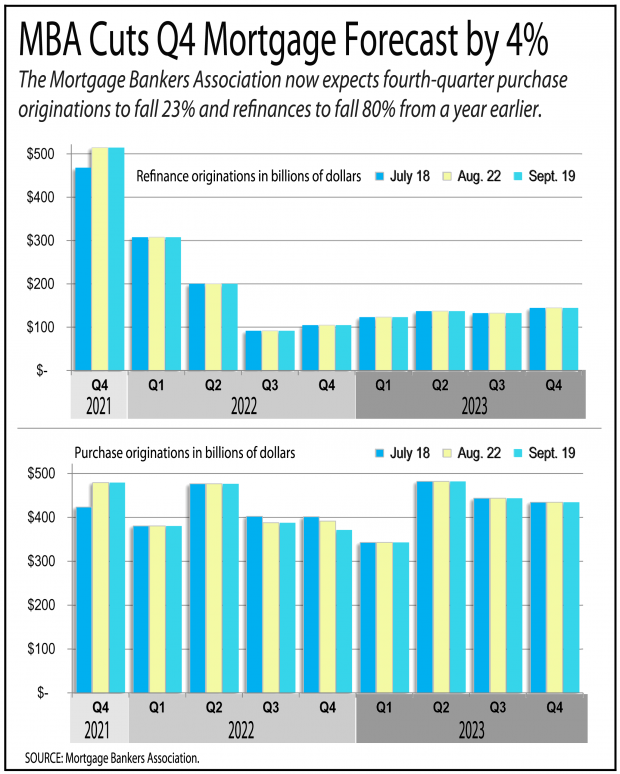
Mortgage Bankers Association reduces its fourth-quarter forecast for purchase mortgage originations.

Chart showing MBA cutting mortgage forecast

Mortgage rates started the week at their highest level in 20 years as the Mortgage Bankers Association continued to pare back expectations for mortgage originations this year.

Investopedia.com reported that the average rate for a 30-year fixed-rate purchase mortgage was 6.96% on Monday. Compared with average weekly data from Freddie Mac going back to 1971, it was the highest rate since it was 6.99% for the week ending April 12, 2002.

The Mortgage Bankers Association last week lowered its forecast for fourth-quarter purchase originations for the sixth month in a row. It said it now expects homebuyers will take out $372 billion in mortgages in the fourth quarter, down 23% from a year earlier and down 4% from the $388 billion it forecast for the third quarter.

The Sept. 19 forecast left refinances untouched. They are expected to be $105 billion in the fourth quarter, down 80% from a year earlier but up 14% from the $92 billion forecast for the third quarter.

For the year, purchase originations are expected to fall 13% to $1.62 trillion, while refinances fall 73% to $706 billion. Total originations are expected to fall 48% to $2.32 trillion in 2022.

In 2023, the MBA forecast total originations will fall about 3% to $2.24 trillion as purchases rise 5% to $1.70 trillion and refinances fall 24% to $540 billion.

Rates in the 7% neighborhood might feel high for those who started buying houses in the last 10 years but they are on the low side for the past 50 years, based on Freddie Mac data published by the St. Louis Fed.

For more than half of the 2,687 weeks from April 1971 through Sept. 22, the rate was at least 7.4%. The median was 9.1% from 1971 to 1999 and 4.8% from 2000 to the present.

Rates peaked at 18.63% for the week ending Oct. 9, 1981 when the Fed under Chair Paul Volcker was battling inflation that had started during the Vietnam war. Volker’s aggressive rate hikes sent the nation into a recession, but knocked back inflation.

The lowest rates from 1971 to 1999 were 6.49% for the week ending Oct. 9, 1998, when the nation was in an economic boom. The lowest over the past 51 years was 2.65% for the week ending Jan. 7, 2021 at the peak of the refinance boom that vanished as rates rose this year to tame inflation.

Monday, September 26, 2022

Economists Expect Downturn to Continue Well Into 2023

Experts believe "a brief and mild recession" will happen and "the U.S. economy should start to expand again toward the second half of 2023.”

Man looking downcast(Photo: Shutterstock)

Although there may be a light at the end of the tunnel late next year, economists expect the economic downturn to linger well into 2023.

“It is our expectation that we will continue to see inflation gradually slow over the course of 2022 and into 2023,” says Eric Lundh, principal U.S. economist for The Conference Board. “That being said, we do not expect the Fed to realize its 2% target even toward the end of next year. What this means in terms of monetary policy is that we will continue to the Fed’s fund rate increase close to 4% in early 2023 and hold there.”

Lundh and Dana Peterson, the organization’s chief economist, shared their insights during the Sep. 16 webinar “The Strangest Recession: Making Sense of the Economic Downturn.” The United States is far from alone in its economic challenges, Peterson says.

“We see several trends dominating the current economic environment and also the outlook for the next 12 to 18 months,” she says. “Certainly the pandemic is still a huge issue, particularly for China. It continues its dynamic zero-COVID policy, which results in shutdowns that disrupt not only commerce in China but supply chains abroad and causes higher inflation for many economies.

“We also have the war in Ukraine continuing to rage on. It’s continuing to disrupt production of key materials such as food, energy, metals, cooking oils and gases that are affecting prices not only in the region but globally.”

Other trends include supply chain disruptions; inflation; tightening of monetary policy by central banks; demographics and lingering pandemic effects buffeting labor markets. Peterson cites several risks that could contribute to weak global growth:

  • Escalation of war/geopolitics
  • Higher inflation
  • Monetary and fiscal policy mistakes
  • Recession
  • Shortages (labor, raw materials, etc.)
  • Industrial policies
  • Green economic policies

“We don’t call for a global recession, but there certainly is a risk that it could happen,” she says. “We do call for a recession in individual economies, including the United States and Europe. Ukraine and Russia already are in a recession. For China, we expect very low growth this year and below their pre-pandemic growth rate for next year.”

Like Lundh, she expects the U.S. recession to continue well into the new year.

“In the United States, we are expecting a recession, basically because the Fed is engaging in very restrictive monetary policy to tackle inflation and return key gauges back to the 2% inflation target,” Peterson says. “Our own forecast is for the Fed to raise the fund's rate to the range of 3.75% to 4%, with a midpoint of 3.78%. We think that will cause the United States to go into recession. We already are seeing a weakening in activity, certainly in housing and consumer spending. Consumers are shifting away from goods toward services, but we expect that services also will come under pressure.”

Lundh agrees.

“As interest rates continue to rise and inflation comes down but still is an issue for consumers, we are anticipating an environment where consumer spending continues to slow and contract,” he says. “Consumer spending is holding up more than a lot of people had expected, but we are concerned about the fourth quarter and the first quarter of next year.

“What we are envisioning at this point is a brief and mild recession. Once that period elapses, the U.S. economy should start to expand again toward the second half of 2023.”

Friday, September 23, 2022

Sno Falls CU Able to Quickly Replace ATMs, With Assist from Dolphin Debit

NORTH BEND, Wash.– Sno Falls Credit Union is reporting that when it needed an ATM upgrade in a hurry, it was able to do so thanks to an assist from  Dolphin Debit.

Sno Falls

According to the company, Sno Falls, which serves members in the Snoqualmie Valley east of Seattle, has been a Dolphin Debit client for seven years. Earlier this year it was alerted by the company that serves as the backend for Sno Falls’ deposits that all of its ATMs needed a security upgrade within months.

“If we didn’t get that done, we would lose the ability to take ATM deposits,” said Abbie Lankford, chief experience officer for Sno Falls. “We couldn’t have that.”

Because the ATMs that Dolphin Debit installed in 2015 were nearing their end of life anyway, the company said Sno Falls opted to go with all new ATMs.

“I was so impressed with the Dolphin Debit implementation team,” Lankford continued. “They were knowledgeable, compassionate, and they understood the impact on our business if they didn’t get it done. But they did get it done, right on time with no issues. We never expected it to go that smoothly.”

Dolphin Debit said the new ATMs are deposit ATMs that are both contactless-enabled and easily upgradable to interactive teller machines. Sno Falls, Lankford noted, is looking into moving to ITMs in order to better serve members beyond typical business hours.

Other ATM Locations

The new ATMs are located at the credit union’s branches, along with one in a historic downtown area of Snoqualmie that gets heavy use. Sno Falls has one cash dispensing-only ATM in a popular local food market as well.

“The real test of any company’s client service is when big challenges come up,” said Joe Woods, VP-business development for Dolphin Debit. “We passed that test with Sno Falls Credit Union, just as we have with so many other clients when they have had urgent needs.”

Existing Home Sales Decline in August; Down 20% Over 2021

 ARLINGTON, Va.—Existing home sales declined by 0.4% in August to a seasonally-adjusted annualized rate of 4.8 million units.

LongCurt

Curt Long

This represents a 19.9% decrease in sales compared to 2021.

“Existing home sales fell for the seventh straight month in August, but by the smallest amount of any month within that period,” said NAFCU Chief Economist and Vice President of Research Curt Long. 

The median existing home price declined by 2.4% in August to $389,500, which Long said is “in line with typical seasonal changes at the end of summer.”

“Inflation and Fed rate hikes have pushed mortgage rates to more than 6%, sidelining many potential buyers,” added Long. “However, supply remains extremely tight, which is supporting current price levels.”

A Quarter’s Worth of Supply

Based on current sales, there were 3.2 months of supply at the end of August. Analysts consider six months of inventory a rough balance between supply and demand.

 “In response to lower demand for homes, renters saw the largest monthly increase in prices since 1991 in August,” said Long. “Homes on the market sold in an average of 16 days last month, which was up 2 days from July, but still down from 17 days in August of 2021.”  

Sales fell in just one region of the U.S., the Midwest (-3.3%). Sales rose in the Northeast (1.6%), as well as in the West (1.1%). In the South, sales remained unchanged.

The Forecast

“NAFCU expects home sales to settle near the current, lower level over the near term as mortgage rates prevent improvement, but a strong labor market and resilient demand prevents further decline,” concluded Long.

NCUA Board Meeting Coverage: New Rules for Expelling Members Are Approved

 ALEXANDRIA, Va.–The NCUA board, meeting for the first time in-person at agency headquarters in 30 months—and with Vice Chairman Kyle Hauptman attending his first-ever in-person meeting—has approved new rules for expelling members from credit unions.

1

(L-R) Kyle Hauptman, Todd Harper, Rodney Hood

The new NCUA rules—technically Part 701, Appendix A, Federal Credit Union Bylaws, Member Expulsion—were outlined to the board by Rachel Ackmann, senior staff attorney in the Office of General Counsel.

The updated rules follow the March 15th passage by Congress of the Credit Union Governance Modernization Act, which required NCUA to develop a policy by which a federal credit union member may be expelled for cause by a two-thirds vote of a quorum of the federal credit union’s board of directors.

Under the prior rules as part of the Federal Credit Union Act and NCUA regulations, there were only two ways by which a credit union could expel a credit union member: by a two-thirds vote of the membership present at a special meeting called for that purpose, and only after the individual was provided an opportunity to be heard; and for non- participation in the affairs of the credit union, as specified in a policy adopted and enforced by the board.

As CUToday.info reported, the credit union trade groups had been pressing the agency and Congress for greater flexibility in expelling members in certain extreme circumstances, such as to adequately address threats of violent or aggressive behaviors of certain members.

‘Some Reservations’ Expressed

While he OK’d the new rules, NCUA Chairman Todd Harper said, “In moving forward today, I do have some reservations. While there are admittedly times in which the expulsion of a member is necessary to protect credit union members and staff, this is a power that credit unions should rarely use. It is, in my view, an extreme remedy that should be saved for egregious examples of member behavior.”

Harper said his reasoning is the FCU Act exists so "people, particularly those of modest means, can access safe, fair, and affordable financial services. That is the statutory mission of credit unions.  So, in acting today, we want to preserve this guiding principle.”

Harper credited Vice Chairman Kyle Hauptman with adding language to the preamble of the new rules that underscore the point CUs should remain focused on financial inclusion by growing their membership and services, not on financial exclusion by expelling members.

Hauptman: Not to be ‘Taken Lightly’

Hauptman called the prior expulsion procedures are so difficult they are impractical for most, if not all, credit unions.

“As an alternative to expulsion, back in 2019, the Bylaws Final Rule allowed the limitation of services to certain members. The final rule also stressed that FCUs are not prohibited from contacting law enforcement to deal with abusive or violent members,” said Hauptman. “While these seem reasonable and effective options, the credit unions told NCUA and Congress that they were not enough.

“While I agree that expulsion of a member – especially in a financial cooperative – should not be taken lightly, FCUs should be allowed every tool possible to protect the safety of staff and other members,” Hauptman continued. “I also agree the board does not want this rule used to deny financial access to individuals. But members who act in an egregious manner are the exception. An FCU should have the ability to deny such a member not only access to services, but also access to its branches and member meetings.

As financial cooperatives, credit unions have member owners, so the notion of expelling a member – as opposed refusing service to a customer – deserves thoughtful consideration from that perspective.”

Hood: I Have Heard the Stories

Hood said he supported the new rules, because he has heard from credit unions stories of members who display  violent and aggressive behaviors.

“Today’s proposed rulemaking notes that the NCUA board is focused on improving access to financial services, in part, through its Advancing Communities through Credit, Education, Stability and Support (ACCESS) initiative,” said Hood. “As part of this initiative, the NCUA is working to expand the availability of credit to stimulate economic growth and improve the financial well-being of all Americans. The rule makes it clear that the board believes that the expulsion of members is an extreme remedy that may have the effect of denying individuals access to financial services so the authority under the Governance Modernization Act and codified in today’s proposed rule should be rare and should be reserved for extremely egregious behavior.”

The Rise of Passive Aggressive Firing and Quitting


Jose Triana  September 22, 2022 SideCar

Just when we thought we were turning the corner on the Great Resignation and a hiring and retention crisis, there’s a new term to worry about – quiet quitting. While not an entirely new phenomenon, quiet quitting is quickly gaining in popularity as professionals share their experiences on social media and shifting mindsets around work continue to evolve in a post-pandemic world. 

So, is this a problem associations should be considering, and how can organizations get proactive about addressing these concerns?

What Is Quiet Quitting?

Not every day at work is going to be the best, and maybe on those tough days, you check out a bit, do the bare minimum and live to fight tomorrow. However, for some professionals, this has become the everyday norm. But that isn’t the only problem. While most definitions of quiet quitting often harp on the fact that staffers are doing the bare minimum, it usually has to do more with engagement at work. 

According to a Gallup Study, in today’s workplace, around 50% of workers are not engaged at work, and an additional 18% are actively disengaged – meaning the ones you see on social media putting an active voice to their dissatisfaction – and that trend is growing. 

But where did it come from?

To say the last few years of work have been challenging is an understatement. However, quiet quitting likely is the culmination of two primary factors – the end of hustle culture and work’s encroachment on our home life. 

Related: Is The Traditional Work Day Broken?
Learn More >

So what happens when professionals everywhere realize that maybe obscenely long hours, loss of work-life balance and a general disassociation with mental health are likely not the best thing for us?

Cue quiet quitting. 

Signals From Your Team

For associations, quickly spotting and addressing quiet quitting is critical as it impacts not only the growth and success of the organization but also your members as a byproduct. Luckily, like most performance-related issues at work, there are some signals to look out for.

  • Disengaging from work – They’re not taking on new projects, stop contributing at meetings or simply seem disinterested in the work. 
  • Constant negativity – They make outward comments about their work or constantly critique coworkers, vendors or members. 
  • Productivity drop –They miss deadlines or it seems that coworkers increasingly have to pick up the slack. 
  • Separation – They’ve stopped participating in meetings, rarely engage coworkers and never go to community-building activities. 

One important note is that many of the symptoms of quiet quitting can also stem from burnout. Of course, if you’ve addressed these issues and the behavior continues – there’s a bigger problem. This is why open communication and support are essential. 

Related: Everything You Need to Know About Combating Burnout
Learn More >

Are Leaders Doing the Same?

Of course, quiet quitting isn't the only thing coming down the passive-aggressive pipeline for organizations. We’ve previously talked about how damaging jerk bosses can be. Whether they’re micromanaging their team or purposefully keeping them in the dark about happenings in your organization – it culminates in the opposite side of the coin – quiet firing. 

But not all bosses realize they’re to blame. In a study by Harvard Business Review researchers, they surveyed workers on how they felt about their boss or manager, including their ability to “Balance getting results with a concern for others’ needs.”

Of that group, staffers who felt their boss was highly effective at balancing results and their staff’s wellbeing were 62% more willing to give extra effort, with only 3% quiet quitting. Managers struggling in that department only had 20% of staffers willing to give extra effort, with 14% quiet quitting. 

What Quiet Firing Looks Like

However, it’s not just about a leader struggling to inspire and care for their direct reports. In some instances, toxic leaders can take an active approach in pushing staff towards quiet quitting, with behavior including:

  • Isolating a particular staffer from the rest of the team.
  • Cutting down on the amount of work a staffer gets (to drive disinterest).
  • Adding an unmanageable amount of work or challenging projects (to cause burnout).
  • Purposefully excluding staffers from major projects or initiatives. 
  • Poor performance reviews with little to no feedback. 
  • Actively preventing staffers from pursuing professional development or growth. 

Curbing The Rise of Unengaged Leaders & Staff

When it comes down to it, whether it’s staffers “quiet quitting” or bad leaders forcing folks out, the real problem is a disengaged workforce. As associations, mission is already a driving force as to why professionals join your ranks, but that doesn't mean it's the reason they’ll stay. 

Often, when leaders look for ways to fix the problem, their focus is misguided – opting for things like hollow office perks that don’t address the issue. Your staff’s priorities are changing, and they want more from their work – more purpose, more balance and more growth. So how do you move the needle? 

  • Create and Reinforce Purpose – Your association has a mission, but what does that mean for your staff? Professionals are looking for ways to make an impact and find fulfillment in their work, so be sure that the organization's mission resonates with them. 
  • Empower Your Staff – Staff want to feel that they’re growing in a role. Not only should you be providing opportunities for professional development – think conferences and online learning – but you should also have a clear roadmap of how they can move up within the organization. 
  • Train Leaders – Your leaders play a significant role in keeping staff actively engaged. And while some professionals are great right off the bat, the vast majority need training. Not only should they understand the intangibles of leading a team, but emotional intelligence and communication training should be a top priority.  
  • Build Boundaries – The days of bragging about 80+ hour work weeks are over. However, as many associations continue with remote work, the responsibility falls on the workplace and leaders to ensure your team is respectful of each other’s boundaries. From scheduling emails and messages only during work hours to actively encouraging vacation for staff, it starts with you. 

Quiet quitting or firing won't be the last trend to impact the workplace as professionals continue to change how they experience work and what they look for in an organization. By understanding the underlying problems and implementing these changes, your association can look to boost retention while doing what matters most – moving your mission forward.

Wednesday, September 21, 2022

The Fed raised its key short-term rate by three-quarters of a percentage point to a range of 3% to 3.25%

Paul Davidson, USA TODAY
·4 min read

WASHINGTON--The Federal Reserve barreled ahead with a third straight outsize interest rate hike Wednesday in an effort to squash high inflation but economists worry the campaign is increasingly risking a recession by next year.

The Fed raised its key short-term rate by three-quarters of a percentage point to a range of 3% to 3.25%, a higher-than-normal level designed to ease inflation by slowing the economy. It also significantly bumped up its forecast for what that rate will be at the end of both this year and 2023.

Fed officials now predict the key rate will end 2022 at a range of 4.25% to 4.5%, a full percentage point above the 3.25% to 3.5% they projected in June, and close out next year at 4.5% to 4.75%, according to their median estimate. That suggests the central bank could approve another three-quarters point hike at its November meeting and then a half-point rate rise in December.

But within the next year or two, as higher rates restrict economic activity, Fed policymakers expect growth to weaken substantially. The central bank expects to cut the fed funds rate by about three-quarters of a point in 2024, presumably in response to a slowing economy or possibly a recession.

The economy is already pulling back. In a statement after a two-day meeting, he Fed said, “Recent indicators point to modest growth in spending and production” but “job gains have been robust….and the unemployment rate has remained low.”

It added it “anticipates that ongoing increases” in the fed funds rate “will be appropriate.”

Wednesday’s rate increase is expected to reverberate through the economy, driving up rates for credit cards, home equity line of credit and other loans. Fixed, 30-year mortgage rates have jumped above 6% from 3.22% early this year. At the same time, households, especially seniors, are finally reaping higher bank savings yields after years of piddling returns.

Barclays says Fed policymakers had little choice but to lift rates sharply again after a report last week revealed that inflation – as measured by the consumer price index (CPI) -- rose 8.3% annually in August, below June’s 40-year high of 9.1% but above the 8% expected.

Also, employers added a healthy 315,000 jobs in August and average hourly pay increased a hefty 5.2% annually. That could fuel further price increases as companies struggle to maintain profit margins.

Markets that try to predict where rates are headed figured there was an 18% chance Fed policymakers would hoist rates by a full percentage point Wednesday.

But Goldman Sachs economist David Mericle says little has changed since Fed Chair Jerome Powell told reporters in late July that the pace of rate hikes probably would slow to account for the increased risk of recession. Rather, he says, the Fed is partly trying to deliver a message to stock markets that until recently had grown complacent about the prospect of more rate increases.

Growth is slowing as the Fed pushes borrowing costs higher. The Fed said Wednesday it expects the economy to grow just 0.2% this year and 1.2% in 2023, below its June estimate of 1.7% for both years, according to officials’ median estimate.

It predicts the 3.7% unemployment will rise to 4.4% by the end of next year, well above its prior forecast of 3.9%.

And the Fed’s preferred measure of annual inflation – which is different than the CPI – is expected to decline from 6.3% in August to 5.4% by the end of the year, slightly above Fed officials’ previous 5.2% forecast, and 2.8% by the end of 2023. That would be moderately above the Fed’s 2% target.

Even without big Fed rate increases, inflation is expected to slow as supply chain bottlenecks ease, commodity prices fall, a strong dollar lowers import costs and retailers offer big discounts to thin bloated inventories. Powell, though, has said it’s critical that the Fed raise rates to tamp down consumers’ inflation expectations, which can affect actual price increases.

A growing number of economists believe the Fed’s aggressive campaign – its key rate began 2022 near zero -- will tip the economy into recession. Economists says there’s a 54% chance of a downturn next year, up from 39% odds in June, according to a survey by Wolters Kluwer Blue Chip Economic Indicators.

For months, Fed Chair Jerome Powell said he thought the central bank could tame inflation without sparking a recession. But in a speech last month at the Fed’s annual conference in Jackson Hole, Wyoming, he acknowledged that higher rates and slower growth “will also bring some pain to households and businesses. These are the unfortunate costs of reducing inflation.”

New Tool Seeks to Offer Better Insights into Range, Value of Electric Vehicles

LAWRENCEVILLE, Ga.—With electric cars (EVs) growing in acceptance and sales, a new tool is available to help consumers and lenders better understand the range (mileage capability on one charge)—and value—of each EV model.

Electric Vehicles

Black Book reported that it is integrating its VIN-specific data into a valuation tool built on Recurrent’s new Range Score.

“Range Score makes it easier to understand expected range in a used EV by comparing a car’s current expected range to what was normal when new, which often differs from its EPA-rated range,” stated Black Book. 
Added Jared Kalfus, president of Black Book, “By combining our vehicle valuation data with Recurrent’s battery health data, consumers and dealers alike can access first-of-its-kind insight into the precise valuation of a used electric vehicle. We are thrilled to have been selected to power this tool.”

Additional Detail
More than 50 dealerships have added Recurrent’s Range Scores to their used EV inventory. More detailed used EV reports, called Recurrent Reports, are also available to share information on battery warranties, expected range in different conditions, and how range is projected to change after three years of ownership, according to the company.

Early results indicate that vehicles with Recurrent Reports can sell for thousands of dollars more than those without, and create a much better buyer experience by setting the right expectations around range, Black Book said.

‘Adding Transparency’
“For EV owners who are looking to sell, Recurrent will share their Range Score with dealerships and organize the offers so it is easy to compare and select a buyer,” Black Book said. “Black Book’s vehicle valuation is combined with Recurrent’s new Range Score value, which uses modeling from 100-million recorded EV miles to make value adjustments for good batteries. The new partnership is a step toward adding transparency to a rapidly growing used EV market that includes more than 2.5 million vehicles in the U.S.”

Initially eligible vehicle models include Chevrolet Bolt, Chevrolet Volt, Nissan LEAF, Tesla Model 3, Tesla Model S, Tesla Model X and Tesla Model Y.

Tuesday, September 20, 2022

The Retention Reset: How to Win Back Your Employees

We’re all experiencing it. Longer phone hold times with customer service support, less prompt service at restaurants, reduced flight options when booking a trip for Labor Day weekend, and longer wait times in doctors’ offices. Some would consider COVID-19 to be a primary reason that businesses may be struggling. That may have been the case two years ago, but now there is a new obstacle that companies across the U.S. are dealing with. Employee retention rates are at an all-time low, and if things do not change, those rates will continue to decline. It’s easy for business owners to blame COVID-19 for this issue, but the truth is that employee retention is down due to employers. Harvard Business Review states that, while the pandemic may have spurred the mass exit from the workforce, there were several underlying issues that played a role in this exodus.

If companies can own their part in this issue, then not all hope is lost. It’s time to take a fresh look at how your programs, communications, benefits and culture are impacting your ability to retain your team — it’s time for a ‘retention reset’.  We find that many companies are keenly focused on attracting new talent into their organization, but what about the people you already have? Like Zig Ziglar famously says, “everyone is in sales,” businesses must take the same approach with their team. We must always be in the business of winning over our employees.  For this reset to be successful, businesses need to reevaluate. There are five areas that employers need to improve upon to see a rise in their employee retention rates – Compensation, Benefits, Learning & Development, Culture, and Flexibility.

As reported by Pew Research Center, 37% of people who left their jobs in 2021 state that the main reason was inadequate wages. With the ongoing pandemic and high inflation rates, employees have had to leave their current jobs to find new opportunities just to make ends meet or maintain their current lifestyle. While wages are extremely important, it is not the sole driver of retaining talent. Building an employee value proposition (EVP) that is authentic and visible allows organizations to remain competitive.

According to research from Gartner, companies that can successfully implement their EVP can lower annual employee turnover by around 70%. Employee benefits play a crucial role in having an effective EVP. Employees are looking for more personal, individualized benefits from their employers. They are no longer interested in the regular benefits that every company offers. One way to customize benefits is by giving employees an ‘allowance’ to spend on whichever specific benefit they want. For example, an employee may want to allocate more money towards childcare benefits versus dental coverage, and with an allowance, they will have the discretion to do so.

Another way to boost employee retention is by showing employees that they are truly valued. According to Inc., employees are no longer loyal to their jobs because they don’t feel valued or heard at their company. It speaks volumes when employers focus on career growth and development. Businesses should be offering their employees multiple opportunities to grow within the company. Otherwise, they may look elsewhere to further their careers if they feel like there is no growth potential.

Offering room for growth is one sign of a healthy company culture, which is an integral part of running a successful business. If the company culture is toxic, you can guarantee that your employees will not stay long. A recent survey conducted at Pew Research Center finds that 57% of people left their job because they felt disrespected at their workplace. Companies must make a shift and focus on creating a culture of caring.

The final piece of this puzzle is flexibility. Throughout the pandemic, many companies realized how productive their employees can be while working from home; however, if companies want to provide a true work-life balance, they must offer flexible working hours. Pew Research Center discovered that 24% of ex-employees blamed the lack of flexibility in their working hours as the main reason for leaving their job. If employers consider the importance of hybrid work and offer true flexibility, employees will recognize and appreciate it.

When companies start reevaluating their staffing model, their employee retention rate will significantly increase. While retention feels uncertain now, this reset will effectively give employers the tools needed to win back their employees and regain a sense of loyalty and confidence in the workplace.

Shelley McLean, Principal, OneDigital

Saturday, September 17, 2022

What are workers thinking in 2022? By Sarah Miller, Ashley Putnam

By Sarah Miller, Ashley Putnam

From Philadelphia to Atlanta to Portland, communities rallied behind workers who couldn’t shift to remote work at the beginning of the COVID-19 pandemic. When 7 pm came around, neighbors stood on their front steps and leaned out windows to applaud health care workers. Handwritten signs supporting grocers, farmers, and first responders decorated windows and lawns. Drivers found snacks and thank-you notes on porches as thanks for delivering packages safely. Workers who could not work from home even got a new name: Essential.

As the pandemic marched on, life resumed some measures of normalcy. You may find yourself eating inside restaurants or shopping more frequently in stores. Once again, more of us are traveling to see family or friends, or to get away for a long-delayed vacation. You might also notice that fewer workers seem to be doing those “essential” jobs we celebrated not too long ago.

More jobs than jobseekers

The question everyone is asking is: Where are all the workers?

Understanding the labor market is one of the most important things we do at the Fed. It reflects part of our dual mandate of price stability and maximum employment. So, we started having conversations about this situation with colleagues. We know that businesses are struggling to find and retain workers. It’s a sentiment echoed in the Fed’s Small Business Credit Survey, for example. We wondered why so many people are hesitant to return to work. What happened during the pandemic to prompt so many people to quit their jobs and look for new ones?

Typically, when the Fed wants to understand what’s going on in the economy, we look to data and we talk to people. We survey consumers and owners of small businesses. Our outreach teams connect with members of our communities to learn firsthand how they are experiencing the economy. For instance, they consult with members of the Fed’s advisory councils and talk to workforce development and staffing agencies, and local leaders, business owners, and bankers. They may also hold listening sessions. These activities are happening regularly, but they only tell us part of the story.

We need to include workers in these conversations, too.

Listening to workers themselves

This year Federal Reserve Banks across the country are hosting 20 virtual focus groups to hear firsthand from workers who are in, or have recently left, high-turnover jobs. We’re calling it the Worker Voices Project. It’s an opportunity to hear directly from workers at a time when our country is going through big changes in how we think about work. Once the focus groups are concluded, we will publish a report with our findings and more details. In the meantime, we can tell you about our approach and some preliminary things we’re learning.

Everyone participating in the focus groups meets at least one of the following qualifications. They have

  • Recently looked for work
  • Shifted where and how they work
  • Participated in a workforce or training program recently

For these conversations, we’re focusing on workers who do not have a four-year college degree so we can understand their unique experiences as they tend to occupy some of those jobs we previously called “essential”. The stories they are sharing reveal some distinct themes about workers in 2022.

Prioritizing careers over ‘just a job’

Our focus groups confirm that work changed for these workers too. Many have articulated that the pandemic caused them to think about their priorities, their career paths, and how they are treated at work. Almost all of them said that the pandemic changed the way they think about what they want out of a job and how they spend their time away from their families and personal lives. Overwhelmingly, they are looking for a fulfilling and meaningful career, not just a job.

That said, they still face barriers such as

  • Lack of affordable childcare
  • High costs of commuting
  • Skills mismatches
  • Finding work that pays enough to make ends meet

The value of workers being heard

One clear thing has emerged: People want to work. What that looks like, however, has shifted.

Workers are telling us that they’re looking for more than a temporary influx of cash. They want jobs that provide both stability and mobility. They may not want to work where they were working before. Feeling valued by their employers is important. And they want to be heard.

Focus group participants have told us how meaningful it is to be able to share their voices and experiences. They will certainly help us have a more well-rounded view of what’s going on in the labor market. We have a number of focus groups yet to conduct. At the same time, research continues into other factors related to workers’ experiences.

We are no longer talking about workers without workers.

Workers. Job seekers. Career changers. They are all essential parts of our economy and we look forward to sharing some of their perspectives with you.

Sarah Miller is a senior adviser for community and economic development within the Atlanta Fed’s Center for Workforce and Economic Opportunity. 


New IRS Auto Loan Reporting Rule Creates Major Compliance Challenge for Credit Unions

Credit unions that make auto loans need to begin preparing now for a significant new IRS reporting requirement that could create an especial...