
Hood: Credit unions are safe and sound

Hood’s term on the NCUA Board will expire in August. 
2023_FCC_Hood_1200
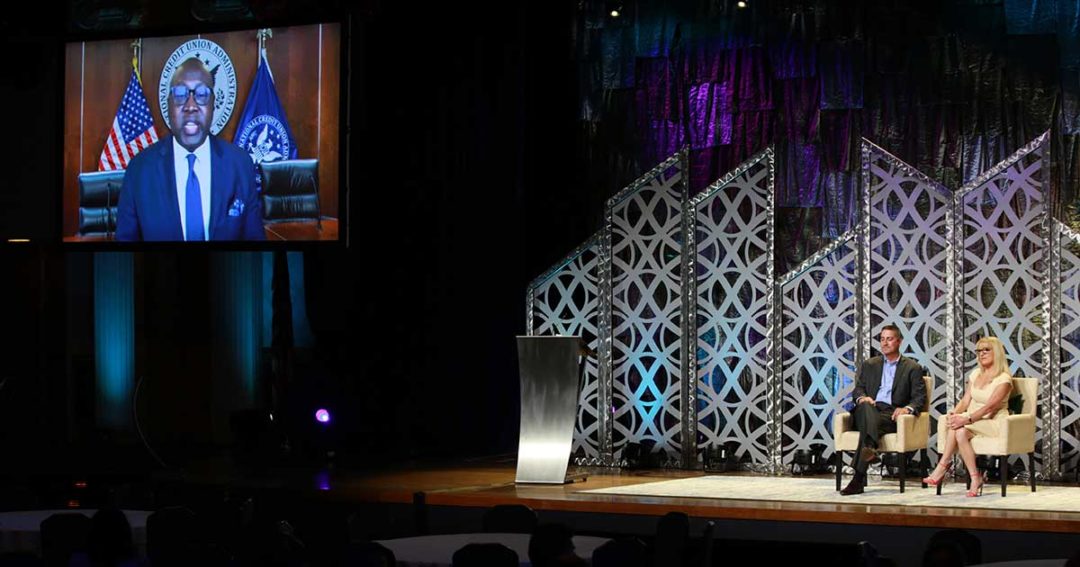
NCUA Board Member Rodney Hood appeared via live stream with Brad Barnes, Air Academy Credit Union, and Amy McGraw, Tropical Financial Credit Union.

The regulator lauds strong membership, asset, and loan growth.

Despite recent headwinds, including high-profile bank failures, the credit union movement is still safe and sound, says Rodney Hood, NCUA board member, and immediate past chairman.

“We’re not seeing the contagion like at other financial institutions,” says Hood, who addressed the 2023 CUNA Finance Council Conference Monday via live stream.

The Silicon Valley Bank (SVB) crisis was one of confidence, he says. Ninety percent of SVB’s deposits were uninsured. In comparison, more than 91% of credit union deposits are insured.

“We don’t have those entanglements,” Hood says. “That bodes well for our future.” 

He lauded America’s 4,800 credit unions for growing membership to 135 million, assets to $2.2 trillion, and loans to $1.5 trillion.

“You’re making loans safely and soundly, with low delinquency and charge-offs,” Hood says.

He cited several areas of focus for NCUA:

  • Balance sheet management. The agency will examine credit unions’ duration risk and efforts to mitigate liquidity and interest-rate risk.

“We’ll be risk-focused and principles-based,” Hood says. “Expect to hear more from us about balance sheet management.”

  • The London Interbank Offered Rate (LIBOR) transition. LIBOR is a key benchmark for setting interest rates for adjustable-rate mortgages, corporate debt, private student loans, and other types of loans. Although many credit unions use U.S. Treasury indices, NCUA examiners will require credit unions to identify any LIBOR exposures and provide a plan to transition to alternative reference rates.

“You can use whatever index makes sense to you,” Hood says.

  • Liquidity risk. Many credit unions have loan-to-share ratios that exceed 80%. Hood stressed the need for credit unions to build a relationship with a Federal Home Loan Bank and the Central Liquidity Facility to ensure proper levels of liquidity.
  • Current expected credit losses (CECL). Hood opposed the implementation of CECL, calling it “a solution in search of a problem.” The agency allowed credit unions to phase in CECL over three years.

“While we have inflation, geopolitical pressures, and banking sector contagion, we’re staying vigilant,” he says. “We want to give you the flexibility you need to serve members and remain vibrant.” 

Hood’s term on the NCUA Board will expire in August. 

Comments

Popular posts from this blog

New Podcast Series -3 Succession Planning Podcasts

https://www.ncofcu.org/podcast Join/Upgrade Check out some of NCOFCU's additional features: First Responder Credit Union Academy Financial Literacy Podcasts YouTube Mini's Blog Job Board

Federal Reserve Board announces pricing, effective January 1, 2026

  December 04, 2025 Federal Reserve Board announces pricing, effective January 1, 2026, for payment services the Federal Reserve Banks provide to banks and credit unions For release at 5:00 p.m. EST Share The Federal Reserve Board on Thursday announced pricing, effective January 1, 2026, for payment services the Federal Reserve Banks provide to banks and credit unions, such as the clearing of checks, automated clearing house (ACH) transactions, instant payments, and wholesale payment and settlement services. By law, the Federal Reserve must establish fees to recover the costs, including imputed costs, of providing payment services over the long run. The Federal Reserve expects to recover 108 percent of actual and imputed expenses in 2026, including the return on equity that would have been earned if a private-sector firm provided the services. Overall, price changes for 2026 will result in an estimated 0.9 percent average price increase for established, mature services. The entire ...

Loan Growth Part 3

MADISON, Wis.–Credit union loan balances rose 1.1% in February, faster than the 0.2% reported in February 2021, even as membership growth slowed significantly during the first two months of 2022, according to data released as part of CUNA Mutual’s April Trends Report. The Report, which is based on data through February, showed overall loan growth was 9.6% during the last 12 months. What is actually happening below the surface? According to the Trends Report, consistent with the trend line the analysis shows large credit unions reported significantly faster loan growth in 2021 as compared to smaller credit unions. Credit unions with assets greater than $1 billion reported loan growth of 8.4% compared to credit unions with assets less than $20 million, reporting loan growth of 0.9%. Here's a look at how credit unions performed by category, according to the newest Trends Report” ...

Credit Union Profits Climb 21% As Margins Widen, NCUA Reports

  If you don't read anything else, read this:  Performance By Asset Category WASHINGTON—Federally insured credit unions posted a sharp rebound in profitability through the third quarter of 2025, with net income up 21% year over year to an annualized $19.1 billion, according to new NCUA data. The increase—one of the strongest gains across the agency’s quarterly metrics—came as institutions benefited from rising interest income, wider net interest margins, and relatively stable credit costs. The NCUA reported that Q3 data show interest income climbed 7.6% over the period while the systemwide net interest margin expanded nearly 13%, helping credit unions absorb higher operating expenses and modest increases in loan-loss provisioning. The earnings surge outpaced the credit union system’s 3.7% asset growth and came amid a mixed lending environment in which residential mortgage balances rose sharply, but auto lending weakened. The industry’s aggregate net worth ratio also im...

Housing Forecast 2026: Mortgage Rates Remain Above 6%, but Affordability Improves Modestly

  Mortgage rates will continue to average above 6% next year, but affordability will improve modestly as the typical monthly payment falls below 30% of a household's income for the first time since 2022, the  Realtor.com®  economic research team predicts in its  2026 housing forecast . The forecast predicts  mortgage rates  will average 6.3% across 2026, a slight improvement from the 6.6% full-year average expected for 2025, but still well above the 4% historic average recorded from 2013 to 2019. Nationally, home prices will continue to grow 2.2% through the end of next year, after rising by 2% in 2025, the forecast indicates. However,  incomes  and overall inflation are expected to continue rising faster than growth in home prices, delivering a slight boost to affordability. Read the complete story and review graphs;  HERE    _______________________________________ Join/Upgrade Check out some of NCOFCU's additional features: First ...

Not Your Mother’s Credit Union

“Stablecoins aren’t a speculative play. They’re the next evolution of payments — and a chance for credit unions to lead, not lag. It starts with connecting members to DLT rails - the digital wallet. Without that, nothing else can happen. It’s just a new payment rail - embrace it or lose the relationship. It’s that simple.” While ‘ stablecoins ’ were the prevailing buzzword across Money20/20 this year, the credit union industry had a significant presence. Small financial institutions have staked a place in the future of payments. Credit unions  received a significant boost this summer with the enactment of the stablecoin bill into law. The Guiding and Establishing National Innovation for U.S. Stablecoins Act authorizes subsidiaries of federally insured credit unions, such as credit union service organizations, to become issuers. Not Your Mother’s Credit Union A Money20/20  fireside chat  with the regulator for credit unions that I moderated focused on the rulemaking task a...

Banking During and After COVID-19

Before COVID-19, the banking industry was experiencing an unprecedented period of growth and prosperity. Despite increasing consumer expectations and increased competition from non-traditional financial institutions, most banks and credit unions were stronger than at any period since the financial crisis of 2008. In a matter of only a few weeks, the world of banking has experienced a level of disruption that will change everything that had been the norm in financial services. There has not only been a major change in the way financial institutions conduct business but in the way, employees do their work and the way consumers manage their finances. Banks and credit unions must use this time of disruption to consider reinventing themselves from the inside out. It is a time when we need to better understand the way consumers expect their financial institution to support their financial needs. This includes the way banks and credit unions use data, AI, technology and human resources t...

Two Members of FOMC Indicate December Rate Cut Not a Sure Thing

  WASHINGTON–Two members of the Fed’s Open Market Committee have indicated they are in no hurry to further cut rates, despite market expectations. “I’m not decided going into the December meeting” and “my threshold for cutting is a little bit higher than it was at the last two meetings,” Federal Reserve Bank of Chicago President Austan Goolsbee said in a Yahoo Finance interview. “I am nervous about the inflation side of the ledger, where you’ve seen inflation above the target for four and a half years, and it’s trending the wrong way.” Goolsbee was interviewed after last week’s Federal Open Market Committee meeting that saw policymakers cut their interest rate target by a quarter percentage point, to between 3.75% and 4%, as officials sought to offset rising risks to the job market while still keeping interest rates in a position where they’ll help lower inflation pressures, noted Yahoo Finance. As the report also noted, Fed Chair Jerome Powell cautioned last week that “a further r...

CUs Encouraged to Promote Automatic Savings Plans

America Saves Week and Military Saves Week kick off this weekend. The week-long, national campaigns will begin Feb. 19 with events that aim to unite government, nonprofit and corporate groups to encourage individuals and families to save and build personal wealth. This year’s campaign theme – “Set Goals, Make a Plan, Save Automatically” – promotes the need for families to get aggressive with automatic savings.****READ MORE: CUs Encouraged to Promote Automatic Savings Plans :