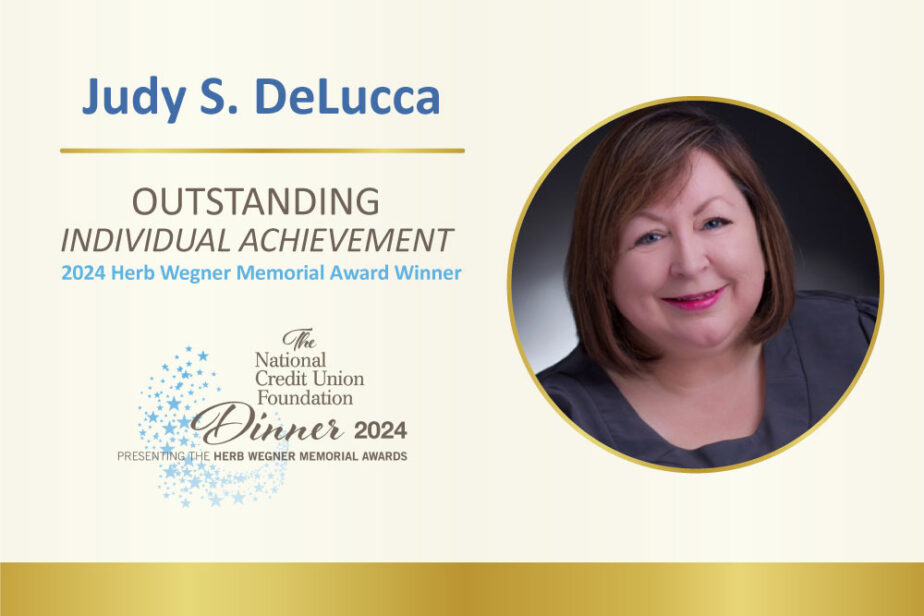
Judy DeLucca: 2024 Herb Wegner Memorial Award Winner

Judy DeLucca Outstanding Individual Achievement Award Winner

For more than 40 years, Judy DeLucca has been moving people forward toward their goals. From the dedicated staff of New Orleans Firefighter’s Federal Credit Union (NOFFCU) who thrive under her leadership to the partners she’s connected to help combat predatory lending, to the members of the credit union and community who struggle to find their financial footing, Judy and her team have been there to answer the call. 

Judy’s core belief in financial inclusion for all hasn’t just inspired the people around her. It has been a catalyst for initiatives that are improving lives in Louisiana and Mississippi every single day.

As the CEO of a Community Development Financial Institution (CDFI), she has paved the way for more than 50% of the credit union staff to become Certified Credit Union Financial Counselors and the formation of a Financial Inclusion Team. The one-on-one counseling and innovative solutions they provide make all the difference in their members feeling seen, heard, and supported in their financial goals.

In the words of Captain Clinton deArmas Sr., a member of NOFFCU, “Ms. Judy plays a huge role in how employees handle themselves with their members, and also cares on how her employees are treated. It’s all a big family. That’s what separates NOFFCU from any other Credit Union and/or Bank.”

Judy has also tirelessly advocated for the underserved outside the credit union’s walls. When she and other leaders were unable to persuade the Louisiana legislature to impose a mandatory cap on payday lending, she and other partners formed the Faith Fund, a a501c3 non-profit to help families manage their money, escape predatory lending, and achieve financial stability. Since the Faith Fund’s founding, it has saved Louisiana families an estimated $13.7 Million that would have been spent on payday loan fees and interest.

When disaster has threatened NOFFCU and its members, Judy’s compassion for people and expertise in disaster preparedness have shown. Hurricane Katrina displaced more than one-third of credit union employees and thousands of members. Not only did Judy lead the effort to convert branches into living quarters with washers, dryers, and stoves, but she also helped employees find hotels in Texas and set them up to work remotely so they could continue to support the many members who had also been forced out of their homes. She also worked with the Cornerstone League to ensure that members could have access to their money even through power failures and core system outages.

Determined to provide members with the right resources at the right times, Judy mobilized NOFFCU’s “Financial First Responders.” This cross-departmental team was well prepared to help members navigate difficult times like Hurricane Ida, the COVID-19 Pandemic, and the financial impact they bring.

“Throughout the unprecedented situations over the past two years, Judy has ensured that all the communities would have the resources they need to weather the financial burdens that were yet to be determined.”, says Amy Rodriguez, NOFFCU Chief Experience officer.

Throughout her career in the credit union industry, Judy DeLucca has been a leader who cares deeply about reaching people from all walks of life, showing them compassion, and helping to lead them toward financial independence. She’s been recognized with local, state, and national accolades for her work, and it pleases us immensely to honor her this year with the Herb Wegner Memorial Award for Outstanding Individual Achievement.

Visit https://www.ncuf.coop/foundationdinner to learn more about the Herb Wegner Award winners and register to attend the Foundation Dinner.

Comments

Popular posts from this blog

Ramp Up Cyber Spending As AI Reshapes Industry Priorities

NEW YORK—Artificial intelligence is rapidly becoming the defining force shaping banking strategy, with 80% of banking executives now expecting AI to significantly disrupt their business and operating models within the next three to five years, according to KPMG's 2026 Banking Technology Survey. The survey of 200 U.S. banking executives found institutions are responding by accelerating investments in cybersecurity, payments modernization and technology-driven acquisitions. "AI, payments modernization, cybersecurity, and tech-driven M&A are no longer separate agendas," said Peter Torrente, KPMG's U.S. Banking Sector Leader, who said banks are increasingly being challenged to keep pace across technology, risk and growth simultaneously. Cybersecurity remains a top concern. More than three-quarters (76%) of banking leaders reported an increase in cyberattacks over the past year, while 92% said they are boosting cybersecurity budgets. In addition, 84% are increasing cyb...

White Paper from WOCCU Examines How Stablecoins are Reshaping Financial Infrastructure

WASHINGTON– World Council of Credit Unions (WOCCU) has released a new white paper that examines how stablecoins are reshaping the financial infrastructure that credit unions and other cooperative financial institutions rely on to serve their members.  According to WOCCU, the white paper, How Digital Money Is Impacting Credit Unions, Part 1: Focus on Stablecoins , is the first in a planned three-part series exploring how emerging forms of digital money are affecting the global credit union movement.  “The report begins by noting that stablecoins are no longer a niche fintech development, but part of a broader structural shift in how money is stored, moved and regulated,” WOCCU explained. “As commercial banks, payment networks, technology firms and retailers build stablecoin offerings or integrate stablecoin rails into their platforms, credit unions must consider how these changes could affect deposits, payments, member relationships and long-term institutional relevance.” For ...

Half of Credit Union & Bank CEOs are Now Older Than 65, Up From 20% Two Decades

NEW YORK — At a time when there are some generational changes in credit union leadership taking place, a new analysis has found the nation’s bank CEOs are getting older, with half of the chief executives leading banks now older than 65, compared with fewer than 20% two decades ago. The KBW Bank Index from Truist Securities found that the median age of bank CEOs has increased by 10 years since the early 2000s, mirroring a broader aging trend among corporate leaders across the United States. However, bank executives remain older on average than their counterparts in many other industries, according to the analysis by Truist Securities Managing Director John McDonald and associates Peter Nicolo and John Manahan. One reason is tenure. Bank CEOs typically remain in their positions longer than executives in many other sectors. According to data from CristKolder Associates cited in the report, financial-services CEOs average nine years in the role, compared with 5.4 years in the energy secto...

What Credit Unions Can—And Can't—Do With New Trump Accounts

07/02/2026 09:36 am         WASHINGTON--With Trump Accounts set to officially launch July 4, America’s Credit Unions updated its frequently asked questions document to clarify the role of credit unions now and in the future. Credit unions do not have a role to play yet, as the Treasury has not announced steps to transition accounts from initial provider BNY Mellon to other authorized institutions, ACU noted. Trump Accounts are tax-deferred accounts that can be established on behalf of a child under the age of 18. Account contributions begin after July 4, with contributions up to $5,000 a year allowed. Created by H.R. 1, the law also established a pilot program to deposit a one-time $1,000 grant into accounts of children born between Jan. 1, 2025 and Dec. 31, 2028. Once the child turns 18, the account funds are available for educational expenses, home ownership, entrepreneurship, and other designated purposes. Once guidance is available from Treasury, credit unions ...

Invest in Education - Invest in Tomorrow


Sunday Reading - We Hold These Truths to Be Self-Evident

We Hold These Truths to Be Self-Evident .  The Declaration of Independence is the founding document that formally announced the American Colonies' break from British rule. Adopted on July 4, 1776, it laid the philosophical and moral foundation for American self-governance, asserting that individuals possess inherent rights and that governments must be accountable to the people. While it didn't create a government or legal framework, the Declaration marked the birth of the United States as a sovereign nation. >  Hear why the Continental Congress decided to declare independence, how the text took shape...

Without President’s Signature, ROAD to Housing Act Becomes Law; Includes CU Board Modernization Act

WASHINGTON — The bipartisan 21st Century ROAD to Housing Act became law Friday without President Donald Trump’s signature after the president allowed the measure to take effect while Congress remained in session, choosing not to sign it in protest over the Senate’s failure to advance separate voter identification legislation.  The legislation includes the Credit Union Board Modernization Act, which reduces the frequency with which credit unions must meet and which had strong support from the credit union trade groups.  Trump announced on social media that he would not sign the housing package because the Senate had not passed the SAVE America Act, a measure he has championed requiring proof of citizenship for voter registration. Under the Constitution, a bill becomes law if the president neither signs nor vetoes it within 10 days, excluding Sundays, while Congress is in session.  Scott Simpson ‘Steadfast in Commitment’ “America’s Credit Unions, our league partners, and cr...

NCUA Tells FICUs Crypto Trading is OK — If Big Exchanges Provide the Service

When it comes to reading between the lines of financial regulators’ advisory letters, tone matters. Take last week’s letter from the National Credit Union Administration (NCUA) which gave the federally insured credit unions (FICUs) it oversees permission to partner with digital asset providers to allow retail customers to buy, sell and trade in cryptocurrencies. Now compare it to the one issued by Comptroller of the Currency Michael Hsu’s agency to the national banks and federal savings associations it regulates a month earlier. On the surface, both said much the same thing: Financial institutions can provide cryptocurrency services (albeit with some notable differences: the OCC’s letter dealt with more back-end services, including custody services as well as holding and using dollar-pegged stablecoins for transaction settlement). Neither was enthusiastic. The NCUA’s letter said it “does not prohibit FICUs from establishing these relationships” — which is not as enthusiastic as “are a...

What You Might Not Know About July 4th.

Twenty-Five Years of Showing Up

www.NCOFCU.org/Tucson-AZ-2026    Attendee Registration Schedule at a Glance ...