For a while now I have had a pretty good idea what someone is
about to say when they begin by saying, “Off the record, Frank, but…
And
then they say out loud what had previously been whispered. That is, the
motto may be “people helping people,” but there is an increasing belief
that credit unions aren’t helping themselves--at all—with these
professional sports franchise tie-ups and with their purchases of banks
that in some cases are located numerous states away and are nowhere near
the home office.
And all of this it taking place with the Senate
Committee on Finance this week set to hold a hearing titled “2025 Tax
Policy Debate and Tax Avoidance Strategies.” While it’s not formally
part of the agenda, the hearing will include among its witnesses an
organization that has been beating a drum when it comes to the credit
union tax exemption: Daniel Bunn, president and CEO of the Tax
Foundation.
Last week, the Tax Foundation’s Scott Hodge appeared
as part of a segment on CNBC that reported on CU purchases of banks
during which he said, “I think it's time to reevaluate the tax exemption
that credit unions now have because they're no longer
these…membership-serving organizations. They're growing and expanding
and they're essentially commercial banks masquerading as nonprofits.”
The Real Problem
America’s
Credit Unions was quick to respond in a letter to the Tax Foundation,
sending along the usual boilerplate language around how CUs “put members
first” and about the “value” of the CU tax exemption. I’m sure the
folks at the foundation printed out the letter and stuck on the office
corkboard with a Post-It Note urging everyone to read it and take notes.
The
real problem here is the time-tested arguments of credit unions are
suddenly being tested in a new and different time, and even Thomas
Jefferson’s best-written and most effectively articulated letter is
little more than a crumpled piece of paper when compared to all the
attention being paid to the $8-mlllion-a-year deal just signed by
Northwest FCU and the NFL’s Washington Commanders for naming rights to
its home stadium, which is just 13 miles from the U.S. capitol, and to
the ongoing acquisitions of banks by credit unions, including a deal
announced last week in which a credit union in South Carolina is buying a
bank 518 miles north in West Virginia.
The Little Man & The Optics
We’ve
reported on a dozen bank acquisitions so far in 2024, and NCUA Chairman
Todd Harper indicated last week he knows of about another dozen that
are in the works. And that deal with the Commanders is hardly a one-off;
we’ve also reported in just the last week alone about credit unions in
deals with the Houston Rockets, Cleveland Browns and New Orleans Saints,
respectively. The Little Man Under the Umbrella is increasingly
playing (and paying) in the big leagues.
There’s more talk in one
hour in Washington about “optics” than what you’ll hear during three
days at an optometrists’ convention, and all of this for credit unions,
as they say, ain’t good optics in DC. The Senate hearing this week is
supposed to be about the expiration of tax cuts and tax policy moving
forward, but you may have heard the rumor that in DC these hearings
often head right off the rails as soon as the train leaves the station.
Sometimes before. In this case, it doesn’t really matter if it’s
accurate, the optics here play right into the “Tax Avoidance Strategies”
piece of the hearing.
Get Ready for the Questions
You
can bet your first week’s Fantasy Football winnings that at least one
senator, whether of their own volition or at the bidding of the banking
industry, is going to ask why the federal tax exemption is being used to
help pay for these deals, and how the seven-figure checks being written
by the people helping people people are actually helping people?
In
their letters to the Hill, America’s Credit Unions may have all the
data in the world to back up noble but abstract concepts like “member
value” and “community service,” and all of it may be completely true,
but we live in a meme world now and a YouTube video of a CU’s name on a
stadium or a TikTok of a bank’s sign being taken down and replaced by
that of a credit union is what gets the eyeballs today. And if there’s
one thing senators understand, like all politicians, it’s eyeballs and
attention.
Extra! Extra! They’ve Read All About It
As
I’ve written here before, I’ve been told more and more often,
especially over the last year, that credit unions’ long-time status as
one of the untouchable third rails in Washington has been increasingly
at risk as politicians show greater willingness to get mighty close to
touching it, and that includes the sacred tax exemption.
That’s
because in addition to the big-time sports sponsorships and bank buys,
Congress and consumers have watched as the number of billion-dollar CUs
has soared; have heard reports over Navy FCU’s alleged mortgage lending
practices (even if new reports eventually prove it wasn’t engaged in
bias, unfortunately, those will never get the attention of the initial
stories and lawsuits alleging that it was and is); have read about some
big data breaches that in recent months alone have involved more than
one-million members; have seen the scrutiny being given some credit
unions' OD/NSF practices, and have read and heard more of the kinds of
headlines that lead to putting crisis management experts on retainer.
And
while they won’t talk about it, none of this is making the job on
Capitol Hill any easier for the Hill advocates at America’s Credit
Unions.
The Real Value of the Exemption
As I’ve
written here many times before, the real value of the CU tax exemption
is not now--nor has it ever been--about the federal income taxes saved.
The tax exemption forces credit unions to think about what makes them different and
“exempt”—and then to act in ways that support that differentiation.
When a credit union is no longer different, it is, well, you know—and
that’s the last thing tens of millions of Americans really need.
If
there is some good news, it is that some people are willing to talk
about some of these issues. I recently had a good discussion with a CEO
whose credit union has been approached about putting its name on a
ballpark. Many inside the credit union, he observed, are excited about
the idea. It feels good to work at a place that is well-known and high
profile. And these sponsorships almost always come perks, like tickets
and often even a suite at the stadium, which, let’s be honest, can be
enticing to some, including board members.
The Debate to be Had
But
then that same CEO shared an observation that showed the CU spirit can
still be found, admitting he would have a hard time explaining to
members what it was they were really getting out of having their money
spent on an expensive sports naming rights deal. “It’s a lot of money,”
he told me. “And I feel like we could better spend it elsewhere.
Especially with our underserved members.”
That’s the debate credit
unions need to be having right now. And, as uncomfortable as it’s going
to be, it can’t be off the record.
So, who’s going to say something?
Frank J. Diekmann is Cooperator in Chief of CUToday.info and can be reached at Frank@CUToday.info.
Mr. Diekmann is also author of several new book, including the brand
new “The Last Lyric,” a humorous satire about a murder investigation at
the Rock & Roll Hall of Fame in which every line of dialogue is
either a classic pop/rock song title or lyric. Available on Amazon,
Apple iBook, Barnes & Noble and Smashwords. Mr. Diekmann is also
author of a non-fiction compilation of the very best & worst he has
seen and heard in covering more than 500 CU meetings and conferences,
“501 Name Tags: How Everything You Need to Know About Business Can Be
Learned at a Conference & Forgotten in the Trade Show.” It is
available on Amazon, Barnes & Noble, Apple, Lulu, and Smashwords.





%20(1200%20x%20500%20px).png)




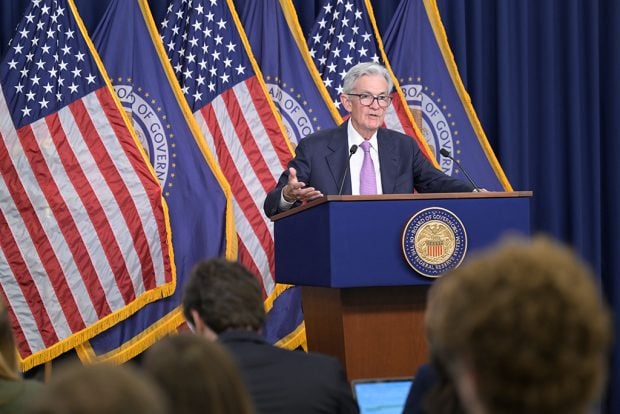 Fed Chair Jerome Powell speaks to reporters in Washington, D.C., Wednesday after announcing a 50-basis-point rate cut.

 Credit/Adobe Stock
 Deedee Myers