NEW YORK—As credit unions look to the new year, forecasters heading into 2026 see the U.S. economy cooling but not collapsing, with slower job growth, easing inflation and modest interest-rate cuts forming the backbone of a “soft-landing” outlook that still hinges on big unknowns: trade policy, geopolitics, fiscal decisions in Washington and whether households keep spending after several years of higher prices.
- 2026 Forecast: The Auto Sales, Lending Trends to be Watching
- 2026 Forecast: What Companies are Saying About Hiring in New Year
- 2026 Forecast: FASB Puts Two Digital Asset Topics on its Agenda
- 2026 Forecast: How One Large Bank is Deploying Generative AI
- 2026 Forecast: Automobile Prices to Remain High as Loan Terms Get Longer
- 2026 Forecast: Is This a Model for How CUs Might Approach Workforce & AI?
What the Fed is Projecting
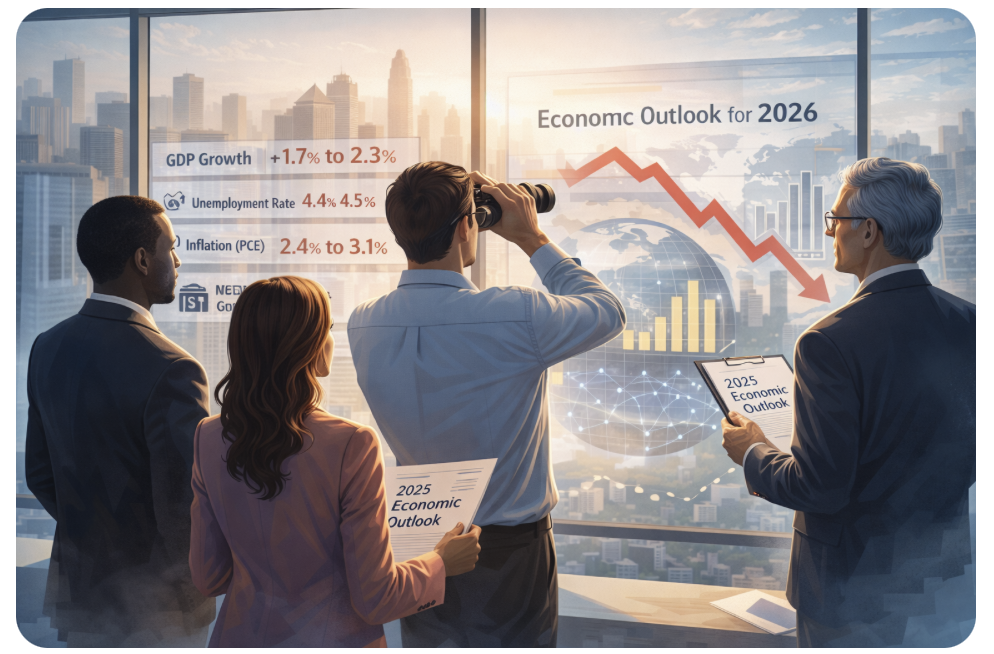
The Federal Reserve’s latest quarterly projections, released after the Dec. 9-10 policy meeting, put officials’ median 2026 forecast at 2.3% real GDP growth, 4.4% unemployment and 2.4% inflation as measured by the personal consumption expenditures index. The median projection for the federal funds rate at the end of 2026 is 3.4%, implying some additional easing from current levels if inflation continues to cool.
Other major forecasting groups are broadly in the same neighborhood on growth but less uniform on how bumpy the ride may be.
The OECD, in its December economic outlook, projects U.S. growth slowing to 1.7% in 2026, citing a cooling labor market and policy-related drags including the inflationary “pass-through” of higher tariffs and fiscal restraint.
The View from Philly
The Philadelphia Fed’s Survey of Professional Forecasters, published Nov. 17, pegs 2026 GDP growth at 1.8% (annual-average over annual-average), with unemployment averaging 4.5%. The same survey shows forecasters assigning a meaningful risk that at least one quarter turns negative — roughly 24% odds for the first quarter of 2026 and similar probabilities in subsequent quarters.
The National Association for Business Economics (NABE), summarizing its November outlook survey of 42 forecasters, says the panel expects inflation to ease toward 2.6% in 2026 on a PCE basis, with unemployment “around 4.5%” throughout the year. NABE also anticipates a December 2025 Fed rate cut and sees the policy rate around 3.1% by year-end 2026, reflecting fewer cuts next year than many investors once expected.
The Conference Board, in its U.S. forecast, expects inflation to prove sticky early in the year, projecting PCE inflation “slightly above 3%” in the first half of 2026 before easing to about 2.3% by year-end, alongside unemployment rising toward 4.7% in early 2026.
A Global Slowdown, Not a Global Slump
Internationally, many economists expect 2026 to look like a year of subpar-but-positive growth, with inflation continuing to cool unevenly across regions.

The International Monetary Fund’s October 2025 World Economic Outlook projects global growth slowing to about 3.1% in 2026, down from 3.2% in 2025, as advanced economies grow around 1.5% and emerging markets a bit above 4%.
The OECD, meanwhile, forecasts global growth cooling further to 2.9% in 2026 before picking up in 2027.
Moody’s, in a 2026 executive summary, describes global growth as “mixed,” with world real GDP growth likely hovering around 2.5% in 2026 and 2027.
The Big U.S. Questions
In the U.S., forecasters largely agree on three themes for 2026:
- Consumers remain the linchpin. Most outlooks assume household spending keeps expanding, though more slowly, supported by wage gains and employment that is still growing — just not as quickly as in the earlier post-pandemic rebound. If job growth cools more abruptly, forecasters warn, spending could follow.
- The labor market softens, but doesn’t crack. Several forecasts cluster around an unemployment rate in the mid-4% range. The Philly Fed survey’s median forecast implies notably slower hiring in 2026 than in 2025.
- Inflation drifts closer to target, with a risk of early-2026 bumps. The Fed’s 2026 median PCE inflation forecast is 2.4%, while private- and association-based forecasts frequently warn that tariffs, supply disruptions or energy shocks could complicate the final stretch back to 2%.
Trade and fiscal policy sit at the center of the uncertainty. The OECD explicitly points to tariff-related price effects and fiscal tightening as near-term drags, while NABE’s survey summary says tariffs add “mild upward pressure” to inflation.

Forecasters also continue to flag geopolitical risks — from shipping disruptions to commodity price spikes — that can quickly reshape inflation and growth paths. The IMF’s outlook notes that heightened uncertainty and policy shifts can weigh on growth even if baseline forecasts remain positive.
A “Soft Landing” Baseline — With Plenty of Ways It Could Miss
The broad consensus heading into 2026 is not a recession call, but a confidence rating on that baseline varies by forecaster.
The Fed’s projections imply the economy expands at or above its longer-run trend while inflation falls toward 2%. Federal Reserve The Philly Fed survey suggests growth continues but highlights a persistent risk of at least one negative quarter. Federal Reserve Bank of Philadelphia. The Conference Board’s outlook emphasizes early-year inflation pressure and a more noticeable uptick in unemployment.
Taken together, the forecasts describe an economy entering 2026 with momentum that is fading but still intact: inflation is expected to cool further, interest rates are expected to drift lower, and growth is expected to continue — though at a pace that leaves little room for policy mistakes or external shocks.
CU Daily
Remember, you're not alone with NCOFCU.org
|
Comments
Post a Comment
Please no profanity or political comments.