“Celebrating 25 Years of Service: Unite, Ignite, and Empower”
“We train and support volunteer leaders of credit unions serving first responders to run stronger, more effective institutions.”
“Great things happen when credit unions serving first responders come together. Our face-to-face and on-line interaction is the platform where collaboration begins, and GREAT ideas are generated.”
Search This Blog
Checking or "Digital Hub" Accounts Will Still be the Primary Account for Most
Whatever they may be called in the future, checking accounts remain a
primary account for consumers across all demographics. Approximately
80% of adults say they have a checking account with a bank or credit
union, according to a Bankrate survey.
Despite the growth in new apps and platforms, checking accounts
remain the primary repository for consumers across all generations, says
Mark Hamrick. Even consumers that rely heavily on platforms like PayPal
and Venmo often have it tied to a checking account or debit card.
“We’ve seen a tremendous amount of innovation in recent years, but
the fact that these accounts are still held among majorities of age
groups is quite noteworthy,” says Hamrick. “It remains the primary
account.”
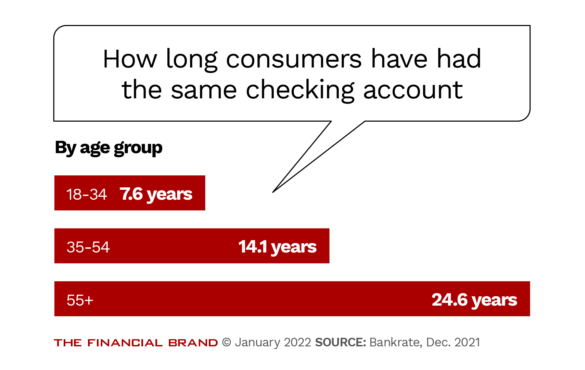
Another notable finding is that consumers said they have used the
same checking account on average for 17 years. As to why, 17% said it
was the “account I’ve always had,” and 10% said it was “too much hassle
to switch.” Not exactly a ringing endorsement. In addition, a quarter of
consumers said they are loyal and stick with the same account because
of low or no monthly fees.
low or no monthly fees.
If that account longevity trend were to continue, it would mean that
even as checking accounts evolve, they’re likely to remain a primary
tool for attracting and retaining long-term customers. Time will tell
whether the youngest user group will feel the same when they are 50+ as
people in that age bracket currently do.
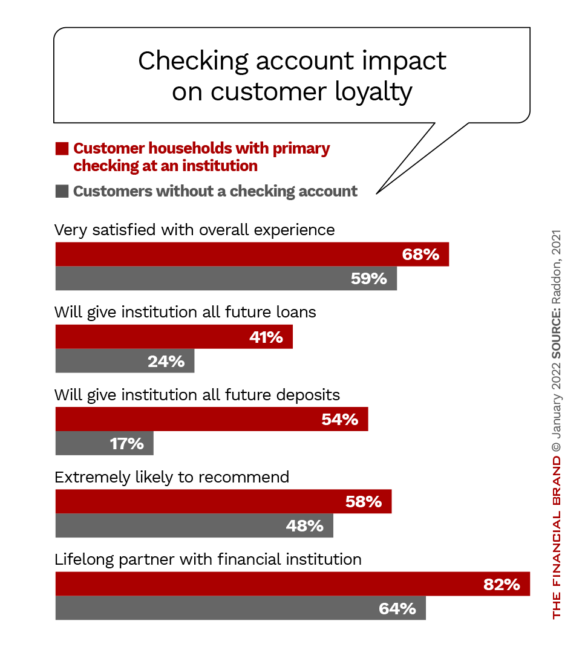
Another plus for checking accounts is that loyalty and cross-selling
potential are strongly correlated to where the accountholder’s primary
checking account is located, according to a Raddon Relationship Survey.
Checking account holders are 70% more likely to bring the institution
their future loans and three times more likely to bring all future
deposits. These account holders are also 30% more likely to keep
accounts at that institution for life.
WASHINGTON—Reps. Janelle Bynum (D-OR) and Young Kim (R-CA) introduced bipartisan legislation Thursday that would significantly broaden the investments available to federal credit unions, including giving them new authority to invest in corporate debt and asset-backed securities. Young Kim The Credit Union Investment Authority Act would amend the Federal Credit Union Act to expand federal credit unions’ investment authority. Under the bill, federal credit unions could invest in marketable debt obligations issued by companies and other organizations that are not limited to serving credit unions. The legislation would cap a credit union’s investment in the obligations of any single issuer at 10% of its paid-in unimpaired capital and surplus. The measure would also expressly authorize investments in asset-backed securities as defined under the Securities Exchange Act of 1934. Kathleen Coulombe The bill would require the NCUA board to issue implementing regulations within one year of enactm...
Liquidity Resources Liquidity is a credit union’s capacity to meet its cash and collateral obligations at a reasonable cost. Adequate liquidity is necessary to efficiently meet both expected and unexpected cash flows and collateral needs without compromising the credit union’s daily operations or financial condition. Effective credit union management identifies, measures, monitors, and controls exposure to liquidity risk. Primary Risks In managing expected cash flows, a credit union may experience situations that increase its liquidity risk. These situations include mismatches between sources and uses of funds, market constraints on the ability to convert assets into cash or to access sources of funds (market liquidity), and contingent liquidity events. Changes in economic conditions or exposure to credit, market, operational, legal, and also can affect an institution’s liquidity risk profile. None of these risks are mutually exclusive, and interrelated risks may contribute to increase...
A core measure of a nation's total economic activity, gross domestic product represents the value of all final goods and services produced within a country's borders in a given year. Economists can calculate a country's aggregate economic activity by adding together its total consumer spending, business investment, government spending, and net exports. As of June 2026, the US' inflation-adjusted GDP was about $24.2T. > The three different ways to calculate GDP. ( More ) > How "nominal" GDP differs from "real" GDP. ( More ) Since the concept was popularized by Nobel laureate Simon Kuznets in the 1930s, GDP has become one of the most important economic indicators in both domest...
WASHINGTON—The U.S. Senate, 51-47, has confirmed John Crews to the NCUA board, clearing the way for him to succeed Kyle Hauptman and return the agency to a single-member board following the Trump Administration's removal of Democratic board members Todd Harper and Tanya Otsuka earlier this year. Maintaining the foundational stability of the credit union system Supporting efficient, risk-based regulation that accounts for institutional size and operational differences Preparing for technological advancement while safeguarding member assets Encouraging the growth of new credit unions to serve underbanked and military communities Preserving an open, accessible, and collaborative dialogue between the NCUA and the credit union movement Crews, who most recently served in the Treasury Department, has said his priorities include reducing regulatory burden for smaller credit unions, encouraging innovation and supporting the chartering of new credit unions, while maintaining the safety and s...
HOUSTON– Dolphin Debit , a full-service ATM management company, said it has entered into a strategic partnership with Credit Union Services, Inc. (CUSI), the Service Corporation of the MD|DC Credit Union Association. “Through the strategic partnership, CUSI adds a budget-ready, industry-leading ATM management program to its portfolio of solutions for credit unions in the Maryland and D.C. region,” Dolphin Debit said. According to Dolphin Debit, its ATM outsourcing service includes purchase and deployment of new ATMs, purchase of the financial institution’s existing ATMs, terminal driving, transaction processing, ATM maintenance, armored car service, communications, monitoring and dispatch, and cash management. “We welcome this oppor...
Scrapes with Death Near-death experiences, 101 A near-death experience usually occurs in the wake of a traumatic physical event or a reversible clinical death, such as when someone is revived after a heart attack . While the experience varies, NDEs commonly feature a feeling of detachment from the body, visions of bright lights, a warped sense of time, or religious experiences. Records of NDEs go back to the ancient Greeks and are found across cultures all over the world. The first known clinical observation was recorded in 18th-century France . In the 1970s, psychiatrist Raymond Moody pioneered the academic study of NDEs as medical events after an acquaintance relayed his own near-death experience. Roughly 5% of the population is estimated to have a memory of an NDE, with common reports of a feeling of peacefulness (80%), followed by bright lights (69%) and encountering other people or spirits (64%). ... Read our full explainer on NDEs here ....
The NCUA’s decisions aren’t reviewed by third parties and credit unions don’t receive consistent messages, trades testify to Congress. **** More At; Trades to Urge Lawmakers to Revamp Exam Process :
On January 20, 2012, the CFPB adopted a final rule amending Regulation E (Electronic Fund Transfers) to include consumer protections for various types of remittance transfers. The rule was originally proposed by the Federal Reserve Board last May; however, authority to finalize the rule-making transferred to the CFPB on July 21, 2011 ****More At; CFPB Issues Final Rule on Remittance Transfers; Proposes Changes As Well : Written by Bernadette Clair, Regulatory Compliance Counsel
This chart shows all Firefighter Credit Unions vs National yield. If you would like to see how your credit union rated Click HERE As of Dec. 31, 2013, credit unions in the United States held more than $362 billion in investments. It’s not only total investments that are shrinking, however. For the past year, investment growth has slowed and the -1.77% growth rate posted at year-end 2013 marks the first time since fourth quarter 2006 the rate has dipped into negative territory. Despite this trend, the investment portfolio still comprises a significant portion, 35%, of the industry’s total asset composition. Read More A Review Of Credit Union Investment Trends At Year-End 2013 - General Features - News | Credit Unions
Comments
Post a Comment
Please no profanity or political comments.