
Update from TruStage - Forecast for CU, Economic Performance for Remainder of 2026, 2027


MADISON, Wis. — Credit unions are expected to post stronger loan, deposit, and asset growth in 2026 despite a slowing economy, persistent inflation, geopolitical uncertainty, and continued pressure on consumers, according to TruStage’s latest Credit Union Trends Report.

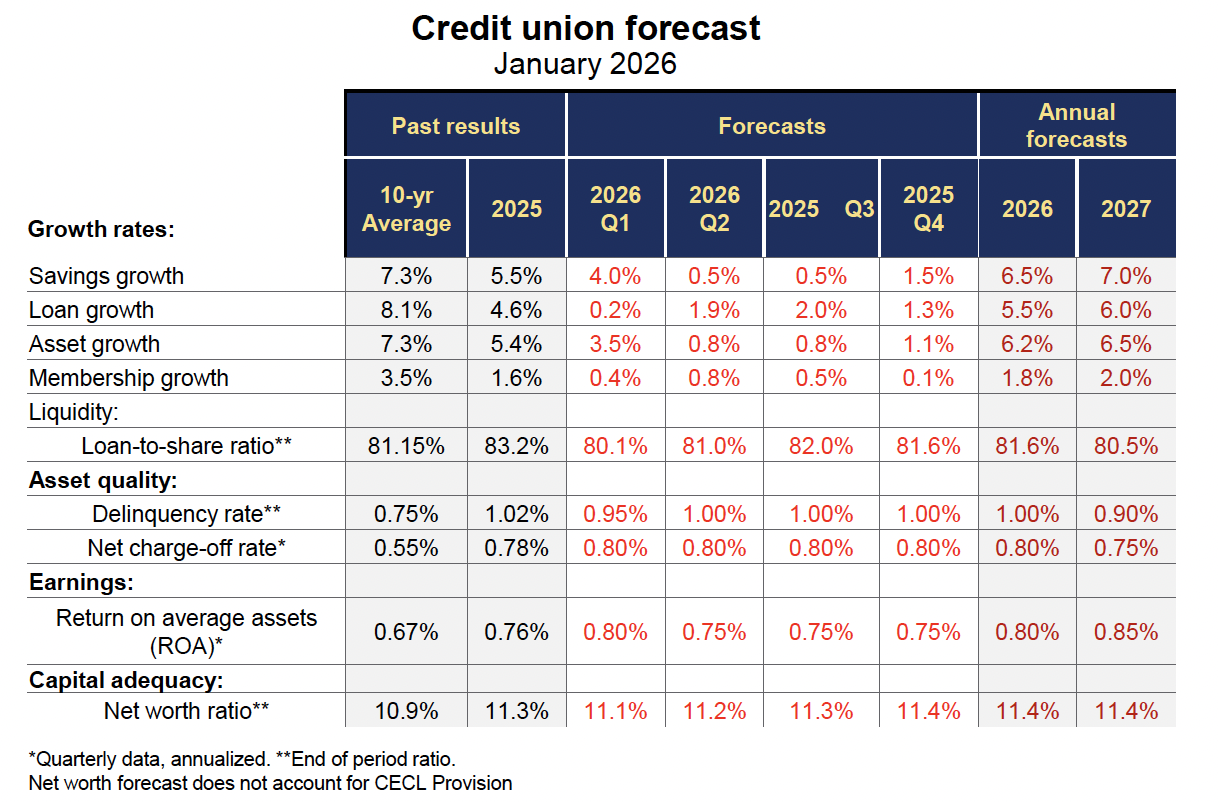
The report, prepared by TruStage Chief Economist Steve Rick and based on December 2025 data, forecasts credit union loan growth will accelerate to 5.5% in 2026 from 4.6% in 2025, while savings growth is projected to increase to 6.5% from 5.5%. Asset growth is expected to improve to 6.2% in 2026 from 5.4% in 2025. Credit union membership growth is forecast to reach 1.8% in 2026 and 2.0% in 2027.

The CU Daily has separate reporting on credit union performance by category here

According to TruStage, a changing global economic environment has altered its outlook for both the U.S. economy and the credit union system.

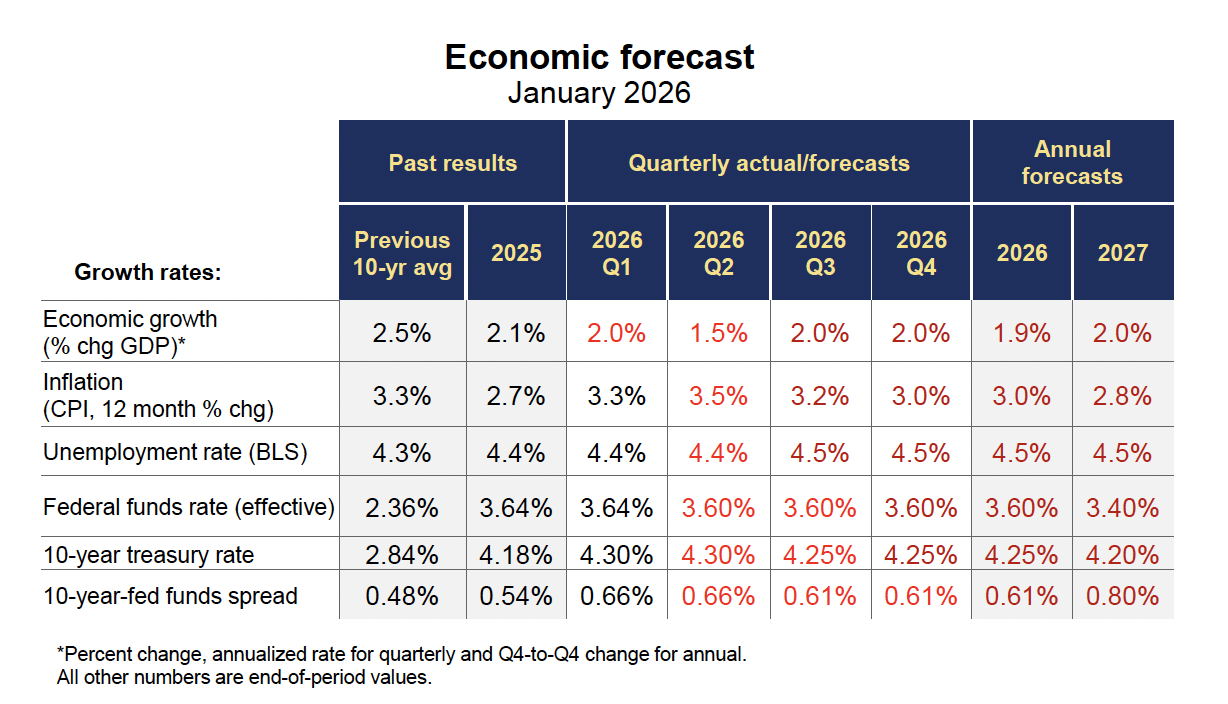
The report noted disruptions stemming from the closing of the Strait of Hormuz have created supply shocks affecting oil, natural gas, fertilizers, helium and industrial chemicals. Those disruptions are expected to increase costs, strain supply chains and reduce economic activity globally. As a result, TruStage lowered its forecast for U.S. economic growth to 1.9% in 2026, down from its prior estimate of 2.4% and below the 2.1% pace recorded in 2025.
Inflation to Remain Elevated

TruStage forecasts inflation, as measured by the Consumer Price Index, will rise to 3.0% in 2026 from 2.7% in 2025 and remain above the Federal Reserve’s 2% target.

The report said higher food and energy prices, tariffs and continued labor-force constraints are expected to keep inflation elevated. As a result, TruStage expects the Federal Reserve to leave the federal funds rate unchanged at approximately 3.6% throughout 2026. The rate is expected to decline modestly to 3.4% in 2027.

The unemployment rate is forecast to remain near 4.5% through 2026 and 2027.

TruStage projects monthly payroll growth will average just 50,000 jobs in 2026, well below the historical average of 170,000 jobs per month, reflecting slower labor-force growth and more cautious hiring by employers.

Long-term interest rates are expected to remain elevated as large federal deficits increase Treasury borrowing needs. The report forecasts the 10-year Treasury yield will average 4.25% in 2026 and 4.20% in 2027. Mortgage rates are expected to remain near 6.4%, keeping the housing market operating roughly 20% below normal levels.
Loan Growth Expected to Improve

Credit union loan balances grew 4.6% during 2025, an improvement from 2.8% growth in 2024 but still below the industry’s long-term average of 7%. According to TruStage, growth was driven primarily by home equity loans, business loans, adjustable-rate mortgages and fixed-rate first mortgages. Consumer installment products such as auto loans, credit cards and personal loans contributed little to overall growth.

The report forecasts loan growth will increase to 5.5% in 2026 and 6.0% in 2027.

TruStage cited four factors supporting improved lending:

  • Stronger deposit growth and improved liquidity
  • Better loan performance and lower delinquency and charge-off rates.
  • Higher capital ratios that provide greater lending capacity.
  • Potential reductions in short-term interest rates later in the year.

At year-end 2025, total credit union loans stood at approximately $1.736 trillion. The composition of that portfolio included:

  • $630.2 billion in first mortgages.
  • $182.3 billion in second mortgages and home equity loans.
  • $812.4 billion in total real estate loans.
  • $322.9 billion in used auto loans.
  • $161.4 billion in new auto loans.
  • $484.3 billion in total vehicle loans.
  • $88.5 billion in credit card loans.
  • $72.9 billion in unsecured loans excluding credit cards.
  • $196.2 billion in member business loans.

The data indicate that real estate lending now represents nearly half of all credit union loan balances.
Consumer Debt Burdens Lower Than Past Cycles

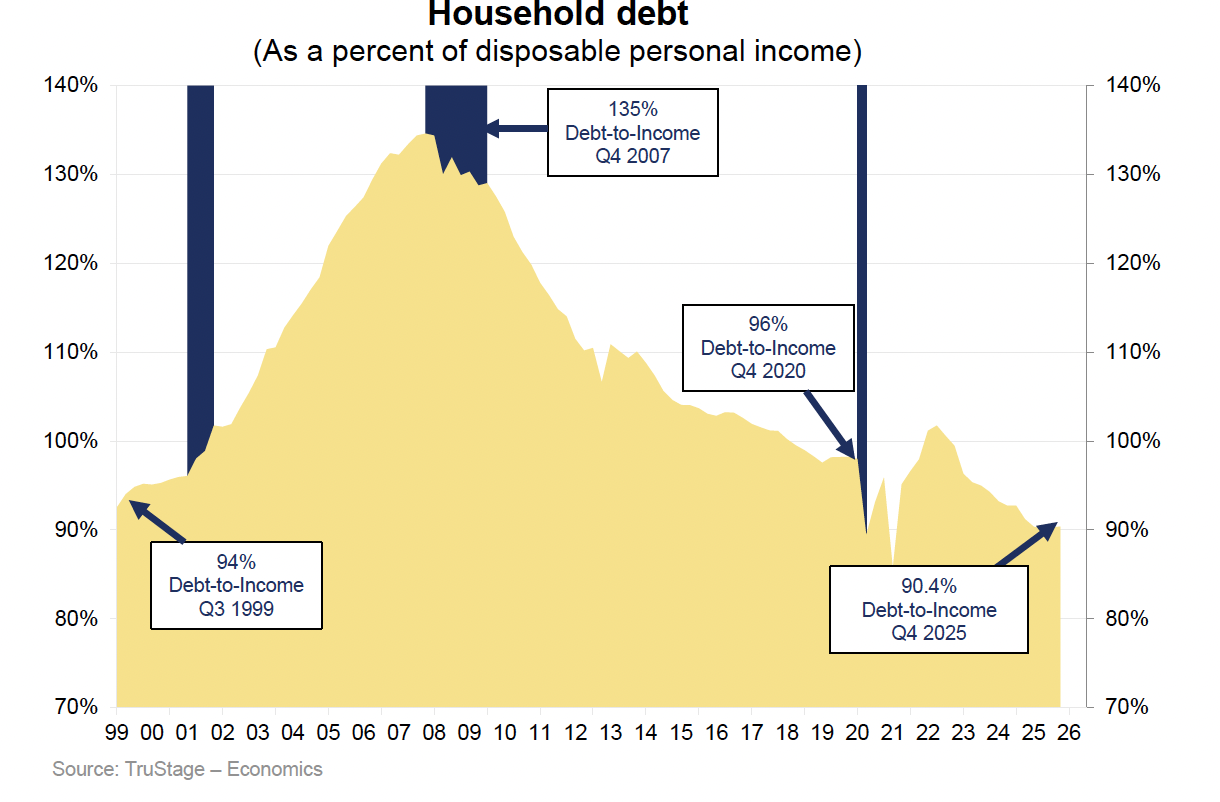
The report noted that household debt burdens remain significantly below levels seen before the Great Recession.

Household debt equaled 90.4% of disposable personal income at the end of 2025, down sharply from the 135% peak recorded in 2007 and below the 94% level reported in 1999.

Credit union credit card balances declined at a 1.9% seasonally adjusted annualized rate during part of 2025 as higher borrowing costs discouraged consumers from carrying balances. Consumer installment credit fell 1.0% during the first nine months of 2025, although the decline was less severe than the 1.9% decrease recorded during the same period in 2024, the report states.

For all lenders combined, consumer credit increased only $4.2 billion in November, well below the average monthly increase of approximately $15 billion recorded between 2015 and 2019, according to Federal Reserve data cited in the report.

TruStage expects consumer credit growth to improve during 2026 due to modest job growth, financial market deregulation and lower interest rates.

Comments

Popular posts from this blog

Hauptman Tells Congress CU Health is Strong; Responds to Questions from Committee

WASHINGTON — National Credit Union Administration Chairman Kyle Hauptman told members of the House Financial Services Committee on Thursday that the nation’s credit union system remains financially strong, while warning that rising delinquencies and consumer financial stress continue to warrant close monitoring. Hauptman also responded to a handful of questions from members of Congress, as well. Hauptman appeared as part of the regular hearings on Oversight of Prudential Regulators. Also appearing as witnesses were Michelle Bowman, vice chair for supervision with the Federal Reserve; Travis Hill, FDIC chairman, and Jonathan Gould, the acting Comptroller of the Currency. Kyle Hauptman In his prepared statement, Hauptman said federally insured credit unions remain well-capitalized and continue to meet members’ borrowing needs despite economic headwinds. He said the NCUA is focused on maintaining safety and soundness, protecting the National Credit Union Share Insurance Fund and creating...

NCUA Board Approves Final Rule on Dependent Care and Board Member Reimbursement

Alexandria, VA (June 8, 2026) ― The National Credit Union Administration today issued a final rule for Dependent Care and Board Member Reimbursement. The NCUA Board amended its regulations concerning the reimbursement of reasonable expenses for federal credit union officials to remove potential barriers to volunteer service. This final rule provides flexibility for a federal credit union’s board to adopt more family-friendly policies tailored to its size, region, and operations. Previously, dependent care costs had not been considered reasonable expenses under NCUA regulation 12 C.F.R. 701.33.  The final rule applies to all federal credit unions, including corporate federal credit unions. It will not apply to federally insured, state-chartered credit unions, which remain subject to state law. The final rule is effective 30 days from the date of publication in the Federal Register and takes into consideration public comments received from the proposed rule that was issued on Januar...

Reuters: Trump Regulators Launch Biggest Bank Oversight Overhaul Since 2008

Is NCUA next? WASHINGTON—Federal banking regulators under President Trump are undertaking what Reuters described as the most significant overhaul of bank supervision since the 2008 financial crisis, shifting examiner focus away from process and compliance issues and toward what agencies consider “material” financial risks. According to Reuters, the Federal Reserve, the Office of the Comptroller of the Currency and the Federal Deposit Insurance Corp. have directed examiners to concentrate on risks that pose direct threats to a bank’s safety and soundness, rather than on paperwork deficiencies, governance concerns or procedural issues that do not immediately affect financial stability. Reuters reported that regulators have also moved away from evaluating banks based on “reputational risk,” a supervisory concept long criticized by banks as overly subjective. The change follows complaints from President Trump and others that financial institutions have used reputational-risk considerations...

Sunday Reading - Changing the Map

  Changing the Map     Redistricting, explained Congressional redistricting is the process by which states redraw electoral district boundaries   that determine representation in the US House of Representatives. The Constitution, federal law, and court rulings require districts to have roughly equal populations, avoid discrimination against racial or language minorities, and, in most states, be geographically contiguous. For most of American history, redistricting has followed a predictable cycle, occurring every 10 years after the census.   Gerrymandering is the deliberate manipulation of district boundaries to advantage one political party. Common tactics  by both major American political parties include packing opposition voters i...

Trump Accounts Program For Children Moves Forward With New Mobile App Launch

  WASHINGTON—The Treasury Department on Thursday announced the launch of the new Trump Accounts mobile app, marking the next phase of the Administration’s rollout of its new federally backed investment savings program for children ahead of the program’s official July 4 launch date. Donald Trump The app, now available through major mobile app stores, will serve as the primary platform for families to manage and activate Trump Accounts. Treasury Secretary Scott Bessent said the app is intended to give parents and guardians a “simple, secure way” to participate in the program, which was created under the 2025 Republican tax-and-spending package. Families that already submitted IRS Form 4547 to enroll children in the program will begin receiving phased activation emails between now and July 4, according to Treasury. Under the program, eligible children born between Jan. 1, 2025, and Dec. 31, 2028, can receive a one-time $1,000 federal seed contribution into a tax-deferred investment ac...

Proposed FOM changes would streamline ability to reach underserved

February 16, 2023 The NCUA Board proposed chartering and field-of-membership changes and issued its final cyber incident reporting rule at its Thursday meeting. The board also heard a quarterly update on the share insurance fund, which noted an increase in the fund's equity ratio to 1.30%." The proposal would amend the chartering and FOM rules through nine changes to enhance consumer access to financial services, especially in low- and moderate-income communities while reducing duplicative or unnecessary paperwork and administrative requirements. “Getting credit union services to more communities across the country is important to CUNA, state leagues and the credit unions we serve, and making that easier to achieve has a big impact on access,” said CUNA Deputy Chief Advocacy Officer Jason Stverak. “While we need to review the proposal in detail, we thank the NCUA board for working to streamline the ability of credit un...

Mortgage Rates Decline to Their Lowest Levels Since April

WASHINGTON–Mortgage rates fell last week to their lowest level since early April. According to Freddie Mac, the standard 30-year fixed-rate mortgage averaged 6.87% in the week ending June 20, which was down from the prior week’s 6.95% average and marks the third consecutive weekly decline. Rates are down from a 2024 peak of 7.22%. “Mortgage rates fell for the third straight week following signs of cooling inflation and market expectations of a future Federal Reserve rate cut,” Sam Khater, Freddie Mac’s chief economist, said in a statement. “These lower mortgage rates coupled with the gradually improving housing supply bodes well for the housing market.” Most economists and forecasters expect rates ...

IRS Reporting Requirement Has Turned Into Uphill Battle for CUs

  It’s in. It’s out. It’s in again. On Thursday, NAFCU, CUNA and more than 100 associations sent a letter to all members of the U.S. House of Representatives and Senate asking them to reject a proposed IRS reporting requirement that credit union trades have been pushing back against since July . The proposed IRS reporting requirement would require financial institutions, including credit unions, to report the inflows and outflows of personal and business accounts, as well as transfers between accounts of the same owner, if it is more than $600 per year. The proposal found new life inside the House version of the budget reconciliation bill after it was rejected in the version approved by the House Ways and Means Committee last month. On Tuesday, Speaker of the House Nancy Pelosi (D-Calif.) said the IRS reporting requirement would be included in the House version of the bill. CUNA, NAFCU and other organizations voiced their objections to the proposal in a joint letter. While the l...

The FedNow Service will launch in 2023 "Are you ready?"

The FedNow Service is a new instant payment service that the Federal Reserve Banks are developing to enable financial institutions of every size, and in every community across the U.S., to provide safe and efficient instant payment services in real-time, around the clock, every day of the year. Through financial institutions participating in the FedNow Service, businesses and individuals will be able to send and receive instant payments conveniently, and recipients will have full access to funds immediately, giving them greater flexibility to manage their money and make time-sensitive payments. Consistent with the Federal Reserve’s historical role of providing payment services alongside private-sector providers, the FedNow Service will provide choice in the market for clearing and settling instant payments as well as promote resiliency through redundancy. Financial institutions and their service providers will be able to use the service as a springboard to provide innovative instant p...