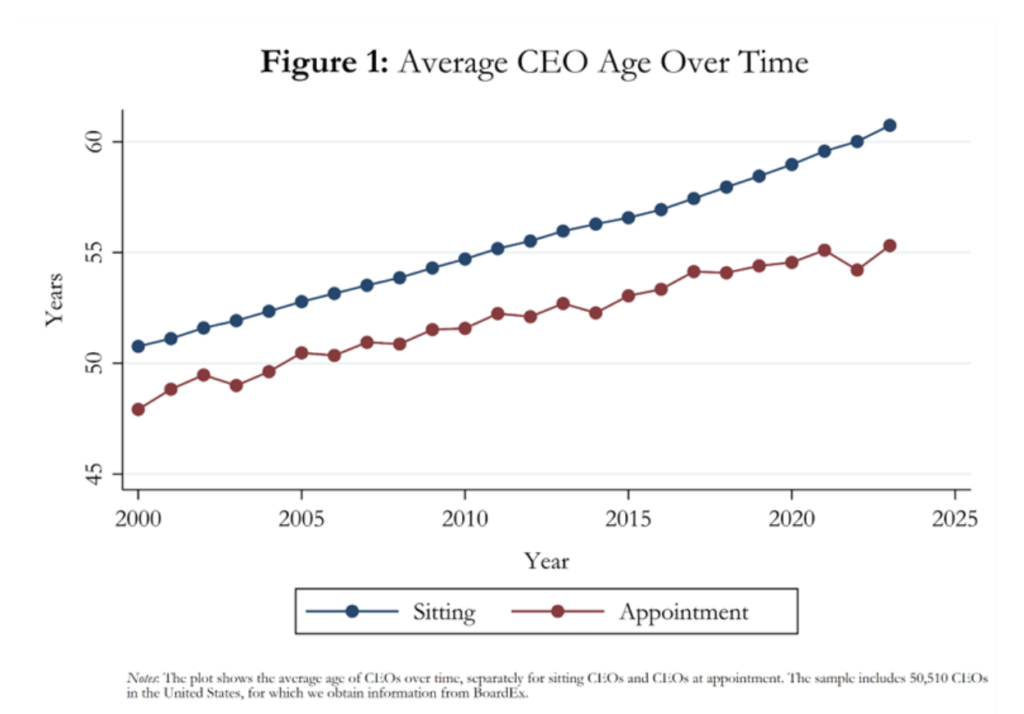
NEW YORK — At a time when there are some generational changes in credit union leadership taking place, a new analysis has found the nation’s bank CEOs are getting older, with half of the chief executives leading banks now older than 65, compared with fewer than 20% two decades ago.
The KBW Bank Index from Truist Securities found that the median age of bank CEOs has increased by 10 years since the early 2000s, mirroring a broader aging trend among corporate leaders across the United States. However, bank executives remain older on average than their counterparts in many other industries, according to the analysis by Truist Securities Managing Director John McDonald and associates Peter Nicolo and John Manahan.
One reason is tenure. Bank CEOs typically remain in their positions longer than executives in many other sectors. According to data from CristKolder Associates cited in the report, financial-services CEOs average nine years in the role, compared with 5.4 years in the energy sector and six years in consumer industries.
‘Important Advantages’
The report said longer-serving CEOs can provide important advantages for financial institutions, including strategic consistency, cultural stability and deep experience managing risk through multiple economic cycles.
“Leadership continuity can foster consistent strategy, ensuring the franchise is aligned around specific long-term goals or targets over time,” the Truist researchers wrote. “Culture remains intact, aiding talent retention and recruitment. Experience managing risk across cycles also helps to build institutional expertise.”
Potential Drawbacks
The report also identified potential drawbacks to extended CEO tenures.
According to the researchers:
- Succession pipelines may weaken if aspiring executives leave in search of advancement opportunities elsewhere.
- Corporate strategy and culture can become stagnant without the introduction of new perspectives.
- Organizations may lose a sense of urgency to improve performance or pursue best-in-class results.
Among the five largest U.S. banks, the oldest chief executives are JPMorgan Chase CEO Jamie Dimon, 70, and Bank of America CEO Brian Moynihan, 66. Dimon has led JPMorgan Chase for 20 years, while Moynihan has been at the helm of Bank of America for 16 years, both well above the industry average, noted Banking Dive.
Assumptions are Challenged
The report also challenged several common assumptions held by investors.
According to Truist Securities, there is little correlation between CEO tenure and a bank’s stock performance relative to the broader market. Researchers also found that CEO age is a poor predictor of whether a bank is likely to pursue a merger or acquisition.
Investors often examine CEO age alongside potential change-in-control payouts when evaluating which banks might be acquisition targets, based on the assumption that older executives may be more inclined to sell.
What a Younger CEO Can Mean
However, the report found that over the past two decades, banks that were sold generally had younger chief executives than many investors might expect.
“A common screen that investors run to evaluate which banks are likely to sell is CEO age versus the amount of their change-in-control payout,” McDonald wrote in the report. But the data suggest that executive age alone has not been a reliable indicator of future merger activity.
The findings were detailed in a Truist Securities report published Monday and reported by Banking Dive.
Comments
Post a Comment
Please no profanity or political comments.