Wednesday, November 29, 2023

Economic Growth to Slow With Mild Recession in 2024, According to New Fannie Mae Forecast

WASHINGTON—Economic growth is likely to decelerate and ultimately result in a mild recession in 2024, followed by a return to growth in 2025, according to the November 2023 commentary from the Fannie Mae Economic and Strategic Research (ESR) Group.

While the combination of ongoing employment gains and decelerating inflation has increased the likelihood of a soft landing, the ESR group contends that, between a likely slowdown in consumption growth stemming from an imbalance between spending and incomes and the rising real federal funds rate weighing on consumer and business activity, a downturn remains the most likely outcome, Fannie Mae said.

Fannie CPI Chart

“With mortgage rates having previously neared the 8% mark, the ESR Group expects existing home sales to decline further in the near term but bottom out in early 2024. Regardless of whether the economy manages a soft landing or enters a mild recession, the ESR Group forecasts mortgage rates in 2024 to retreat from their recent highs and average 6.8% by the fourth quarter. As such, the ESR group expects home sales to begin to increase modestly over 2024 but to remain constrained by the likely persistence of the so-called ‘lock-in effect’ and the low supply of homes for sale. New home sales and starts, which have remained comparatively resilient over the past year, are expected to remain so in 2024,” Fannie Mae said.

“The economy is now slowing from the otherwise robust first estimate of third quarter growth,” said Doug Duncan, Fannie Mae senior vice president and chief economist. “The slowdown in employment gains has continued, and stress is growing on consumers’ ability to sustain their high levels of spending – unsurprising results that we attribute to the often-lagged economic effect of monetary policy tightening.”

‘Serious Affordability Pressure’

“At the same time, housing has been and continues to be under serious affordability pressure, resulting in recessionary-level home sales activity,” Duncan continued. “While many current owners with low mortgage rates will likely continue to be discouraged from listing their homes, we expect mortgage rates to trend modestly downward in 2024, which should help kickstart a gradual recovery in home sales into 2025.”

The full forecast and report can be found here.

Tuesday, November 28, 2023

NCUA Reinstates Civil Money Penalties for Late Call Report Filing


NCUA Express


Wednesday, November 22, 2023

Fed Minutes Indicate Rate Increases Now on Hold; Cut Could Come in 2024

WASHINGTON–While Federal Reserve officials indicated they remain open to the possibility of again raising rates, minutes released from the Fed’s October meeting show they are more likely to keep rates steady--and one credit union economist sees potential for a rate cut in 2024.

“All participants agreed that the committee was in a position to proceed carefully,” said the minutes of the Oct. 31-Nov. 1 meeting state. “Participants expected that the data arriving in coming months would help clarify the extent to which” a slowdown in inflation was continuing amid higher borrowing costs, according to the minutes. 

The Fed’s Open Market Committee is set to meet again on Dec. 12-13, but few expect any rate increase to be considered. 

"The minutes from the October FOMC meeting reaffirm that the committee believes monetary policy is currently restrictive,” said NAFCU VP-Research Curt Long. “Given the significant moderation in inflation in 2023, NAFCU believes the FOMC is done raising rates in this cycle and will proceed with the first rate cut in the first half of 2024." 

Federal Reserve

Other Risks 

The minutes indicate the Fed sees risks in raising rates too much, even as inflation appears to be moderately cooling.

The Fed last raised rates in July, when they increased the benchmark federal-funds rate in July to a range between 5.25% and 5.5%, a 22-year high. That’s up from near zero in March of 2022 when the Fed began raising rates. 

Monday, November 20, 2023

Charitable Donations Final Rule Approved by NCUA Board

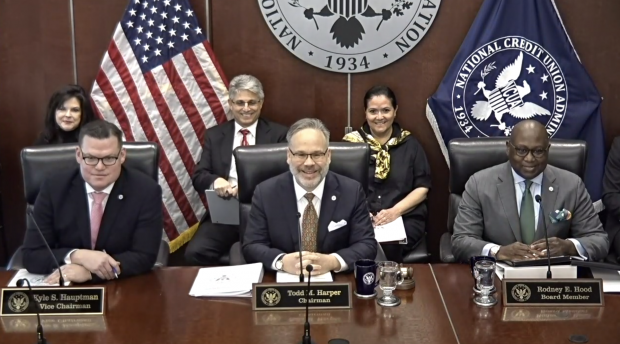
NCUA Board meeting, Nov. 16, 2023 NCUA Board meeting, Nov. 16, 2023

During Thursday’s NCUA Board meeting, members voted 3-0 to approve the final rule to amend the charitable donation accounts section adding “war veterans’ organizations” to the definition of a “qualified charity” that federal credit unions may contribute to with a charitable donation account.

According to the NCUA, the final rule “adds a post or organization of past or present members of the Armed Forces of the United States, or an auxiliary unit or society of, or a trust or foundation for, any such post or organization recognized as exempt from taxation under section 501(c)(19) of the Internal Revenue Code to the definition of a ‘qualified charity’ that a federal credit union may contribute to using a charitable donation account.” Of note, “qualified charity” is a section 501(c)(3) entity defined by the Internal Revenue Code and must be both a non-profit and organized for a charitable purpose.

NCUA Board Chair Todd Harper said, “With this final rule, the NCUA is taking an important step in honoring our nation’s many veterans. The rule is good for veterans, good for military families, good for credit union members, good for credit unions and good for our country. And, it fits nicely within the credit union ethos of people helping people.”

Credit union trade groups have fully supported the final rule.

In a statement, CUNA Deputy Chief Advocacy Officer for Regulatory Affairs Alexander Monterrubi said, “This final rule means many worthy tax-exempt organizations that serve veterans can now receive support from credit unions. We appreciate NCUA responding to our engagement on the need for this rule, which was based on direct feedback from our member credit unions — this is a great example of collaboration between the industry and agency that results in better outcomes for consumers.”

The final rule will go into effect 30 days after publication in the Federal Register.

Credit Unions - Invest in a Charitable Donation Account (CDA)

In December of 2013, the NCUA Board approved a final rule giving credit unions expanded investment powers to fund charitable donations, to organizations like NCOFCU, through investment returns rather than as an expense.  Today, credit unions have invested more than 700mm in Charitable Donation Accounts (CDAs). 

Credit Unions make our communities stronger, But in an effort to do more, now more than ever, credit unions are faced with the unique challenge of how to best fund your charitable giving focus while remaining responsible and accountable to your members.  CDAs allow credit unions to make more so they can give more.

Download our CDA brochure to learn more

For additional information, please visit https://memberstrust.com/credit-unions/institutional-investments/charitable-donation-accounts/ or contact:

Jason Ritzenthaler, CFA, CTFA
Co-Chief Investment Officer
Director of Investments & Institutional Business
p: 813.386.8705
f:  813.631.9898
e:  jason.ritzenthaler@memberstrust.com
www.memberstrust.com
Main Street values. Wall Street expertise.TM

*The National Coalition of Firefighters Credit Unions, Inc. (NCOFCU) is a non-profit, 501(c) (3) charitable organization. Donors may deduct contributions as provided in IRC 170(c) (3) of the U.S. Tax Code. Employer Identification Number 27-2387106

NAFCU’s Long: Economic indicators calm fears of immediate recession


NAFCU Chief Economist and Vice President of Research Curt Long explores economic indicators, recent survey data, and the NCUA’s proposed 2024-2025 budget in a new economic update video.

On the economy, Long notes the slowdown in activity, but says it’s a good thing as the slowdown is controlled: “We’re not seeing a nosedive in the economy that would cause us to worry about a recession.”

He also reviews some of the “disappointing” provisions of the NCUA’s proposed budget. Long testified at the agency’s public hearing on the proposal last week.

Watch the full video. For more economic updates from NAFCU's award-winning research team, view NAFCU's Macro Data Flash reports.

Consumer Advocates Continue To Target ODs

By Ray Birch

ARLINGTON, Va.—NAFCU hopes credit unions in California don’t begin to back away from offering overdraft programs just because some consumer advocates don’t like the service that has been the target of strong criticisms in national media.

As CUToday.info reported here, California’s financial regulator, following a law requiring data be published showing how much state-chartered insitutions in the Golden State are earning from overdraft fees and NSFs, the state’s Department of Financial Protection and Innovation published the first-ever report with details.

The full report can be found here.

Feature NAFCU on Calif. OD

That report was soon followed by one opinion piece in national media that claimed, “There’s a new predator making money off overdraft fees: credit unions.” 

The article, published by Politico under the headline, “Credit Unions Are Making Money Off People Living Paycheck to Paycheck,” was authored by Aaron Klein, the Miriam K Carliner chair and senior fellow in economic studies at the Brookings Institution. Klein served as deputy assistant secretary of the Treasury from 2009 to2012 and as chief economist of the Senate Banking, Housing and Urban Affairs Committee from 2004 to 2009.  

“I don’t think credit unions should be afraid of a product because some consumer advocates don't like it,” NAFCU Senior Vice President of Government Affairs Greg Mesack told CUToday.info.

Mesack

Greg Mesack

Mesack asserted the report and the follow-up opinion piece were assembled by those opposed to overdraft fees and overdraft programs.

“They think that if they can force credit unions to show how much they collect (in OD revenue) it will somehow (paint credit unions in a negative light),” he said.

The California report also applied to state-chartered banks.

Overdraft programs, Mesack pointed out, are relied on by many Americans.

“People really love them,” he said. “There are those who think they're important. They think they're critical. And we also know, with credit unions and all financial institutions, it's an optional program. Someone has to affirmatively choose to opt in because they think it will be valuable. We also know that credit unions, clearly upfront—before anyone even opts in—disclose the cost of the program, so the consumer can make an informed decision.”

Mesack said experts and consumer advocates can continue to speculate about the cost of overdraft programs.

“And doing so just makes them look bad, good, whatever,” he said. “But, the end of the day, it's a consumer tool that a consumer affirmatively chooses to use.”

NAFCU, Mesack said, stands firmly behind the view that overdraft programs are an important consumer option.

“Without it, people can be putting themselves in financially difficult positions,” he said. “Sometimes, they need to buy the food for their kids. And, in their mind they do the calculation of the charge versus not having the money to buy essentials. Consumers are very rational people, they do the math—which is more expensive, and overdraft fee or a missed mortgage payment? An overdraft fee or missing the car payment? And they'll make those decisions. They know when their money's coming in and they manage toward it.”

The California report, contended Mesack, has many “abstract” numbers that he believes has some trying to twist to tell a certain story.

“From my point of view the more important story is what is the utility of this program,” he said. “Is it clearly disclosed to consumers, and does the consumer have a choice. In these (California report) instances they did.”

Mesack further believes those he called “so-called” consumer advocates are behind the criticism being leveled.

“They like to call themselves consumer advocates. But how many of these advocates have ever had to worry about bumps in the (financial) road?” he said. “I think a lot of these people (behind the report) have not had to worry about money like many of the lower-income Americans who rely on this service. They have not worn the shoes of the consumers who use overdrafts. There’s a group of people who have for a long time been very opposed to overdraft programs. They've been working relentlessly to try to shut them down.”

Long, Curt

Curt Long

Mesack contended Klein’s opinion piece in Politico clearly reveals the author does not like overdraft programs and thinks they should not exist.

“I ask the question, would a consumer be better off going to a payday lender? Because that's the only other option,” he said.

One ‘Interesting’ Aspect

NAFCU Chief Economist and Vice President of Research Curt Long doesn’t believe the data in the California report has been manipulated.

“However, if you read through that report, you know it was the California State regulator who produced a report as a result of legislation,” Long explained. “I don't know a lot of the details on who was behind the legislation, but it was interesting in the report that the regulator noted they are going to produce the report consistently.

“And they also added some other metrics that were not required by that legislation, just to provide a maybe a les- distorted view,” continued Long. “If you read the notes from the regulator, I think you know when you're comparing the percent of income that comes from overdraft between a not-for-profit institution and a for-profit institution that is naturally going to lead to a distorted picture. I think the regulator recognized that.”

As a result, Long asserts the report needs more context.

“Such as who are the customers of these institutions? Are they high-income people or low- and moderate-income people? If it's the latter, then you would naturally expect more demand for overdraft services,” he said. “I think there's a lot of important context that that is not available from the report.”

What to Think About Now

What should CUs in California be thinking about now?

“I don’t think that from the report credit unions are necessarily painted in a bad light, it just shows what credit unions collect from overdraft fees, and I don’t know if that’s good or bad,” said Mesack. “In some ways it shows that credit union members value the service. I don't think the fact that credit unions collect overdraft fees makes them look bad. It means they have a product that consumers consider important and essential.”

The California report stated a number of credit unions are overly reliant on fee income. Long disagreed.

“If you look at the numbers, fee income as a percent of credit union assets (nationally) has been trending steadily downhill,” he said. “I just don't see any basis for making that claim.”

What to Do Now

Mesack believes it would be wise for CUs in California to gauge the value members see in the overdraft service, make sure overdraft materials are very clear about the OD program’s structure and pricing and, to provide financial education to members—especially those showing signs of trouble.

CUToday.info reached out to the California League but it has declined to comment to date.

Wednesday, November 15, 2023

NAFCU: Cooling Inflation May Hasten Rate Cuts

NAFCU, CUNA economists say a report shows the key measure for the Fed is showing progress.

Inflation, dollar hyperinflation with black background. One dollar bill is sprayed in the hand of a man on a black background. The concept of decreasing purchasing power, inflation Credit/AdobeStock

Inflation fell in October by enough that a NAFCU economist believes it could bring the day closer when the Fed will start cutting rates.

The U.S. Bureau of Labor Statistics reported Tuesday that the Consumer Price Index rose 3.2% in the 12 months ending in October, down from 3.7% through September.

Moreover, there was also progress in the measure most closely watched by the Fed: Core inflation, which excludes the volatile energy and food categories. Core inflation was 4.0% for the 12 months ending October — its smallest 12-month change since September 2021.

NAFCU Economist Noah Yosif said the overall inflation rate was below expectations. Falling prices of gasoline was a major contributor, but other sectors slowed as well.

“Service inflation has been more stubborn and was the driving force behind last month’s upside CPI surprise. But in October service price growth settled back into its pre-September range,” Yosif said.

Noah Yosif Noah Yosif

“With aggregate labor income slowing, there will be more confidence among Federal Reserve officials that price growth is on a sustainable path back to target,” Yosif said. “NAFCU expects these conditions place the Federal Reserve on track to commence rate cuts in the second quarter of 2024, with an outside chance of earlier if unemployment continues to rise.”

CUNA Senior Economist Dawit Kebede said one area of continued rising prices in October was shelter, but the growth returned to a normal monthly rate of 0.3% after jumping to 0.6% in September.

Dawit Kebede Dawit Kebede

“The October inflation report is good news for the Federal Reserve determined to bring prices down to its 2% target,” Kebede said. “Annualized core inflation is down to 2.8%; and core inflation less housing — a lagging indicator — is lower than 2%.

“A moderating labor market is also another indication that underlying prices pressures are easing,” he said. “All these indicate that the Federal Reserve may not need further rate hikes to bring prices under control.”

Monday, November 13, 2023

Growing Delinquencies, Especially in Auto Loans, Can be Seen in New CUNA Report

MADISON, Wis.–Ongoing increases in delinquencies, especially in automobile loans, can be seen in the new CUNA Economic Update.

According to CUNA Chief Economist Mike Schenk, the report shows:

  • Mortgage delinquencies. With data obtained by Equifax, CUNA economists said they have found “slight upward movements” in mortgage delinquency rates.  
  • Credit card delinquencies. Bigger increases in delinquency rates relative to the cyclical low – as seen during the COVID-19 pandemic – is concerning, said Schenk.  
  • Auto loan delinquencies: Data shows a “dramatic” increase in delinquency rates among institutions such as auto financing companies. 
thumbnail_CUNA Economic Update

CUNA Forecast
 
CUNA’s economists are forecasting delinquency rates will peak at 1% by the end of 2024. Net charge-off rates are also believed to be heading towards 70 basis points, the CUNA forecast states. Schenk said both forecasts are higher than long-term norms, but only modest in comparison to the Great Recession.  

“The U.S. economy is not in recession at the moment. Experts say recessions are defined as a significant broad-based decline in economic activity that lasts for more than a couple of months,” said Schenk. “With the labor market as strong as it is, it is very difficult to say that this is a broad-based decline in economic activity.”

Thursday, November 9, 2023

Mortgage Rates See Biggest Decline in a Year; Applications Rise

WASHINGTON–Mortgage rates saw the biggest one-week drop in over a year last week, causing the first increase in mortgage demand in a month, according to new data.

Total mortgage application volume rose 2.5% last week, compared with the previous week, according to the Mortgage Bankers Association's seasonally adjusted index.

thumbnail_Mortgage Rates

The average contract interest rate for 30-year fixed-rate mortgages with conforming loan balances ($726,200 or less) decreased to 7.61% from 7.86%, with points falling to 0.69 from 0.73 (including the origination fee) for loans with a 20% down payment.

The Rate Driver

"Last week's decrease in rates was driven by the U.S. Treasury's issuance update, the Fed striking a dovish tone in the November FOMC statement, and data indicating a slower job market," Joel Kan, vice president and deputy chief economist at the MBA, told CNBC.

According to the data, applications to refinance a home loan increased 2% for the week and were 7% lower than the same week one year ago.

Applications for a mortgage to purchase a home rose 3% for the week but were 20% lower than the same week a year ago.

Supply Remains Low

“The decline in interest rates is still not enough to offset sky-high home prices, which are still rising due to the very low supply of houses for sale,” CNBC noted.

Monday, November 6, 2023

Many Questions, No Answers

By Michael Fryzel

Screenshot 2023-11-03 at 2.17.31 PM

For the last 24 months and for at least the next 14, the most talked about subject, has been and will be, the economy. 

Will inflation slow down? Will there be a recession? Will the Fed increase or decrease the interest rate? What will be the price of a gallon of gas? Will the holiday season be strong enough to save struggling retail stores? Will the cost of groceries ever go down? How high will mortgage rates go?

In addition, the crises erupting in Israel, Gaza and Ukraine will continue to be part of the nightly news, as will crime in our cities, devastating storms, worker strikes and the all-important question, will it be Biden vs Trump, again? 

All these “other” news events are important and will have an impact on individual lives across the world. And, each one of them, in some way, will have an impact on the economy; again, making it the one subject that will continue to dominate everyone’s life. 

Looking to the Experts

To get the answers to all these questions about the economy, everyone always looks to the experts. Every day economists are asked what they see happening today, tomorrow and the next day. The majority of them will pontificate. They will point to statistical data, historical trends, consumer borrowing and spending, and the wars in the Middle East and across the globe. As designated experts, they feel the need to respond even though what they may be saying is only their best guess.

In the past, economists have always based their predictions on past performance, length of cycles, regulatory action and world events to predict fairly well when things would get better and back to some resemblance of normality. Reliance on those benchmarks were once considered a reliable forecast for the future. Now, however, they haven’t proved to be the most accurate.

‘Not Going to Happen’

You are probably expecting a summary to this short dissertation that will include a list of what is needed to be done to put our country on a path to a strong economy and world peace. That’s not going to happen.

Just like the economists, the Federal Reserve, our illustrious Congress, political candidates and fortune tellers, I do not have any answers or predictions. 

What I do know, my fellow Americans, is what you know as well. We need to buckle up, because before it gets better, it’s going to get worse. 

Mr. Fryzel is the former chairman of NCUA who is now in private practice in Chicago.

‘A Few More Reports Like This One,’ & Fed May Move to Cut Rates, Says NAFCU Economist Kurt Long

WASHINGTON–Hiring during October cooled considerably, according to new data released last week by the Labor Department.

After several months of strong job reports, the new report shows U.S. employers added 150,000 jobs in October, down from the previous month’s revised gain of 297,000.

According to the department, those numbers mark the smallest gain since June, with automakers having around 33,000 fewer workers on payroll because of the United Auto Workers strike. The unemployment rate rose to 3.9% from 3.8% the prior month.

thumbnail_New Labor Numbers Chart

‘A Clear Signal’

"The October employment report sends a clear signal that the labor market is cooling,” said NAFCU VP-Research and Chief Economist Curt Long. “A broad range of measures fell during the month, including employment, labor force participation, and wage growth. Furthermore, there were substantial downward revisions to prior month job gains. NAFCU continues to believe that Fed hikes are finished during this cycle, but a couple more reports like this one will have the FOMC considering a rate cut as early as Q1." 

As CUToday.info reported, the Federal Open Market Committee (FOMC) adjourned last week without raising rates, indicating it could do so when it meets again in December, depending on the data.

Rates are currently at a 22-year high.

Other Data Points

According to the new Labor Department numbers:

  •  Average hourly earnings rose 4.1% from a year ago, the department said, down from 4.3% in September.
  • The share of people working or looking for work fell slightly to 62.7% in October from 62.8% in September.
  • Healthcare industries and governments added more than 50,000 jobs each in October, while transportation and warehousing lost 12,000. Employment was also down in the information industry, due in part to the strike by TV and film actors.

Saturday, November 4, 2023

ATM Attacks on the Rise


ATM Attacks on the Rise

Joe Woods, SVP Marketing & Partnerships

Dolphin Debit Access


Skimming, vandalism, and physical attacks on the ATM, armor/cash-in-transit (CIT) and ATM technicians are all on the rise throughout the U.S. For a criminal, the ATM presents an open environment with multiple escape routes.  Criminals are also very adept at approaching the ATM and making it appear they are conducting usual business.  But in reality, they are placing devices on the ATM to capture card and pin data. 

Some sources claim that these attacks on ATMs and personnel have increased 50% over the past three years.  It is clearly a very serious problem. While we cannot control or prevent every attack, we can all work together to help reduce these threats.  Here’s a short list to put into action immediately for your ATM fleet. 

1.     If you have branch staff loading external ATMs (or ATMs not loaded from inside the branch) vary the day of the week and time of day they head to the ATM.  Keeping a consistent load cycle makes staff an easy target.

2.     If you are concerned with having staff loading your external ATMs, contact the armor/CIT currently providing your branch cash and ask for pricing and the documents for ATM replenishment.  Even if you don’t make the change immediately, having the necessary pricing and paperwork can enable a faster transition when needed.

3.     Have your branch staff check the ATM a minimum of twice a day for skimming devices.  Although not all skim devices are detectable, many of them are.  They should inspect the card reader and pin pad for tampering or any noticeable changes.  Have them grab the card reader and wiggle it.  It should not move.  If it shifts or moves, it could be a skim device on top of the original reader.  Also, inspect for glue or tape around the edge of the reader.  Many skim devices are put on with the intent of removing them quickly after a period of time, so they are not going to be bolted or adhered tightly to the ATM fascia. 

4.     Have your branch staff schedule visits to the ATM on the way into the office and the way out at the end of the day.  You can also have them visit around lunch time. 

While nothing is foolproof, these steps can help protect your ATM, your staff, and your cardholder data.  For more insight or information regarding ATM functionality or ITMs and their role in branch transformation, speak to your association representative. 

Joe Woods, CUDE | SVP, Marketing & Partnerships

Dolphin Debit Access, LLC | 1340 Rayford Park Rd., Spring, TX 77386

(M) 614-378-0367


Thursday, November 2, 2023

Historic CUNA, NAFCU Merger Approved

The new group will now become America’s Credit Unions.

Hand putting ballot in blue election box Credit/Adobe Stock

The members of CUNA and NAFCU have voted overwhelmingly to approve the merger of the two organizations to form America’s Credit Union.

According to a statement Thursday morning from CUNA and NAFCU officials, of those who voted, 94% of CUNA members and 86% of NAFCU members voted in favor of the merger. Voting ended Wednesday at 5 p.m. and were tallied and finalized by each organization’s independent ballot provider.

In a statement, CUNA President/CEO Jim Nussle said, “I’d like to thank our credit union members who have been engaged throughout this merger process – asking tough questions, holding us accountable, and helping us plan for the future. I am incredibly humbled to lead this new organization and fight for a stronger credit union industry. Your needs will remain our priority as we embark on this transformation over the next several months.”

NAFCU President/CEO Dan Berger added, “This successful vote is a monumental moment for the credit union industry. With Jim at the helm, supported by the Board of Directors’ expertise and leadership, I am confident America’s Credit Unions will prove to be a successful, innovative, and service-first association that will elevate the industry well into the future.”

Nussle will take over the leadership position for America’s Credit Unions and Berger plans to step aside to pursue other opportunities at the end of the year.

Unraveling the future of FedNow for credit unions

The world of payments is ever-evolving, and a significant leap in that trajectory is the move towards real-time payments. A recent webinar delved deep into this topic, and toward the end, webinar attendees were able to ask their questions directly to Dan Gonzalez, VP of Customer Relations at Federal Reserve Financial Services, and Mark Majeske, SVP of Faster Payments at Alacriti. Here are some of the top questions, and what we learned from the Q&A session.

Q: What are some of the specific fraud mitigation tools put in place for the FedNow® Service?

A (Dan Gonzalez): The FedNow service will offer several tools for fraud mitigation:

  • Mandatory reporting of any fraud to the service, which then notifies both parties involved in the transaction.
  • Creation of negative lists to allow credit unions to block certain payments either in or out.
  • Introduction of dollar limits, initially set at $500,000 per transaction, but institutions can set their own maximum limits based on comfort levels.

Q: Does the Fed list, which service providers support, send capabilities?

A (Dan Gonzalez): The Fed lists certified service providers but doesn’t break them down by capabilities. The FedNow Explorer website does showcase vendors supporting the FedNow service, where they list their capabilities.

Q: With the introduction of real-time payments, how has the gap between receiving and sending capabilities evolved?

A (Mark Majeske): The time between wanting to receive and then send has shortened considerably. While both actions might not occur simultaneously, the interval between them is decreasing.

Q: Why wouldn’t institutions need to staff 24/7 to monitor and manage their accounts in real-time?

A (Dan Gonzalez): Initially, most credit unions will primarily receive funds, which means money is coming into their accounts. Managing liquidity is more critical when sending money. The challenge is more about ensuring enough money is available for outgoing transactions than monitoring incoming ones.

Q: Considering that some platforms offer free real-time payment services, is it viable for institutions to charge for the same?

A (Mark Majeske): While some platforms might offer free services to end-users, there’s intrinsic value in expedited payments. Financial institutions can potentially adopt a model where standard transfers remain free, but expedited ones come at a cost.

Q: Can international payments be made using the FedNow Service?

A (Dan Gonzalez): Initially, the service is domestic-only. While future capabilities may consider international payments, no timeframe has been set for this expansion.

Q: Are payments through the FedNow Service one-time or can they be scheduled in advance?

A (Mark Majeske & Dan Gonzalez): While the system can operate both ways, once a transaction hits the network, it processes instantly. Any scheduling needs to happen at the user interface level before the transaction is sent to the network.

Q: Given that transactions are irrevocable, how are institutions addressing issues like account takeover and potential fraudulent transfers?

A (Dan Gonzalez): The onus of confirming transactions lies with the sender. Once funds are received, the receiving institution isn’t obligated to return them. However, institutions need to be prepared and ensure that the transactions are valid before sending.


To get insights, strategies, and actionable steps to ensure your credit union is ready for the FedNow Service, watch the full webinar, The FedNow Service is Coming: Is Your Credit Union Ready?, featuring the Federal Reserve and Alacriti.

Alacriti’s centralized payment platform, Orbipay Payments Hub, provides innovation opportunities and the ability to make smart routing decisions at the financial institution to meet their individual needs. Financial institutions can take full ownership of their payments and control their evolution with ACH, Wire, TCH’s RTP® network, Visa Direct, and the FedNow® Service, all on one cloud-based platform. To speak with an Alacriti payments expert, please contact us at (908) 791-2916 or info@alacriti.com. 

As Expected, Fed Opts Not to Raise Rates--But Says It May in Future

WASHINGTON–As expected, the Federal Reserve has adjourned its meeting here without raising rates, but it also indicated it could again do so in the future.

The decision means rates remain at a two-decade high. The adjournment without action marks the second consecutive meetings at which the Fed has not raised rates, it the longest period without an increase since it began to lift rates from near 0% in March 2022.

In announcing it would maintain the Fed Funds rate at a range of 5.25% to 5.50%, the Fed said in a statement that recent indicators suggest economic activity expanded at a strong pace in the third quarter, job gains have moderated since earlier in the year but remain strong, and the unemployment rate has remained low. Inflation remains elevated.

Federal Reserve

‘Prepared to Adjust’

“The (Federal Open Market Committee) would be prepared to adjust the stance of monetary policy as appropriate if risks emerge that could impede the attainment of the Committee's goals,” the Fed said. “The Committee's assessments will take into account a wide range of information, including readings on labor market conditions, inflation pressures and inflation expectations, and financial and international developments.”

Overall, the Fed said “The U.S. banking system is sound and resilient. Tighter financial and credit conditions for households and businesses are likely to weigh on economic activity, hiring, and inflation. The extent of these effects remains uncertain,” the Fed said. “The Committee remains highly attentive to inflation risks.”

The Fed said its Open Markets Committee will continue to assess additional information and its implications for monetary policy, and that it will take into account the cumulative tightening of monetary policy, the lags with which monetary policy affects economic activity and inflation, and economic and financial developments. 

Reducing Holdings

In addition, the Fed said it will continue reducing its holdings of Treasury securities and agency debt and agency mortgage-backed securities, as described in its previously announced plans. 

Wednesday, November 1, 2023

Fed Set to Conclude Meeting Today; Most Analysts Expect No Rate Increase

WASHINGTON–The Federal Reserve will wrap up two days of meetings today, with most analysts predicting it will not move to again raise rates.

Following recent numbers showing U.S. GDP was robust, NAFCU’s VP-research and chief economist, Curt Long, said, “Government spending accounted for 0.8 percentage points of overall growth, with state and local spending making up half that growth, while defense spending dominated at the federal level. Despite strong spending, core PCE inflation dropped to 2.4% during the quarter, which is in the neighborhood of the FOMC’s 2% target. NAFCU believes that the Fed is unlikely to raise rates further unless inflation picks up, but strong economic returns will support a higher-for-longer posture.”

Federal Reserve

‘Diminished Chances’

Others agree.

Chances of a rate increase “appear to have diminished, in part, as longer bond yields have risen somewhat,” noted Forbes in its recent analysis. “Market expectations currently give a one in 10 chance of an interest rate hike in November, and statements from Fed officials in recent days have generally sounded a little more dovish, though not uniformly so.”

The current Fed Funds rate is a range of between 5.25% and 5.5%, up from 3.25% one year ago.

What the 2027 FedNow Discount Program Means to Credit Unions

  For credit unions that have been considering FedNow but have yet to move forward, the Federal Reserve has added a significant financial in...