“Celebrating 25 Years of Service: Unite, Ignite, and Empower”
“We train and support volunteer leaders of credit unions serving first responders to run stronger, more effective institutions.”
“Great things happen when credit unions serving first responders come together. Our face-to-face and on-line interaction is the platform where collaboration begins, and GREAT ideas are generated.”
ALEXANDRIA, Va.–NCUA has sent a Letter to Federal Credit Unions (24-FCU-02) reminding them that the board voted in July to continue the
temporary 18% interest rate ceiling for loans made by federal credit
unions.
The agency noted that the Federal Credit Union Act generally
limits federal credit unions to a 15% interest rate ceiling on loans.
“However,
the NCUA board may establish a temporary, higher rate for up to 18
months after considering certain statutory criteria,” said the agency.
The previously approved 18% interest rate ceiling had been set to expire on Sept. 10, 2024.
The July NCUA board action extends the temporary 18% interest rate ceiling through March 10, 2026.
Highlighting the personal and professional benefits of serving on your
nonprofit’s board can help you make the role more appealing to younger
candidates.
Discover the strength of “the pleasure principle.”
Let me share a story: When I was a senior in high school, the only
other candidate for the presidency of our church group was someone who
was…well…difficult. My friends convinced me to run; I agreed — and won.
For the next year, I planned projects, met people, ran meetings, created
events, and worked hard on teams. It was a whirlwind, and most of the
time I was smiling.
This profound experience revealed a fundamental truth about nonprofit service: It was fun.
It lit a neuron in my brain that felt great and led to decades of
service on several boards. I believe that this episode demonstrates the
strength of the pleasure principle. Let’s talk about how you can use it to recruit board directors.
But first — what is the pleasure principle?
More than a century ago, Freud explicitly recognized that humans
inherently seek pleasure and avoid pain. Based on my experiences as a
college student, this is perhaps not a very surprising conclusion — but a
conclusion supported by science, nonetheless.
Of course, this human characteristic sometimes gets us into trouble,
but it can also act as a powerful motivator. And as we present a new
generation with the possibilities of nonprofit board membership, it is
crucial to tap into this principle’s universality.
Selling Pleasure, Not Boring Meetings
When a board opportunity is presented to a candidate, it is often
framed as a sales “ask.” Basically, you’re saying to a candidate: We represent a worthy organization, and we are asking you to contribute your time, treasure, and talent to help us.
Announcing the National Council of Firefighter Credit Unions Inc (NCOFCU) First Responder Credit Union Academy (FRCUA): A New Benefit for Chairman Circle Members
The NCOFCU First Responder Credit Union Academy is a comprehensive
training program tailored specifically for credit union leaders who serve our
nation’s heroes—our first responders. This academy will offer a mix of online
courses and conference hands-on learning experiences to enhance board governance, operational efficiency, and community engagement.
1.Tailored Learning
Experience: The Academy's curriculum is specifically designed to address the unique
challenges and opportunities faced by credit unions that service first
responders. Board members will gain insights into best practices that can
enhance member services and strengthen community ties.
2.Conference NetworkingOpportunities: Participants will connect with fellow credit union leaders from across
the country, fostering collaboration and sharing of ideas. This network will be
invaluable for exchanging strategies and solutions that work in real-world
settings.
3.Expert Guidance: The Academy will
feature industry experts and seasoned credit union professionals who will
provide mentorship and guidance. This direct access to expertise will help
board members make informed decisions that benefit their organizations and
communities.
4.Enhanced Governance
Skills: Board members will receive on-line training on effective governance
practices, risk management, and strategic planning. This knowledge is crucial
for ensuring that their credit unions operate smoothly and sustainably.
5.Commitment to First
Responders: By participating in the Academy, board members will reinforce their
credit union's commitment to serving first responders, ultimately enhancing
member loyalty and community support.
How to Get Involved
Chairman Circle members can take advantage of this incredible opportunity
by enrolling in the NCOFCU First Responder Credit Union Academy. Stay tuned for
more information on upcoming sessions, course offerings, and registration
details.
We believe that this Academy will enhance board members' skills and
contribute to the overall success of credit unions serving first responders.
Together, we can strengthen the financial foundations of those who dedicate
their lives to protecting our communities.
Thank you for your continued support and commitment to excellence in
serving our first responders. We look forward to seeing you at the Academy!
For any questions or additional information, please feel free to reach
out to our member services team. Let's make a difference together!
Grant Sheehan CEO / CCUE ceo@ncofcu.org 305-951-3306
ACKSON HOLE, Wyo.–The chairman of the Federal Reserve has all but officially announced a rate cut is coming in September.
Speaking
at the conclusion of the Kansas City Fed’s annual retreat here, Jay
Powell made clear the Federal Reserve needs to make changes to its
policy on rates—meaning lower them--in order to not weaken the job
market further and to prepare the economy for a soft landing.
“The
time has come for policy to adjust,” said in remarks at the conclusion
of the week-long event. “The direction of travel is clear, and the
timing and pace of rate cuts will depend on incoming data, the evolving
outlook, and the balance of risks. “We will do everything we can to
support a strong labor market as we make further progress toward price
stability.”
Curt Long
'The Growing Risk'
A credit union economist believes the Fed needs to act.
"Chair
Powell delivered a forceful declaration of the FOMC’s intent to avoid
further erosion in the labor market," said America's Credit Unions
Deputy Chief Economist Curt Long. "Some recent Federal Reserve officials
had suggested that while a September rate cut is likely, the Committee
will act with caution in reducing rates down the road. But Powell’s
comments will reassure markets that the FOMC is cognizant of the growing
risk of recession, that the September cut will be the first in a
series, and that the Committee stands ready to make more drastic cuts if
the labor market weakens." --America's Credit Unions Deputy Chief Economist Curt Long
A Year of Holding Steady
Powell’s
comments come after more than a year of holding interest rates at
between 5% and 5.50%, which is the highest level in two decades. Many
analysts had expected rate cuts this year, but a stronger-then-forecast
jobs market and indicators of cooling inflation have led to delays in
any such cuts.
Now analysts, including economists in credit
unions, expect the Fed to make a move when it next meets Sept. 17-18.
Some have predicted the cut could be as much as 50 basis points, rather
than the traditional 25.
Others expect a 25-basis-points reduction, with additional reductions to come when the Fed meets again in November and December.
‘Upside Risks Diminished’
“We
do not seek or welcome further cooling in labor market conditions,”
Powell said, adding that a strong labor market could be maintained with
“an appropriate dialing back of policy restraint.”
As reported
earlier, the unemployment rate jumped in July, and Fed officials will
receive August jobs data on Sept. 6, just ahead of their next meeting.
“The
upside risks to inflation have diminished,” Powell said in his prepared
remarks. “And the downside risks to employment have increased.”
WASHINGTON—Despite the recent pullback in mortgage rates, total home
sales are expected to come in lower than previously forecast through the
rest of 2024, and then not pick up meaningfully until further out in
2025, according to the August 2024 commentary from the Fannie Mae Economic and Strategic Research (ESR) Group.
The
ESR Group reported that purchase mortgage applications have “barely
budged” in response to the more favorable rate environment, and
high-frequency measures of home purchase demand, including mortgage
applications, showing requests, and listings views, remain below
year-ago levels.
Additionally, Fannie Mae said its Home Purchase Sentiment Index continues to report a near-record low share of respondents indicating it’s a “good time to buy” a home.
Downgraded Forecast
“As such, the ESR Group has
downgraded its total home sales forecast to 4.78 million in 2024 and
5.19 million in 2025, with the expectation that homebuying will not pick
up meaningfully until income growth begins to outpace home price growth
and mortgage rates move closer to 6%,” Fannie Mae said. “On the new
home side, the ESR Group continues to expect comparative strength
relative to existing home sales as strong builder margins are likely to
drive concessions in the quarters ahead.
“However, a near-term
slowdown in starts is expected, as the number of new homes for sale that
are already under construction has risen, likely delaying new projects
until this inventory can be sold,” Fannie Mae added.
The Forecast
The ESR Group is forecasting rates to average 6.4% by the end of 2024 and 5.9% by the end of 2025.
On
the macroeconomic side, the ESR Group upgraded its 2024 real gross
domestic product (GDP) outlook to 1.9% from 1.6% due to the
stronger-than-expected second quarter GDP reading.
However, the
analysis notes a slowdown in growth is still expected given the
historically low savings rate and the relatively weak July employment
report, which showed the unemployment rate up six-tenths from the
beginning of the year to 4.3%.
The ESR Group further said it continues to expect a soft landing as
their base case forecast but notes that the odds of an economic downturn
have likely increased given the historical relationship between sharp
rises in the unemployment rate and previous business cycles. ‘Slower Paths’
“After
absorbing recent economic data, bond market participants now appear to
expect slower paths for economic growth and inflation, which contributed
to a softening in mortgage rates over the last few weeks,” Mark Palim,
Fannie Mae vice president and deputy chief economist, said in a
statement. “On its face, the lower rate environment should be good for
home sales by helping loosen the grip of the so-called ‘lock-in effect,’
in addition to aiding affordability more generally.
‘Reluctant to Jump’
“However,
high-frequency data, such as mortgage applications, home showing
requests, and listings views, suggest that many potential homebuyers
remain reluctant to make the jump,” continued Palim. “Even with
moderately lower mortgage rates, affordability remains close to historic
lows due to the high level of home prices relative to incomes. We are
therefore expecting continued sluggishness in home sales over the rest
of the year. One bright spot for the mortgage industry has been the
recent uptick in refinance applications, albeit from very low levels.”
WASHINGTON—Credit union loans outstanding increased 0.5% in June,
similar to the 0.5% increase in May of 2024 and a 0.7% increase in June
2023, according to America’s Credit Unions’ latest Monthly Credit Union Estimates.
Estimates
are based on information from a monthly sample of credit unions and are
revised whenever more complete data is available, ACU said.
Other
mortgage loans led loan growth during the month rising 3.7%, followed
by adjustable-rate mortgages (3.0%), home equity loans (1.3%), unsecured
personal loans (1.3%), and credit card loans (0.8%).
On the decline were new auto loans (-0.2%), used auto loans (-0.2%), and fixed rate mortgages (-0.3%), ACU said.
Credit union savings balances declined -0.03% in June, compared
to a 0.9% increase in May of 2024 and a 0.6% increase in June of 2023.
The Metrics
Among the other metrics reported:
One-year certificates led savings growth during the month rising to
1.6%, followed by individual retirement accounts (0.2%). On the decline
were money market accounts (-0.4%), regular shares (-0.7%), and share
drafts (-1.3%), ACU said.
Credit unions’ 60+ day delinquency rate increased to 0.9% in June.
The loan-to-savings ratio increased from 83.4% in May to 83.8% in
June. The liquidity ratio (the ratio of surplus funds maturing in less
than one year to borrowings plus other liabilities) decreased from 14.4%
in May to 14.3% in June.
Total credit union memberships increased 0.04% in June to 142.3 million, ACU said.
The movement’s overall capital-to-asset ratio increased to 9.3% in
June. The total dollar amount of capital increased by 1.4% to $216.7
billion.
NEW YORK–The fees for using out-of-network ATMs continue to rise,
with an average fee of $4.77 this year, according to Bankrate’s 2024 Checking Account and ATM Fee Study.
“This
reflects an increase from $4.73 last year and the highest annual amount
since Bankrate began tracking ATM fees in 1998,” the company said in
releasing the analysis.
Other fees on the rise include overdraft
fees, Bankrate reported, with the average having climbed this year to
$27.08, up from $26.61 in 2023.
“This increase comes after two
straight years of declines, after the average overdraft fee had peaked
at $33.58 in 2021,” Bankrate said. “Overdraft fees are still charged by
94% of accounts Bankrate surveyed, and they can run as high as $38.”
Meanwhile, it may be getting harder to avoid monthly service fees for interest-earning checking accounts,
with the average minimum balance required to waive such a fee climbing
to a record high of more than $10,000, according to the Bankrate survey.
One Bright Spot
“Like last year, a particular bright spot from this year’s survey data is that free checking accounts are
still easy to obtain: Nearly half (47%) of non-interest accounts charge
no monthly service fees, while another 46% allow customers to avoid the
fee by setting up regular direct,” Bankrate reported.
Additional Key Findings
Additional insights from Bankrate’s 2024 Checking Account and ATM Fee Study include:
ATM fees are at an all-time high. The average total cost for
using an out-of-network ATM is now $4.77. This includes the average
surcharge of $3.19 levied by ATM-operating banks, plus the average
charge of $1.58 from one’s own bank for using an out-of-network ATM.
Overdraft fees are back on the rise. After declining for the
previous two years, the average overdraft fee has climbed to $27.08 in
2024, up 1.7% from last year. Meanwhile, the average nonsufficient funds
(NSF) fee has landed at $17.72, which is down 11% from a year ago.
For interest checking accounts, the average minimum balance to avoid service fees is up sharply. The
average monthly fee for interest checking accounts is now $15.45, with
the average minimum balance to avoid a monthly fee being $10,210 — up
18% from last year, Bankrate reported.
Free checking accounts are highly accessible. Nearly half of
non-interest checking accounts (47%) charge no service fee, while
another 46% waive the fee for those who set up regular direct deposit.
Atlanta is the metropolitan area with the highest ATM fees. Among
the metro areas covered in Bankrate’s survey, Atlanta is where you’ll
see the highest average out-of-network ATM fee, of $5.33. The metro
areas of San Diego and Phoenix are tied in 2024 for the second highest
average combined ATM fee, of $5.22
The area with the lowest average combined fee is Boston, at $4.16, followed by Seattle ($4.34) and Philadelphia ($4.42
Surcharges continue to rise: In 2024 (and in every year since
2019), 100% of the banks Bankrate surveyed said they charge
non-customers for using their ATMs. This year, the average surcharge has
climbed to a record high of $3.19, with increases in surcharge amounts
outnumbering decreases by a four to one margin, Bankrate reported.
Average out-of-network fee holds steady: Meanwhile, the
average out-of-network ATM fee remains unchanged from last year, at
$1.58, and it’s charged in 61 percent of cases, Bankrate’s survey found.
Among the banks charging this fee, the most common amount is $3, while
39 percent of banks surveyed have at least one account offering free
out-of-network withdrawals.
Combined ATM charges climb to a new record: Together, the
total average cost for using an out-of-network ATM is now $4.77, which
is up for the fourth consecutive year and the highest amount since
Bankrate began the survey in 1998. This combined fee consists of the
average charge from one’s own bank and the average surcharge assessed by
an ATM-owning bank, Bankrate said.
Overdraft fees have risen over last year: After the average overdraft fee declined for
two straight years, it has now climbed to $27.08 in 2024, up 1.7% from
$26.61 in 2023. “This increase also comes after the average overdraft
fee hit its lowest level in nearly two decades last year,” Bankrate
said. “Among banks surveyed in 2024, overdraft fee increases outnumbered
both fee decreases and fee eliminations.”
ST. PETERSBURG, Fla.–Speaking on the third anniversary of the
“chaotic” final day of the U.S. pullout from Afghanistan, the man who
oversaw the jam-packed flights out of the Kabul airport is sharing what
he learned that day when it comes to leadership, how to view “rules,”
and more.
Alex Pelbath, a former Air Force officer who was the air
mission commander during the evacuation from Kabul, shared with
attendees at the Defense CU Council’s annual meeting his experiences on a
day that was widely documented in worldwide media coverage as desperate
Afghans stormed the airfield and attempted to crowd onto planes to flee
the country.
The situation reminded him, he said, of the Mike
Tyson observation that “everyone has a plan until they get punched in
the mouth.”
And during the 16 days the U.S. pulled out of the country, there were a lot of punches to the mouth, as Pelbath made clear.
But as he also emphasized, It was a great example of a saying in the Air Force that “flexibility is the key to air power.”
The
Mortgage Bankers Association has lowered its forecasts for existing
home sales and purchase mortgage originations through the end of 2025
despite interest rates falling and the economy dodging a recession.
But
despite steady downward revisions for 2024, this year will look much,
much better than last year because of a heavy downward revision for
2023.
Last year was seen as the pit of
mortgage originations with total originations as reported in July at
about the level of 2018. With the revision, the pit got deeper with the
total now well below 2018 levels. The MBA's July 19 forecast said the total originations were $1.64 trillion in 2023; its Aug. 15 forecast lowers it by 11% to $1.46 trillion.
Purchase originations for 2023 were lowered 6.5% to $1.24 trillion, while refinances were lowered 30% to $219 billion.
And looking out over the next 16 months, prospects are also dimmer for purchases.
The
MBA lowered its purchase originations forecasts by 3% for the second
half and 3% for 2025. It now expects purchase originations of $697
billion in the second half, up 8.6% from the downward-revised second
half of 2023. It expects they will rise 11% to $1.47 trillion for all of
2025.
The
MBA made no revisions to refinance originations for this year or
beyond. It still expects they will more than double to $252 billion in
the second half and rise 37% to $591 billion in 2025.
Falling
interest rates goosed the previously moribund refinance market in late
July and early August. The MBA reported refinance applications for the
week ending Aug. 2 rose 16% from the previous week, and then rose
another 35% for the week ending Aug. 9.
The market
for purchases remained relatively stuck, rising a seasonally adjusted 1%
for the week ending Aug. 2 and 3% for the week ending Aug. 9.
Joel
Kan, the MBA's deputy chief economist, said the "refinance index also
saw its strongest week" since May 2022 and was 117% higher than a year
ago, driven by gains in conventional, FHA and VA applications.
Joel Kan
Kan
said the small gain in purchases spanned various loan types,
"indicating that prospective homebuyers are slowly reentering the
market."
The average contract interest rate for
30-year fixed-rate mortgages with conforming loan balances fell to 6.54%
on Aug. 9, down from 6.82% on July 26.
The MBA is
forecasting rates will fall 10 basis points more by the end of the year
than it predicted a month ago. It now expects rates will end 2024 at
6.5% and fall to 5.9% by December 2025.
Sam Khater,
Freddie Mac's chief economist, said it measured average rates at 6.49%
as of Aug. 15, down from 7.09% a year earlier.
"In
2023, the 30-year fixed-rate mortgage nearly hit 8%, slamming the brakes
on the housing market," Khater said. "Now, the 30-year fixed-rate
hovers around 6.5% and will likely trend down in the coming months as
inflation continues to slow. Lower rates are good news for potential
buyers and sellers alike."
Point/Counterpoint: This story is part
of Callahan’s new “Point/Counterpoint” series, examining credit union
issues from multiple perspectives. Want a different take on incentives?
Learn how two credit unions align staff efforts with organizational
goals to boost the bottom line and enhance member value in “Incentives That Power Performance And Improve Outcomes.”
Top-Level Takeaways
Capital Credit Union’s transition away from individual
performance-based incentives has resulted in improved employee
engagement, lower turnover, and better member service.
Seattle Credit Union is still evaluating the effectiveness of
incentive programs, balancing potential benefits with concerns about
unintended consequences and ethical considerations.
Both credit unions emphasize the importance of aligning compensation
strategies with organizational values and member-centric missions.
As workplace dynamics and labor market realities continue to shift,
credit unions are reassessing their approach to employee incentives.
For Capital Credit Union
($2.5B, Green Bay, WI), that means moving away from individual
performance-based rewards toward a more comprehensive compensation
strategy. For Seattle Credit Union (1.1B, Seattle, WA), the future of incentives is an open question yet to be answered.
Senior leaders at both cooperatives say they are coming to realize a
traditional incentive structure might not align with their
member-centric missions or foster the desired organizational culture.
Bad Behavior
Laurie Butz, president and CEO of Capital, joined the organization in
November 2021 with more than 30 years of credit union and HR
experience.
“I came on board with a history of working with incentive programs
gone bad,” Butz says. “My experience has been that while the intention
is good, unless there are clear guardrails and balancing elements, they
incent bad behavior.”
Laurie Butz, President & CEO, Capital Credit Union
According to Butz, Capital itself identified member experience issues
arising from its incentive program. For example, MSRs predominantly
returned calls related to loans because those inquiries had incentives
attached. Such behavior led to member complaints about unresponsiveness.
“We were incentivizing loan volume, which led to an imbalance,” says
Jonathan Probst, a 21-year Capital veteran and the cooperative’s chief
lending officer. “Even though we need deposits, we weren’t incentivizing
anything other than checking accounts.”
These observations led Capital Credit Union to form an incentive
committee, whose investigation revealed potential ethical concerns and
unintended consequences of the existing system. Today, individual
incentives are history, an organizational bonus is in place, and base
pay is higher.
Disparity And Change
The transition away from individual incentives wasn’t without its
challenges. Butz notes some employees had come to rely heavily on
incentive pay, which created significant disparities in total
compensation among staff in similar roles. For example, one MSR might
have made $10,000 a year on incentives while another made $200. Moving
away from an incentive program could look like the credit union was
trying to cut the salary of the one making almost $10,000.
Jonathan Probst, Chief Lending Officer, Capital Credit Union
To address these concerns, Capital conducted a comprehensive market
analysis of every position, adjusting base wages to ensure employees
remained whole after eliminating incentives. This process took nearly
two years from start to implementation, and clear communication proved
crucial to its success. Butz personally conducted all information
sessions, whether live or recorded, to ensure consistent messaging and
minimize misinterpretations.
“We had to talk through vision, our values as an organization, and
our strategic direction,” Butz says. “This had to be in place before
eliminating individual incentives and putting in a new compensation
structure.”
Probst also emphasizes the importance of employee buy-in and where it originates.
“We spent a lot of time making sure the messaging was correct,” the
Capital CLO says. “Ensuring leadership understood the direction and why
we were moving that way was our first consideration.”
Better Service Without Incentives
The results of Capital’s shift away from individual incentives have
been significant, the Capital executives say. Employee engagement scores
rose from 75% to 84% whereas the member Net Promoter Score increased
from 60 to 75, with a 95% satisfaction rating.
But that’s not all.
“When I started, our turnover rate varied between 19-21% on a
12-month rolling basis,” Butz says. “Our latest turnover rate is at
15.1%. Employees aren’t leaving as much anymore.”
The credit union also noted improvements in product knowledge and member service.
“Our employees now look holistically at members, teaching them the
right products and how to make and save money,” Probst says. “This is a
complete change for the better.”
A Mixed View In Seattle
Although Capital has moved decisively away from individual incentives, other credit unions are grappling with the question.
Richard Romero, President & CEO, Seattle Credit Union
“I haven’t figured it out,” says Richard Romero, president and CEO at
SCU since February 2012. “I’m not opposed to incentives or bonuses. I
just have not been able to conclude, yet, whether they truly incent the
behavior the organization needs.”
Romero sees both potential benefits and drawbacks in incentive
programs, which is why SCU is currently reviewing its incentive
structure.
“I think they’re good, especially when they’re sales incentives,
product cross-sells, and such, but even those have their pitfalls,”
Romero says. “They could incent an employee to recommend products not
beneficial to a person because they’re incentivized for the commission.”
Romero likes the idea of increasing focus where needed, and if the
incentive is around service or specific product sales or
revenue-increasing activities and metrics, he sees the benefit to the
organization.
“The biggest question is human nature,” he says. “You can make all
this incentive stuff mathematically sound, but the question is how it
influences human nature. When you go to buy a car, you know the
salesperson does not have your best interest in mind. That’s not the
salesperson’s fault. It’s the way they get paid.”
As not-for-profit, member-owned institutions, credit unions are expected to behave differently, and in Romero’s view, they have.
“I’ve not experienced any kind of abuse or behaviors that make me
want to steer away from incentives,” he says. “For me, it’s more about
whether they become a part of your paycheck, like an expectation, or if
they continue to be an incentive.”
Balancing Complexity And Fairness
CU QUICK FACTS
Seattle Credit Union
HQ: Seattle, WA ASSETS: $1.1B MEMBERS: 55,627 BRANCHES: 8 EMPLOYEES: 173 NET WORTH: 12.0% ROA: -0.61%
One of the key challenges in designing effective incentive programs
is balancing organizational goals with fair compensation practices —
then competing for top producers.
“The market dictates a lot,” Romero says. “If we go to our real
estate loan officers and tell them we’re getting rid of commission for a
flat salary, typically higher than their current salary, it’s not
helpful if competitors are paying lucrative commissions for the same
work.”
This complexity extends to the timing and structure of incentives as
well. Romero questions whether annual bonuses truly drive behavior or if
more frequent rewards would be more effective. He also notes the
potential for unintended consequences when incentivizing specific
metrics without considering the broader impact on the organization and
its members.
Both Capital and SCU are exploring alternatives to traditional cash incentives and regularly review and adjust as best they can.
CU QUICK FACTS
Capital Credit Union
HQ: Green Bay, WI ASSETS: $2.5B MEMBERS: 118,730 BRANCHES: 24 EMPLOYEES: 453 NET WORTH: 11.7% ROA: 0.72%
Capital already has implemented an organizational annual bonus based
on collective goals, including member experience, employee experience,
and growth metrics.
Meanwhile, Romero, reflecting on research he conducted years ago as a
college student working at a credit union, notes that non-cash
incentives might be more effective in some cases.
“The result of my research was that cash incentives did not incent as
well as time off or recognition,” he recalls from that work, which
still influences his thinking to this day.
However, he also acknowledges that preferences can vary widely based on an employee’s life stage and financial situation.
“When I was 21 and starting in banking, I was told how important a
401(k) was, but you couldn’t convince me of that,” he says. “I was just
trying to make ends meet and pay tuition. That’s all that mattered to
me.”
No End In Sight
As credit unions continue to evolve their compensation strategies,
the debate over employee incentives remains complex and nuanced. While
some, like Capital, have found success in eliminating individual
incentives in favor of higher base pay and an organization-wide bonus,
others like SCU continue to weigh the pros and cons of their existing,
perhaps more traditional system.
What’s clear is there is no one-size-fits-all solution. Credit unions
must carefully consider their own culture, member needs, and
competitive landscape when designing compensation systems.
“It’s so complicated that I don’t feel like it’s a question that can be answered with 100% certainty,” Romero says.
Ultimately, however, the goal for any compensation plan, with or
without incentives, remains the same: to create a compensation structure
that motivates employees, aligns with organizational values, and
delivers the best possible service to members.
As the movement continues to grapple with these challenges, ongoing
analysis, communication, and flexibility are key to developing effective
strategies that balance the needs of employees, members, and the credit
union itself.
In today’s marketplace, attention has become
the ultimate commodity. Gone are the days of traditional media when
newspapers, magazines, radio, and even television were at the forefront
of gaining customer attention. At little to no cost, social media
platforms are the conduit by which products and services are offered and
sold to the masses. In order for credit unions to remain relevant and
competitive, they must leverage social media to convey the people
helping people, member-focused, fintech message that distinguishes them
from other financial institutions.
Facebook, Instagram, Twitter, and LinkedIn have revolutionized the
way businesses connect with consumers. With billions of users worldwide,
these networks offer a vast audience for credit unions to tap into. By
utilizing social media effectively, credit unions can gain the attention
of potential members who may not be aware of the financial and
technological benefits they offer. Currently, Facebook has approximately
3.1 billion users and YouTube, the second largest search engine in the
world has 2.7 billion users. Not far behind are What’s App with 2.4
billion and Instagram with 2.35 billion users.
One of the biggest advantages of social media is its ability to
facilitate two-way communication. Unlike traditional advertising
methods, social media allows credit unions to interact directly with
current and potential members. This interaction can build trust and
establish a sense of community, which aligns perfectly with the values
of credit unions. For example, a credit union can post about a new
service, product offering, or community event on Facebook and then
engage with members who comment on the post. Consequently, members feel
valued and heard, which is something larger for-profit banks may not be
interested in doing.
This personalized communication can be especially appealing to young
people, who are searching for more than just another financial services
institution, desiring to be part of something that makes a difference
not just in their lives but in the wellbeing of others. Younger
generations, particularly millennials and Gen Zs, spend a significant
amount of their time on social media. They are often looking for content
on brands and organizations that align with their values. This is an
opportunity for credit unions to distinguish themselves from banks. By
showcasing the people helping people philosophy, community involvement,
financial education, and member-focused services, credit unions can
attract young people who might otherwise turn to traditional banks.
For example, Instagram and TikTok are great platforms for credit
unions to share visually engaging content via reels that provide
financial tips for young adults or that highlight the institution’s
community involvement. Twitter could be used for quick and succinct
updates and interactions, making it easy to engage with followers in
real-time. LinkedIn, on the other hand, can be a place to share more
professional content, such as career advice and employee engagement that
may even result in recruiting opportunities.
Credit unions can also leverage social media to run targeted
campaigns that appeal to younger audiences. An entertaining series of
posts or videos explaining the benefits of joining a credit union such
as: lower fees, better interest rates, or a focus on signature member
service can capture the attention of young people. Moreover, attention
grabbing content can highlight the latest digital and mobile banking
solutions that the credit union provides. These campaigns can be
designed to be shareable, encouraging members and followers to spread
the word to their own networks.
“TestiMonies” can also be a powerful and effective strategy to
highlight stories of actual members in their peer group who have
benefited from the credit union’s services. This not only provides
social proof but also actualizes the credibility of the credit union,
making it more relatable to potential younger generations. To remain
relevant in an attention seeking landscape, credit unions must be
proactive in their social media efforts.
This means not only posting regularly, but also staying up to date
with trends and adapting to the changing preferences of younger
audiences while still maintaining strong credit union values. Whether
using Facebook or Instagram features or participating in trending
hashtags on Twitter, credit unions need to be where their potential
members are.
Content must be fresh, engaging, and current! Blogs should feature
new articles and material on at least a monthly basis—minimum. Effective
YouTube videos must have an attention-grabbing title, an eye-catching
“thumbnail”, and an opening “hook” that captures the viewer’s curiosity
and piques their financial services interest.
Leveraging social media offers credit unions an incredible
opportunity to connect and gain the attention of not only young people
but other age groups. By utilizing these platforms, credit unions can
share their message of community support and member-centric financial
services with a massive audience. In a world where attention is the
ultimate commodity, social media is the key to staying relevant and
competitive, ensuring that credit unions continue to thrive across
current generations and the ones to come.
Mark S. Brantley, Esq. is currently known as the CUEvangelist -
“Spreading the Good News About CUs!” Mark is also an Asst. Director of
Operations at Arizona State University and ... Web:
https://cuevangelist.com
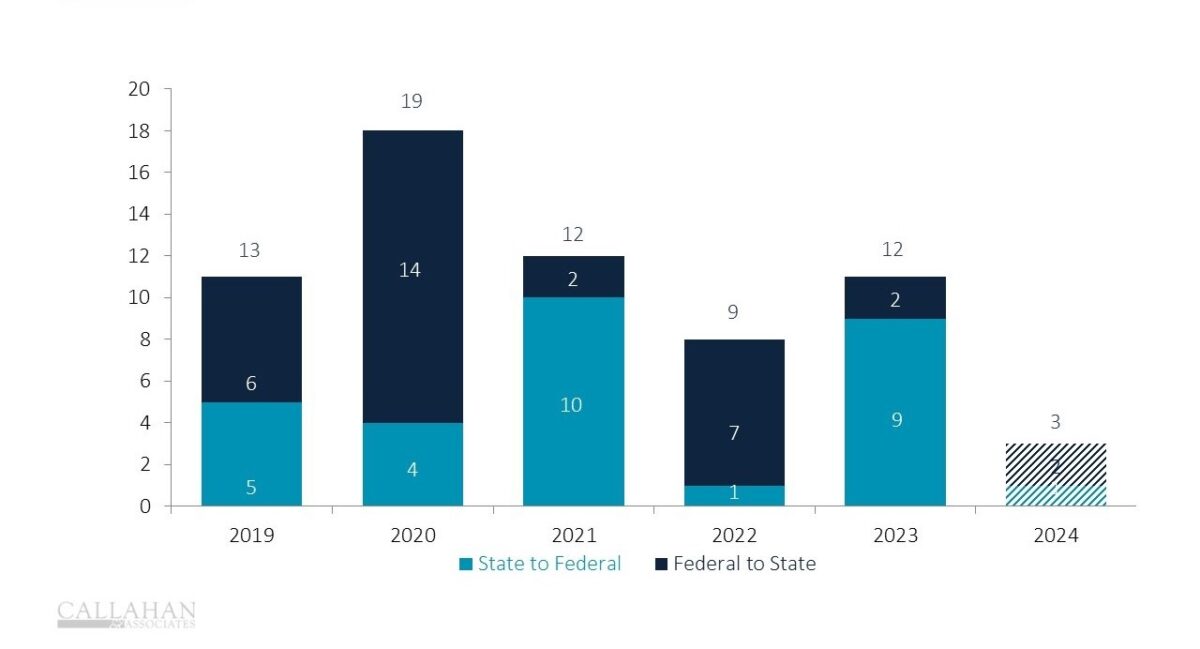
Credit
union charter changes by year. Any mathematical discrepancies reflect instances of state charters converting from private deposit insurance to
being federally insured.
Selecting a federal or state charter doesn’t just impact how a
credit union is regulated – it plays a major role in that institution’s
expansion options. Sixty-eight credit unions have converted their
charter since 2019, a nearly even split between moving from federal to
state-chartered and vice versa.
One of the major factors driving state-to-federal conversions is the
ability to open new branches across state lines, which is much more
difficult under a state charter. The Credit Union Membership Access Act
of the late 1990s was also a major driver in advancing federal charters
by making it easier for credit unions to incorporate multiple common
bonds into their fields of membership, casting a wider net for
membership growth.
That’s not to say there aren’t perks to converting from federal to state oversight. In early 2021, for example, Michigan’s TRUE Community Credit Union ($890.7M, Jackson, MI) converted from a federal to a state charter following a merger and rebrand in order to expand its field of membership statewide.
While some institutions prefer dealing with the National Credit
Union Administration, some institutions feel state-level policies are
favorable to their goals. It all comes down to which regulator’s
policies are more likely to help each credit union advance its own
interests.
State-chartered shops tend to be smaller than their federal
counterparts. The average state charter holds $647 million in assets
compared to $1.2 billion for federal charters, according to a Callahan
& Associates analysis. Five-year averages show relatively equal
performance between the two when it comes to deposit growth and ROA, but
state charters have performed slightly better when it comes to asset
growth, while FCUs have seen better membership growth – both by about 65
basis points, respectively.
Regardless of growth, federal charters still make up the lion’s
share of the industry. As of the first quarter this year, 2,862 credit
unions held a federal charter while just 1,808 were state chartered, a
ratio not dramatically different from a decade ago.
One factor plays a role in federal charters’ dominance from a
numbers perspective: At least five states, as well as the District of
Columbia, do not have state charters, meaning all credit unions
headquartered in those boundaries are federally chartered.
Any
exercise trainer will tell you if you workout one day for 12 hours,
you're going to be really sore. But if you work out 30 minutes a day for
30 days, you're going to be really fit. Why? Because consistency trumps
intensity.
In a recent LinkedIn post,
I noted that I'm often asked, what is the key to success for credit
union growth? The one-word answer: Consistency. But not just random
consistency. For credit unions it's consistency in five critical areas:
Messaging, marketing, staff, sales and training.
Below
is a breakdown of each of those areas along with a quick hack to ensure
your credit union is bringing more consistency to them.
Messaging
Change
is good. But not when it comes to your core messaging. You want items
like your vision and tagline to remain consistent. The challenge with
some credit unions is that they update their core messaging too
frequently. Maybe they get tired of saying the same things. But
repetition is often king.
Research
suggests that consumers need to see information between five to seven
times for it to transition to memory. Most marketing sources use the
Rule of Seven: It takes exposing your message at least seven times
before someone can recall it.
While
your individual campaign concepts (think loan and deposit product
promotions) certainly need creativity, it's your brand messaging that
needs consistency. Consistently tell your stories and relate those
stories back to your brand vision. Remember, one of the three "Cs" to a
strong brand is consistency. The strongest brands today rarely deviate
from their central message and themes.
Messaging
Consistency Hack: Develop a brand plan and communicate to your niches. A
brand plan details your core message and target audiences. It's hard to
have a consistent message without a brand plan.
Marketing
Inconsistent
marketing never works. Yet too many credit unions are guilty of this
practice. We only market CDs and checking accounts when we need
deposits. We need loans so we drop our auto rates and quickly put
together a member email with a landing page talking about how great our
auto loans are.
Marketing is not like a faucet that
you can turn on and off when the mood strikes. It is much more like a
soaker hose: You need a continual drip.
This is
especially important in emails, social media and online efforts. The
credit unions that have the most success in their digital marketing are
the ones that consistently use SEO, PPC, geotargeting and online ad
buys. The ones that struggle are the ones who fluctuate their spending.
Marketing
Consistency Hack: Hire an outside partner to help fill in your
consistency gaps. Consistency takes time and sometimes our marketing
bandwidth is stretched thin. Having a partner that serves as your
marketing arm leverages your resources.
Staff
One
of the biggest areas credit unions struggle with when it comes to
consistency is staff service. In some credit unions, a member won't get
the answer they want from one particular branch, and they will drive
clear across town to the same credit union but different branch hoping to get a different answer.
We
see this when conducting mystery shops for our clients across the
country. One branch will deliver an over-the-top engaging experience.
Then another branch of the same credit union will completely bomb. Why?
Because there is no consistency.
If your staff
gives great service every now and then or only when they feel like it,
then that is a lack of consistency. It's not enough to give a great
member experience once. You need to do it every time.
Staff
Consistency Hack: Create a journey map and brand service standards.
Detail how you expect staff to treat members at every delivery channel
(branch, phone, chat, etc.). In other words, operationalize your brand.
Sales
Leadership
expert John Maxwell writes, "Small disciplines repeated with
consistency every day lead to great achievements gained slowly over
time." Nowhere do credit unions need more discipline than when it comes
to sales. Even though some credit unions may shy away from the "S"
word, the truth is everyone is in sales.
But sales
takes consistency – monthly, weekly and daily consistency. Practical
sales techniques your employees should use include writing handwritten
thank-you notes, recognizing members on their birthdays, asking where
else members have other financial products (the average consumer has 10
financial products spread over four different financial institutions),
conducting outbound phone calls and discussing product benefits rather
than features.
Sales Consistency Hack: Create a
follow-up system. Whether it's a complex CRM system or a simple Post-it
note reminder, creating a way to consistently reach out to directly to
members improves your sales. As networking expert Keith Ferrazzi says in
his book "Never Eat Alone", "Follow-up is the key to success in any
business."
Training
One trap many credit
unions fall into is a "one and done" training approach. A one-time
employee orientation. A one-day brand event. An annual employee rally.
While all those are good, they often don't move the needle as much as
you'd like. Why? Because training takes consistency and repetition.
Even
the late great motivational speaker Zig Ziglar noted, "Repetition is
the mother of learning, the father of action, which makes it the
architect of accomplishment." If you want your employees to accomplish
more, you have to train them more.
"We've found the
credit unions that have the most employee engagement are the ones who
invest in their experience training at least monthly," Laura Loy,
experience director for On the Mark Strategies, said. "It's the
consistent reminders that move the needle."
Training
Consistency Hack: Conduct micro training, which are short but regular
bursts of tips, tricks and learning. These could include 30-minute Zoom
sessions, a short video or even quick, guided reads.
Dwayne
(The Rock) Johnson doesn't work out 12 hours a day. But he does workout
every day. He also notes, "Success isn't always about greatness. It's
about consistency. Consistent hard work leads to success. Greatness will
come."
And great growth success will come to your
credit union when you bring more consistency to your messaging,
marketing, staff, sales and training.
Mark Arnold
Mark
Arnold is founder and president of On the Mark Strategies, a Dallas,
Texas-based consulting firm specializing in branding and strategic
planning for credit unions.
WASHINGTON–Mortgage rates last week hit their lowest mark since May of 2023.
With
economic data perhaps indicating a slowdown and with new predictions
the Federal Reserve could cut rates by as much as 50 basis points when
it next meets, the 30-year fixed-rate mortgage averaged 6.47% last week,
according to Freddie Mac. That’s down substantially from one week
earlier when the average was 6.73%. The one-week drop was the biggest
since late December.
The 30-year mortgage rate average peaked (so far) earlier this year at 7.22%.
Growing Purchasing Power
“The
decline in mortgage rates does increase prospective homebuyers’
purchasing power and should begin to pique their interest in making a
move,” Sam Khater, Freddie Mac’s chief economist, said in a released
statement. “Additionally, this drop in rates is already providing some
existing homeowners the opportunity to refinance, with the refinance
share of market mortgage applications reaching nearly 42%, the highest
since March 2022.”
Affordability remains tough — but lower mortgage rates may help. Economists have also said they expect rental rates to decline.
“Homebuyers
who were priced out a few months ago should re-check whether they can
enter the homebuying market if they have secure jobs,” Lawrence Yun,
chief economist of the National Association of Realtors, said in a
released statement.
The next reading on inflation will come this Wednesday when the Consumer Price Index for July will be released.
Housing Inventory Grows
According
to data quoted by CNN, total housing inventory has increased every
month this year so far, registering at 1.32 million units at the end of
June, up 3.1% from May and a significant 23.4% higher from a year
earlier, NAR figures show.
LAWRENCEVILLE, Ga.—Used vehicle values continued to decline in July, reported Black Book.
Last
month the company’s Used Vehicle Retention Index decreased 1.1% (1.6
points) to 145.0 from June 2024 (146.6), which is 15.2% below where it
was at the same time in 2023. The Index sits 26.5% above the March 2020
reading – the last pre-pandemic month.
“In July, the Black Book Retention Index continued its decline
that began in April, driven by greater-than-expected depreciation in
wholesale values,” Laura Wehunt, vice president of analytics at Black
Book, said in a statement. “Although auction conversion rates were
strong, staying in the high-50% range, the retail market saw an increase
in days to turn, starting at 45 days at the beginning of the month and
rising to 52 days by the end.”
How Values are Calculated
The
Black Book Used Vehicle Retention Index is calculated using Black
Book’s published Wholesale Average value on two- to six-year-old used
vehicles, as percent of original typically equipped MSRP. It is weighted
based on registration volume and adjusted for seasonality, vehicle age,
mileage, and condition.
WASHINGTON–The National Federation of Independent Business is reporting its July jobs report has
found a seasonally adjusted net 33% of small business owners reported
raising compensation in July, down five points from June and the lowest
reading since April 2021.
It further found a net 18% (seasonally
adjusted) plan to raise compensation in the next three months, down four
points from June.
“Fewer small business owners are planning to
raise compensation in the coming months, and plans to hire remain
stable,” NFIB Chief Economist Bill Dunkelberg said in a statement. “July
marks the second month of net gains in employment on Main Street, and
the number of firms with open positions remains exceptionally high.”
The Findings
According to the NFIB survey:
The percent of small business owners reporting labor quality as
their top small business operating problem was unchanged from June at
19%, although labor quality as the top problem has eased considerably
over the last two quarters.
Labor cost reported as the single most important problem for
business owners fell two points to 9%, four points below the highest
reading of 13% reached in December 2021.
38% (seasonally adjusted) of small business owners reported job openings they could not fill in July, up one point from June.
A seasonally adjusted net 15% of owners plan to create new jobs in
the next three months, unchanged for the third consecutive month.
Overall, 57% of small business owners reported hiring or trying to
hire in July, down three points from June. Forty-nine percent (86% of
those hiring or trying to hire) of owners reported few or no qualified
applicants for the positions they were trying to fill. Twenty-nine
percent of owners reported few qualified applicants for their open
positions and 20% reported none.
32% have openings for skilled workers (up one point) and 16% have openings for unskilled labor (unchanged).
Job openings in construction were up four points from June and over
half of them (55%) have a job opening they can’t fill. Job openings were
the highest in the construction, transportation, and retail sectors,
and the lowest in the agriculture and finance sectors.
The Dow tumbled more than 1,000 points, and the broader
market plunged 3% Monday. The Nasdaq, full of risky tech stocks, dropped
3.5%.
All of that comes amid a global market selloff. Japan’s Nikkei 225 index nosedived 12% — its worst rout in history. All major Asian and European markets fell substantially Monday.
Three fears are emerging all at the same time to send
markets into a tailspin Monday: Growing worries about a recession,
concern that the Federal Reserve has failed to act promptly enough and a
belief that big bets on AI may not pay off.
On Friday, the Bureau of Labor Statistics reported that the US economy added just 114,000 jobs
in July — far fewer than expected — and the unemployment rate jumped to
4.3%. Although that’s not in and of itself an unhealthy unemployment
rate, its sudden march higher is alarming: Last year, the unemployment
rate was at its lowest level since the moon landing.
But recession fears are mounting. Goldman Sachs economists
Monday raised the odds of a recession to one in four in the next 12
months. That’s still a “limited” case, because the economic data looks
strong overall and the Fed has plenty of room to reduce rates from a
23-year high.
But Goldman’s recession chances are still 10 percentage
points higher than they were before Friday’s jobs report, which it
called “more concerning now.”
Fed concerns
The stock market had hit record after record this year,
buoyed by falling inflation and the growing sense that the Fed would
shift from its series of aggressive rate hikes and start to rate cuts,
which can boost corporate profits.
But the Fed didn’t cut rates as many had hoped last week. The market increasingly views the Fed’s patience as a mistake.
The Fed is notoriously horrible at timing its rate cuts and
hikes. It was way behind the curve on inflation and had to catch up with
multiple historic rate hikes in 2022 to tame runaway prices. Likewise,
some economists believe the Fed should have started cutting rates sooner.
Rate cuts could help support the job market by cutting
borrowing costs for businesses and freeing up money for companies to
spend on hiring. But policy decisions take time to work their way into
the economy. As inflation has cooled dramatically in recent months and
the unemployment rate has risen, some fear the Fed may be too late to
act before slow hiring turns into rampant layoffs.
The Fed’s next meetings are scheduled for September,
November and December, Analysts at Citigroup and JPMorgan predict the
Fed will slash rates by half a point at its next two meetings. But that
may be too late, and it may be forced to make an emergency rate cut
before then.
An emergency cut — which hasn’t happened since the early
days of Covid, is exactly what the Fed needs to do, said famed Wharton
professor emeritus of finance Jeremy Siegel on CNBC Monday morning.
“It’s so far behind the curve right now. I mean the Fed is
up in the bleachers,” said Siegel. “You take a look at the data; it’s
not at all comforting.”
AI worries
Stocks had also been flying high over the past two years
because of big bets on tech companies involved in artificial
intelligence: Many hoped that AI would create another global industrial
revolution.
But AI profits are basically nonexistent,
and the unproven technology isn’t yet ready for prime time. Some fear
it’ll never get there. Traders are beginning to unwind big trades on
Apple, Nvidia, Microsoft, Meta, Amazon, Alphabet and other tech stocks
that had been surging since the beginning of last year.
Warren Buffett — CEO of Berkshire Hathaway and a notoriously
calm force when markets go haywire — is also ditching tech. He just sold half of Berkshire’s Apple stake, which is a troubling sign for the health of the tech sector.
Because those companies are each worth close to $1 trillion
or more and make up an enormous chunk of the overall value of the
S&P 500, when investors sell off tech stocks, that has a massive
detrimental effect on the broader market.
What happens next?
Investors are running for the hills. They’re selling off
oil, crypto and especially tech stocks. Instead, they’re pouring into
safe havens like bonds, sending Treasury yields lower.
That could spell trouble for some folks’ retirement
accounts. But people who are close to retirement could actually benefit
if they have a heavy mix of bonds, which are benefiting from the flight
to safety.
Lower rates, if the Fed follows suit with cuts, could help
lower punishingly high mortgage rates, car loan rates and other consumer
loan costs. It could mean, however, that people with money stored in
savings accounts could yield less interest in the coming months.
One thing not to do: panic. This is not a market crash.
Not yet, anyway. Investors are nervous, but not panicked. Monday’s
rout, if it ends at current levels, wouldn’t even crack the top 100
worst days in market history.
The only question now: How long will this fear last before investors sense a buying opportunity?


 Credit/Adobe Stock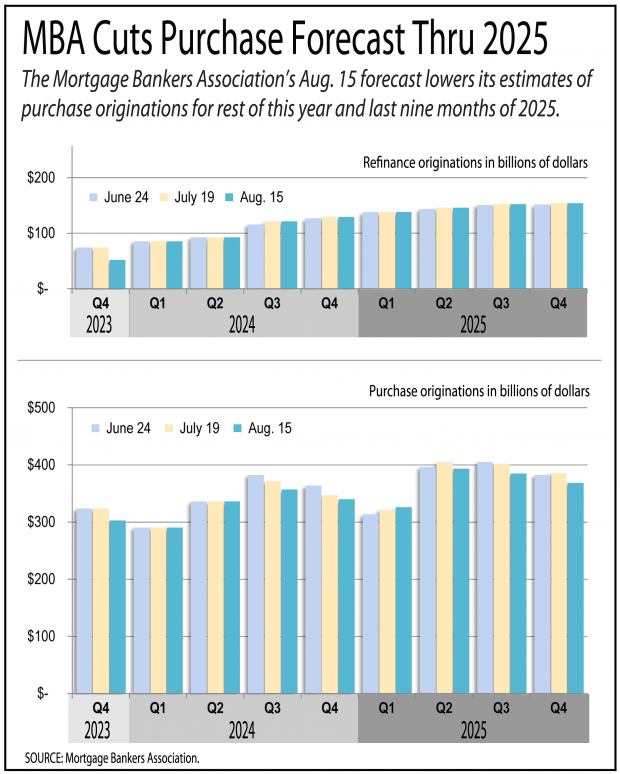
 Joel Kan




 Credit/AdobeStock
 Mark Arnold