
The Widely Cited Mortgage Lending Benchmark 45% DTI May No Longer Reflect How Lenders Evaluate Borrowers, Says Fed Bank

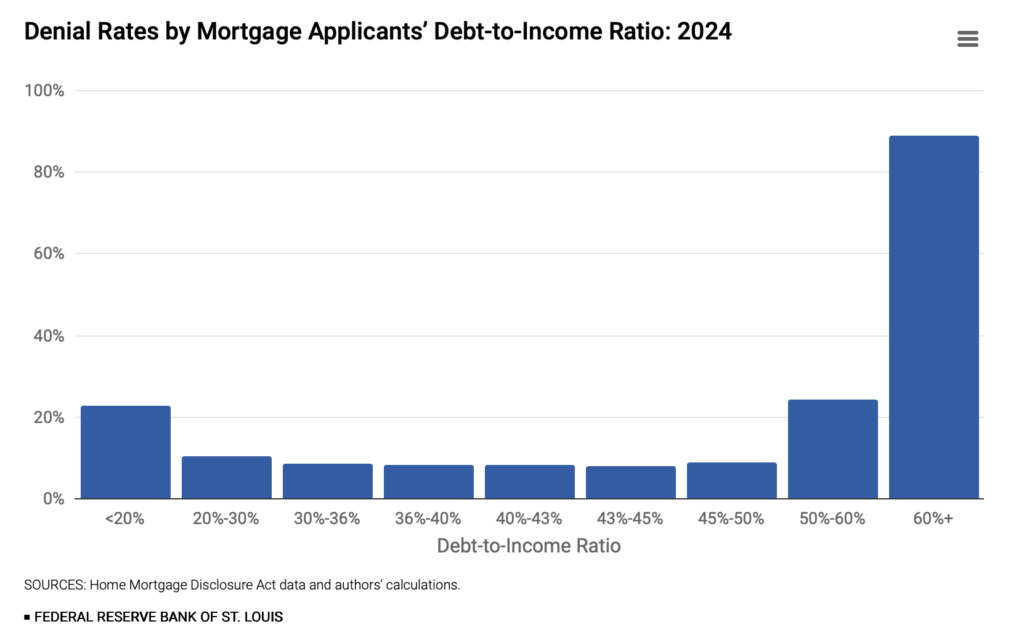
In an analysis of more than 30 million home-purchase mortgage applications filed between 2018 and 2024, researchers found that the long-discussed 43% debt-to-income ratio threshold has little apparent impact on mortgage approval decisions. Instead, denial rates begin to rise sharply once applicants exceed a debt-to-income ratio of 50%.

The findings were published as part of a four-part series examining barriers facing prospective homebuyers.
‘Practical Lesson is Clear’

“For borrowers, the practical lesson is clear: A debt-to-income ratio of 45% is treated by lenders much like a ratio of 35%,” the researchers wrote. “But crossing 50% changes the game entirely.”

The 43% debt-to-income ratio gained prominence under the 2010 Dodd-Frank Act, which established it as a key threshold for so-called qualified mortgages. Loans meeting that standard provided lenders with legal protections against ability-to-repay lawsuits. However, in 2021, the Consumer Financial Protection Bureau replaced the ratio-based standard with a pricing-based approach amid concerns that the 43% cap was unnecessarily restricting access to credit.

Despite the regulatory change, mortgage lenders and personal finance experts frequently continue to cite 43% as a guideline for borrowers.

‘Little Evidence’

The St. Louis Fed analysis found little evidence that lenders treat 43% as a meaningful cutoff.

Using Home Mortgage Disclosure Act data, researchers found mortgage denial rates remained relatively stable between debt-to-income ratios of 20% and 50%, generally ranging between 8% and 10% in 2024. No significant increase in denials was observed at the 43% mark.

By contrast, denial rates rose sharply once debt-to-income ratios exceeded 50%, eventually surpassing 80% for applicants whose ratios exceeded 60%, according to the research.

Additional Tests Conducted

The researchers also conducted statistical tests to determine whether borrowers or lenders were clustering applications below the 43% threshold. They found no evidence of such behavior.

In addition, regression discontinuity analysis showed that denial rates increased by less than one-half percentage point at the 43% threshold. At 50%, however, denial rates jumped by between 15 and 17 percentage points.

“The 43% mark that has drawn enormous regulatory attention barely registers in actual lending decisions,” the researchers wrote. “The 50% mark, which has received no comparable scrutiny, is where applications hit a wall.”

=================================================

Remember, you're not alone with NCOFCU.org

Comments

Popular posts from this blog

Reuters: Trump Regulators Launch Biggest Bank Oversight Overhaul Since 2008

Is NCUA next? WASHINGTON—Federal banking regulators under President Trump are undertaking what Reuters described as the most significant overhaul of bank supervision since the 2008 financial crisis, shifting examiner focus away from process and compliance issues and toward what agencies consider “material” financial risks. According to Reuters, the Federal Reserve, the Office of the Comptroller of the Currency and the Federal Deposit Insurance Corp. have directed examiners to concentrate on risks that pose direct threats to a bank’s safety and soundness, rather than on paperwork deficiencies, governance concerns or procedural issues that do not immediately affect financial stability. Reuters reported that regulators have also moved away from evaluating banks based on “reputational risk,” a supervisory concept long criticized by banks as overly subjective. The change follows complaints from President Trump and others that financial institutions have used reputational-risk considerations...

Hauptman Tells Congress CU Health is Strong; Responds to Questions from Committee

WASHINGTON — National Credit Union Administration Chairman Kyle Hauptman told members of the House Financial Services Committee on Thursday that the nation’s credit union system remains financially strong, while warning that rising delinquencies and consumer financial stress continue to warrant close monitoring. Hauptman also responded to a handful of questions from members of Congress, as well. Hauptman appeared as part of the regular hearings on Oversight of Prudential Regulators. Also appearing as witnesses were Michelle Bowman, vice chair for supervision with the Federal Reserve; Travis Hill, FDIC chairman, and Jonathan Gould, the acting Comptroller of the Currency. Kyle Hauptman In his prepared statement, Hauptman said federally insured credit unions remain well-capitalized and continue to meet members’ borrowing needs despite economic headwinds. He said the NCUA is focused on maintaining safety and soundness, protecting the National Credit Union Share Insurance Fund and creating...

Sunday Reading - Changing the Map

  Changing the Map     Redistricting, explained Congressional redistricting is the process by which states redraw electoral district boundaries   that determine representation in the US House of Representatives. The Constitution, federal law, and court rulings require districts to have roughly equal populations, avoid discrimination against racial or language minorities, and, in most states, be geographically contiguous. For most of American history, redistricting has followed a predictable cycle, occurring every 10 years after the census.   Gerrymandering is the deliberate manipulation of district boundaries to advantage one political party. Common tactics  by both major American political parties include packing opposition voters i...

Trump Accounts Program For Children Moves Forward With New Mobile App Launch

  WASHINGTON—The Treasury Department on Thursday announced the launch of the new Trump Accounts mobile app, marking the next phase of the Administration’s rollout of its new federally backed investment savings program for children ahead of the program’s official July 4 launch date. Donald Trump The app, now available through major mobile app stores, will serve as the primary platform for families to manage and activate Trump Accounts. Treasury Secretary Scott Bessent said the app is intended to give parents and guardians a “simple, secure way” to participate in the program, which was created under the 2025 Republican tax-and-spending package. Families that already submitted IRS Form 4547 to enroll children in the program will begin receiving phased activation emails between now and July 4, according to Treasury. Under the program, eligible children born between Jan. 1, 2025, and Dec. 31, 2028, can receive a one-time $1,000 federal seed contribution into a tax-deferred investment ac...

Letter to Credit Unions Says NCUA Exam Modernization Now Underway

ALEXANDRIA, Va.—NCUA has sent a Letter to Credit Unions ( 21-CU-08 ) detailing the agency's transition to modernized systems. The agency said it will begin this transition in August. NCUA’s efforts will include the implementation of emerging and secure technology that supports the NCUA’s examination, data collection, field of membership, and reporting efforts. “These new applications will streamline processes and procedures and provide significant benefits to credit union users,” NCUA said. Key areas affected: NCUA Connect Admin Portal Consumer Access Process and Reporting Information System (CAPRIS) 1 Modern Examination & Risk Identification Tool (MERIT) Data Exchange Application (DEXA) Training Available To prepare credit unions for the transition to these new systems, NCUA said it will provide credit union user training through various avenues, including: A self-paced training curriculum covering MERIT functionality available through the NCUA’s Learning Management Service An...

Supplemental Capital to be Considered by NCUA

Supplemental Capital At the NCUA’s October board meeting, senior staff of the NCUA submitted a briefing report (the “Report”) to the NCUA Board (the “Board”) on the issues concerning the use of supplemental capital by federally insured credit unions (“FICUs”).  The use of supplemental capital presents a number of regulatory and policy issues that would need to be addressed prior to authorizing this form of capital for all FICUs.  The Board considered issuing an advanced notice of proposed rulemaking (“ANPR”) in the near future which would give credit unions and the public the opportunity to provide comment before the proposed rule stage.  Supplemental capital does not provide any capital support under the NCUA’s net worth requirements because it does not count as equity under generally accepted accounting principles, but it would allow FICUs to have a greater concentration of member business loans and long term mortgage loans since it could be used by FICUs to meet...

Cheer Up and Change: "Wait and see is not a plan."

I posted this a year ago and thought I would bring it back to see if any of his predictions came true. Take a look and tell us what you think. Grant Sheehan CEO Cheer Up and Change: The Demographic Mandate At a conference I recently attended Monday morning started off with a great session by demographer and futurist Ken Gronbach, who laid out his predictions on where we’re going and what we can expect as demographics change. I was pleasantly surprised that the future isn’t sounding as bleak as the news might have you believe. Gronbach offered lots of predictions for where our society and our world is headed. His predictions were given with a purpose: To help associations build their vision and plan for the future. As Gronbach stressed,  "Wait and see is not a plan." I’ve decided to arrange this recap into a list of my takeaways rather than a narrative recap. I hope you get as much out of this information as I did! Things to Expect: Big Changes in Retail : Gronbach ...

Fire Family Foundation Establishes Erksine Fire: Rebuilding Lives and Community Fund

Fund Will Assist Fire Victims and Firefighters in Kern County July    8, Los Angeles, CA:   Responding to the emergency of deadly wildfires that are currently blazing through communities in Kern County, Fire Family Foundation, the charitable hand of Firefighters First Credit Union, has created the Erskine Fire: Rebuilding Lives and Community Fund. California’s largest wildfire so far this year, the Erskine fire erupted Thursday afternoon and continues to burn; two people have died, thousands have left their homes, 200 homes were destroyed with many others severely damaged. Four firefighters who were working on the blaze learned the sad news that their own homes were completely destroyed by the fire. The Erskine Fire Fund will dedicate 100% of the funds raised to be distributed to firefighters and fire victims; funds will be used for short-term assistance to pay expenses for essential and immediate needs from food to mortgages/rent "Our firefighters are battli...

Proposed FOM changes would streamline ability to reach underserved

February 16, 2023 The NCUA Board proposed chartering and field-of-membership changes and issued its final cyber incident reporting rule at its Thursday meeting. The board also heard a quarterly update on the share insurance fund, which noted an increase in the fund's equity ratio to 1.30%." The proposal would amend the chartering and FOM rules through nine changes to enhance consumer access to financial services, especially in low- and moderate-income communities while reducing duplicative or unnecessary paperwork and administrative requirements. “Getting credit union services to more communities across the country is important to CUNA, state leagues and the credit unions we serve, and making that easier to achieve has a big impact on access,” said CUNA Deputy Chief Advocacy Officer Jason Stverak. “While we need to review the proposal in detail, we thank the NCUA board for working to streamline the ability of credit un...

Mortgage Rates Decline to Their Lowest Levels Since April

WASHINGTON–Mortgage rates fell last week to their lowest level since early April. According to Freddie Mac, the standard 30-year fixed-rate mortgage averaged 6.87% in the week ending June 20, which was down from the prior week’s 6.95% average and marks the third consecutive weekly decline. Rates are down from a 2024 peak of 7.22%. “Mortgage rates fell for the third straight week following signs of cooling inflation and market expectations of a future Federal Reserve rate cut,” Sam Khater, Freddie Mac’s chief economist, said in a statement. “These lower mortgage rates coupled with the gradually improving housing supply bodes well for the housing market.” Most economists and forecasters expect rates ...